The conference’s main agenda was to discuss what is Hindutva? How does it pose a threat to academic freedom, minority and basic human rights? Several research questions were raised and discussed. The conference revealed several transnational dimensions of Hindutva, its history of influence from Casteism to Zionism and its current ties and connections to authoritarian movements around the world. Research on Hindutva usefully integrates such comparative transnational perspectives and these were discussed. The lessons to be learnt from international resistance movements were examined. Some old questions were also revised with the hope to find new answers such as can caste be moved from a Hindu way of life? Analysis offered at the conference could be used to construct a social, political and ecological vision as an alternative to Hindutva. This could break through and overcome current polarisation and divisions in working towards a balanced vision.
The participants also discussed the difference between Hinduism and Hindutva. They explained that Hinduism and Hindutva are different from one another. Hinduism is tolerant towards other religions and beliefs. Hindutva is a part of Hinduism but radical. Hindutva never fits into the criteria of Hinduism at large. Hinduism believes in secularism while Hindutva only believes in Hindu dominance at the cost of other communities. Hence the speakers mentioned that Hindutva is destroying Indian society by polluting their minds and creating rifts among groups. The goal of Hindutva is to create hatred in the community.
Serious questions were considered, such as what is Hindutva and where did it emerge from? It was asked that was India a democratic country that cared about academic freedom and basic fundamental rights to its citizens or a country under militancy?
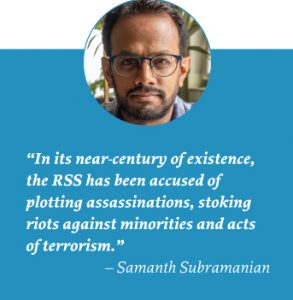
The term Hindutva came in the 19th century. Its narrative is deeply rooted in Brahmanism and is the offspring of Hinduism. Its strategy is based on violence, hatred, terrorism and is an enemy of democracy. Hindutva is resistant to Casteism. It uses rape as an instrument to achieve its objectives. It’s a sort of war against women and humanity. Hindutva emerged from RSS, an Indian right-wing, Hindu nationalist, paramilitary volunteer organization founded in 1925 by K.B Hedgewar. In 2020, RSS had almost 585,000 members and over 57,000 branches, including a trade union wing (Bharatiya Mazdoor Sangh), women’s wing (Rashtriya Sevika Samiti), student wing (Akhil Bharatiya Vidyarthi Parishad), and economic wing (Swadeshi Jagaran Manch). The Print, an Indian news outlet, estimates that 3 out of 4 ministers in the ruling BJP are members of the RSS, including the current Prime Minister, Narendra Modi.
The biggest tool of Hindutva is rape and they use it as a weapon against minority groups in India. Muslim women are highly targeted while Dalits, Sikhs and Avadasis are also not spared. Women’s rights are at stake and never considered equally.
Hindutva is not limited to India. It has spread its tentacles across the globe. Western academia has become the immediate target of Hindutva ideology. Hindutva not only targets Indian academics but bans western academics too. It has threatened the American faculty for teaching Hinduism or anything controversial for the Hindutva ideology. Many western scholars have spoken about Hindutva’s influence.
Dr Audrey Truschke, Associate Professor of South Asian Studies at Rutgers University has become a target of Hindutva. Her scholarship explains the truth about Indian history that South Asia has always been a diverse place where many religious and cultural groups co-exist. But, why does teaching or speaking about this basic fact in the US pose a huge challenge to the political project of Hindutva?
Dr Audrey explains that Hindu nationalism is a political ideology that advocates Hindu supremacy and the exclusion of the members of other religious groups from equal participation in Indian society. It is a fiercely anti-intellectual ideology in both conception and practice. She spoke openly about the threats Hindutva is posing in real-time to academic freedom in the United States. For more than five years she received hate mail from Hindu nationalists or Hindu supremacists every single day. She has been a target of so many death and rape threats while the recent pilot threat was via phone. She is seeking help from the police department to investigate the caller. The threats are extended to her family members, including her children ages 3, 5, and 7 years. She mentioned that when she speaks publicly she often requires armed security, whether she is speaking about modern South Asia or ancient Indian History. She emphasised how extraordinary and worrisome it is that she requires armed protection on US soil to speak about areas of her scholarly expertise. She is also becoming a target of smears and misinformation campaigns. She mentioned that Hindu nationalists failed to prompt Rutgers University to take punitive actions to silence her.
Many Hindu supremacist harassments come from overseas while a certain share comes from the United States. Hindu supremacists born and brought up in the US have taken a leadership role in the relentless attacks on academia. Therefore it has turned out to be a militant organisation that poses a serious threat not only to the US but to the rest of the world. To talk about the growing threat of Hindutva, around 18 organisations briefed US congressmen on the issue. The conference proved to be an eye-opener for US academic freedom, freedom of speech and basic human rights. It has been proven that Hindutva is not only a threat to democracy, human rights and religious freedom in India but also around the world, particularly in the US. Now it is up to the US to continue the Hindutva spread in the US or at least curb its extremist agenda. 





Hindutva is real threat to region. It is a new form of Nazism. Victims are not only Muslims but almost all minorities and even low caste Hindus too. International community must take preventive measures.