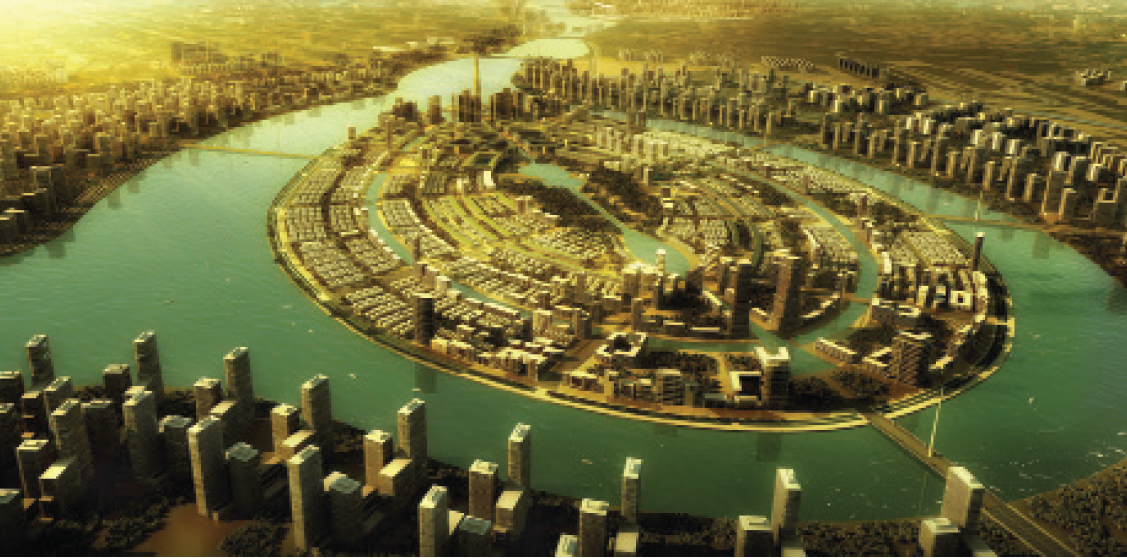
The RRUDP will encroach upon the floodplain, altering the basic natural landscape of the river irreversibly. This means that River Ravi will have to be channelized, which goes against all principles of sustainable development and the ecological sustainability of a river and its environment. It is important to remember that riverbanks are an integral part of the river ecosystem and that the hydraulics of a river should be maintained without defining any edges for the river. Keeping this in mind, the channelization of River Ravi and building 3 barrages along the length of the project (spanning 46 km) is simply not an option.
“Even a plot in DHA cannot be a substitute for a generations old house in the old city.”
Employing river training to reclaim land for urban development cannot be considered an improvement to the environment by any definition. The Punjab Floodplain Act of 2016 clearly defines the principles and policy for the development of floodplains and the rules for their management. These principles, based on scientific evidence and the specific needs of the population, need to be followed in letter and spirit. The RRUDP also considers setting up wastewater treatment plants. Seven treatment plants are proposed to be set up at the outfalls of the Ravi. However, the intention behind these is suspect, at best, as a large number of drains (originally storm water channels) running through the city are filled with sewage and industrial waste.
Leaving the city in a dirty and neglected state and focusing on new areas is a questionable strategy for urban development. A far more effective strategy would be to focus on cleaning the drains running through the city and to rehabilitate those areas using bioremediation techniques. Cleaning up these drains will, in turn, put less pressure on the proposed treatment plants, which already cost millions of rupees and demand assiduous maintenance. The channelizing of the river with a 9-meter rise in the water level will also result in damage to, and even possible obliteration and submersion of, the historical site of Kamran’s Baradari. In addition, Jahangir’s Tomb stands almost on the banks of the Ravi. No details have been provided in the EIA about the protection and maintenance of authenticity of either of these sites. In fact, Jahangir’s Tomb has not even been mentioned in the report.
According to the writ petition, acquisition laws had been blatantly violated by the government as farmers were being deprived of their precious land. The counsel said compulsory acquisition would deprive the farmers of their agricultural land and could pose food security threats in future. Also pointed out was that a vast chunk of agricultural land being converted for the benefit of property developers was against the convention of biological diversity that the government of Pakistan also ratified. Justice Karim observed that the Punjab government was not serious in complying with environmental laws. The judge directed the government to justify public purpose in the Ravi Urban Development project after the lawyer pointed out that the government had not issued any notification to disclose any public purpose of the project which it was supposed to do under Section 4 of Land Acquisition Act 1890. The provincial government is to appoint an international consultant to prepare the Environmental Impact Assessment (EIA) report for the project.
The indicators used in the EIA are based on data that is over 7 to 8 years old and, therefore, obsolete. There are strict criteria for measuring the ecological footprint of any development project. However, none of these criteria have been taken into consideration in the EIA. Therefore, the local population is more than justified in rejecting the project for its threat to their livelihood and habitation. Furthermore, the inevitable environmental damage resulting from the unchecked continuation of the project warrants a thorough review and a reconsideration of its feasibility. Recommendations of an alternative approach, which is sustainable both environmentally and economically, need to be explored seriously. Finally, in the place of the project in its current form, the prospects for the restoration of the river landscape to its natural conditions need to be taken into consideration and worked on, as a matter that demands much more urgency. 





Leave a Reply