

Book
Solving the Puzzle

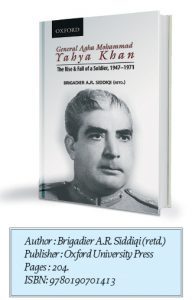
Brigadier A.R. Siddiqi (Retd.) is no stranger to those who like to keep up with historic events related to the Pakistan Army. He has written several articles and books, the most recent of which is a valuable addition to documents on acts of omission and commission by the key personalities responsible for the breakup of Pakistan. In this book, Siddiqi puts into place pieces of the jigsaw puzzle: the actions of Gen. Yahya Khan, Zulfikar Ali Bhutto and Mujibur Rehman during the years leading up to the 1971 war.
As a former Director General of the Pakistan Armed Forces’ ISPR (Inter–Services Public Relations), and being associated with Gen. Yahya Khan over many years, the author gives an objective account of both the 1965 and 1971 wars and, unlike most writers, does not hesitate to mince his words. He places the responsibility of the army’s decision not to take over the strategic location of Akhnur in the 1965 war, a move that would have won the war for Pakistan, squarely upon Gen. Yahya’s shoulders. Yahya had decided not to proceed, simply because “he was not tasked for it.” During his two year rule as President, Gen. Yahya made a number of strategic and tactical errors that cost the country dearly.
The Armed Forces have run Pakistan for almost half its life and controlled it from behind the scenes for the remaining period. The sentiment voiced by Gen.Yahya to Brig. Siddiqi in 1961: “The armed forces are all we have in one piece. .... We are very fortunate to be in uniform” may seem to be still valid by many. As the book walks the reader through stages in Yahya’s career and the author’s life, it provides interesting insights into the working of the army.
Siddiqi traces the path of deep religiosity and the spirit of armed jihad that was injected within the psyche of the ranks of the army and seeped into its very core over decades of rhetoric and training. Ironically, drinking was common in the army, Yahya being famous for excessive wining and womanising.
Siddiqi is unequivocal in his criticism of Field Marshal Ayub Khan and the damage he had done to plant the seeds of deep resentment among the Bengalis due to the arrogant behaviour of many armed forces personnel from West Pakistan. Yahya had followed in his footsteps. Taking over from Ayub Khan, he was “prepared to rule this unfortunate country for the next 14 years”. While he considered Maulana Bhashani, a popular leader of the rural masses in East Pakistan, to be a better option than Mujib ur Rahman, he backtracked from his promise to fund the establishing of a university in the former’s home town at his request, thus losing a valuable friend. His response to the devastating cyclone of 1970 was initially to shrug off the damage as being minimal. In all fairness to him, he did try his best to negotiate with Bhutto and convene the National Assembly in Dhaka after Mujib emerged as the winner in the 1971 elections, but gave in to Bhutto’s threats to “break the legs of anyone who went there”.
Few people would know that a draft constitution for the undivided country, with a rotating capital between Islamabad and Dhaka, had been prepared but was cancelled. These and other bits of information of what transpired behind the scenes during March 1971, that fateful and terror-filled period, would be essential knowledge for the discerning Pakistani reader. Many perceptions about the democratic persona of previous civilian governments would be corrected as Siddiqi presents first person evidence of what had really happened. While Mujib wished to arrive at a joint decision with Bhutto, excluding Yahya, ultimately it was Mujib who was kept out, with drastic consequences.
The incidents leading up to the army action beginning on March 25, 1971 (preceded by the brutalities and incursions of the Mukti Bahini) and the subsequent attack by India on December 3, 1971, are explained in some detail. Siddiqi mentions the reprehensible acts committed by the army as it attempted to eliminate the Bengali resistance; his disgust is evident. According to him, by then, Yahya had started to lose interest in the Eastern wing and spent more time with his women and drink. He refused to listen to the saner voices of Admiral Ahsan and General Yaqub who had both commanded East Pakistan and had advised a political solution to the crisis. The former was relieved of his duties and the latter resigned. The response of both the army and the West Pakistan politicians to the civil war was self-serving, shameful and contemptuous of 54 percent of the population, leading to Pakistan’s defeat by India.
Siddiqi’s writing style is simple and unemotional, although his anger and concern at what was happening shows through at places. Notwithstanding editing errors and repetition of some paragraphs and sentences, the book is an important, albeit painful read and a must for members of the armed forces.![]()
|
Cover Story
|
|
News Buzz
|
Update |


Leave a Reply