



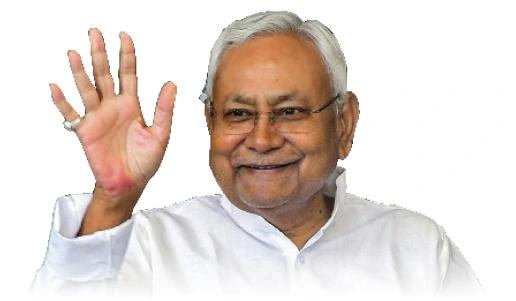
Nitish Kumar, the present Chief Minister of Bihar, a State of the Union of India, commands a historic unbreakable record of well-known frequent U-turns who took the oath of his chief ministership 9th time on January 28, 2024 and again returned to the BJP-led National Democratic Alliance (NDA) saying good-bye to Mahagathbandhan of Congress and Rashtriya Janata Dal (RJD) just before the holding of elections to the Lok Sabha, the Lower House of the Indian Parliament.
Nitish Kumar holds a significant position in current Indian national politics, mainly due to his extensive political experience, leadership in the Janata Dal (United) party, and his role as the Chief Minister of Bihar. His political journey, characterized by multiple alliances and a pragmatic approach to governance, highlights his adaptability and strategic acumen, which are crucial in the complex landscape of Indian politics. In addition, his tenure as Chief Minister of Bihar has been marked by significant governance reforms and development initiatives, earning him a reputation as an effective administrator.
His efforts in improving law and order, fighting corruption, and promoting economic growth have been notable, contributing to his national stature. Recently, his push for a caste-based census and advocacy for backward caste empowerment, including his own Kurmi community, resonated with a significant portion of the electorate, potentially influencing voter sentiment and political alliances.
Thus, despite criticism for his political opportunism, Nitish Kumar’s ability to navigate the intricacies of alliance politics, maintain a relatively clean image despite long tenures in power, and his experience in both coalition and solo governance make him a key player in the run-up to the 2024 Lok Sabha elections.
Early Life and Orientations
Born on March 1, 1951, in Bakhtiarpur, Bihar, Nitish Kumar is a prominent Indian politician serving in this capacity multiple times since 2000. He is known for his Janata Dal (United) party leadership. His political journey includes being a Union Minister and a member of the Lok Sabha. His alignment with various political alliances over the years reflects a dynamic political career, including periods with the National Democratic Alliance (NDA) and the Mahagathbandhan, a grand coalition with parties like the Rashtriya Janata Dal (RJD) and Indian National Congress. Nitish Kumar’s early life was influenced by his father, Kaviraj Ram Lakhan Singh, an Ayurvedic practitioner and a freedom fighter associated with the Indian National Congress. This environment fostered Kumar’s inclination towards politics from a young age.
Despite initially working for the Bihar State Electricity Board, his discomfort with this role led him to pursue a political career. He has a strong educational background, including an Electrical Engineering degree from Bihar College of Engineering (now NIT Patna). Kumar has been known throughout his career for his socialist leanings, influenced by prominent figures such as Jayaprakash Narayan, Ram Manohar Lohia, and others. He played a significant role in the JP Movement during the 1970s and has been recognized for his deft communication skills and ability to navigate complex political landscapes. His tenure as the Chief Minister of Bihar has been marked by various initiatives to improve the state’s governance, law and order, and development.
Political Journey of Nitish Kumar
Nitish Kumar’s political journey is a testament to his significant impact on Bihar’s political landscape and evolving national affiliations. He first entered politics as a member of the Janata Dal, being elected as an MLA in 1985. In 1994, Kumar co-founded the Samata Party with George Fernandes, marking a pivotal shift in his political trajectory. The Samata Party was established following a split in the Janata Dal, primarily due to ideological differences and political ambitions. Further, his entry into national politics was solidified when he was elected to the Lok Sabha in 1996, representing the Samata Party and becoming a Union Minister in the government led by Prime Minister Atal Bihari Vajpayee.


The writer is Professor and Head of the Department of Political Science as well as Dean, Faculty of Social Sciences at the Bhupendra Narayan Mandal University in Madhepura, Bihar. He can be reached at rajkumarsinghpg@gmail.com
Leave a Reply