



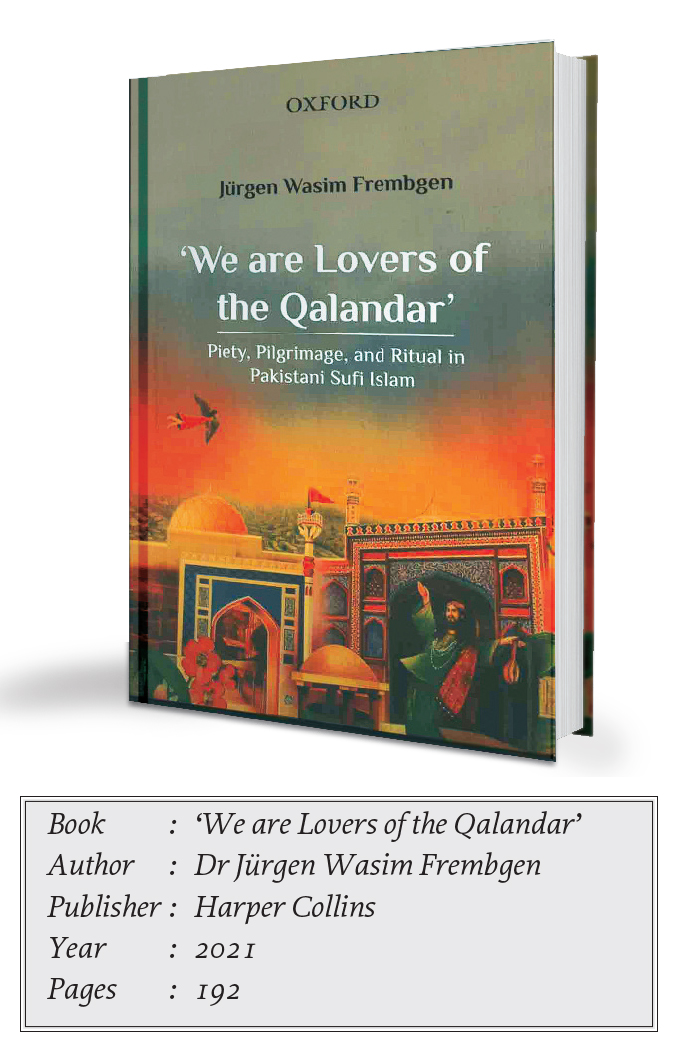
 Sufism and its various branches, including shrine-related rituals, are quite popular among the masses. These have been the focus of research by Western scholars, who are enamoured by the perceived plurality, freedom of dance and music, abandonment of the human body and alleged transcendence to the divine spirit. Perhaps one reason for this popularity is also the suspicion and violent opposition that many Islamic schools hold towards these beliefs and concomitant actions. The book describes the worship practices of people, mainly from rural areas of Punjab and Sindh at the shrine of Lal Shahbaz Qalandar in Sehwan, as well as other shrines in Punjab.
As a work on anthropological research, the book is both useful and interesting. It will find readers among students of anthropology, culture and religious practices because of its rigour in ethnography and analysis of “observed religion” at shrines. It is written around three themes: piety, pilgrimage and ritual. Under the first, the writer has studied the audio-visual depiction of the Qalandar through use of various media: posters, banners, wall hangings, paintings in homes, vehicles such as trucks and rickshaws and pendants as well as in films and music (qawwalis and songs). Under the second theme, he describes the networks that organise and manage the visits of thousands of visitors to the shrine, as well as the composition of the latter. The last theme deals at length with the much-famed dance called dhamal.
The author has spent many years visiting shrines, participating in the celebratory events and talking with many devotees directly. He has thus presented a truthful and a very positive image of shrine practices. The Qalandar cult emerged only after 1947. The number of visitors has increased phenomenally, especially since the patronage of the Bhutto regime and due as well as to the Lahore film and music industry. Most of the pilgrims are from under-privileged and uneducated classes, who find catharsis and release from daily frustrations in the trance dance of dhamal. The elite group comprises large landholders and feudal lords who have turned into politicians and derive pleasure from control of these shrines and of the people who come to worship here.
The feelings and beliefs of the devotees have been detailed extensively. The exalted state of the haal which dhamalis achieved during the dance and the touch of divinity perceived to be attached to them is supposedly given by God. Visitors to the shrine believe that they are healed and their daily problems addressed by the “saint”. Some practices remind the Muslim reader of the rituals during Hajj, such as the bathing and covering of the shrine every year and the prostration of the dhamalis in the direction of the “saint’s” tomb. This is actually called the dhamali’s namaz. Shia rituals, too, are regularly practised at Sehwan.
The legitimacy and honesty of the author’s research into the physical, sensual, emotional and perceived spiritual experiences of worshippers at shrines must be appreciated, as well as the very obvious admiration he possesses for both the rituals and practitioners. He lauds the egalitarian culture, the mutual connection and solidarity that cuts across class, race, religion, sect (Hindus and Christians, Sunnis and Shias venerate the Qalandar as well) and gender.
Although many groups are male only (and are often engaged in chatting, drinking alcohol and smoking hashish and bhang), some women groups are also involved. The story of a woman oriented silsila explains how the male-dominated process of Sufi lineage was apparently transmitted through women in one instance. Women dancers too perform dhamal but arrangements are in place to protect them from male advances.
Some of the Urdu words are translated into English with a sacred connotation although in reality there exists none. Masti is defined as divine rapture; deewangi is holy folly; mastana or mastani is one intoxicated by love of God and so on. These are obvious aberrations as one would be hardpressed to find anything holy about these states of intoxication.
Despite the contentious nature of its contents, the book is a scholarly venture into the “lived religion” at shrines and draws extensively upon the work of other scholars of anthropology and shrine practices. The book does not refer to the enormous wealth gathered by shrine custodians and pirs as nazrana by their murids but this could be added in a subsequent edition. 
Leave a Reply