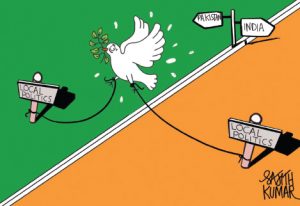
Recent developments have raised hopes that some progress might soon be made to normalize relations between India and Pakistan.
BySyed Zain Abbas Rizvi | June 2021
The bitter relations between India and Pakistan is a continuing story. The region has rarely witnessed peace since the British departed. The contention over Kashmir has picked up from a regional tension to a large-scale global issue. Now the stagnant frozen relations between the two states are witnessing a thaw.
Backchannel engagement and a reconfigured ceasefire seem too good to be true. The hotline contact between the two militaries sounded berserk but a mutual understanding seems only the tip of the iceberg. The fate of IIOJK is, however, still under haze.
The present state of deadlock was reached when the Indian government revoked the special status of the IIOJK region.
Articles 370 and 35A were introduced by a Presidential Ordinance in 1954 to cement the property rights in the region to safeguard the historical demography of the territory. Both Article 370 and 35A ensured a separate and liberal identity of Kashmiris within India, preventing demographic dilution. Snapping the clauses in the name of a ‘Monolithic India’ came about as a devious agenda of the Bharatiya Janata Party (BJP). The attempt was said to be a step towards a unified and secular India, free of religious discrimination. However, the underlying intent was criticized as a rightest attempt to wipe away the symbolic Muslim majority in the region through war crimes against the Tehreek-e-Hurriyat.
While the atrocities inflicted by the Indian army were domestically and globally criticized, Pakistan turned out to be the flagbearer of the campaign. The lockdown persisted in the IIOJK region with perpetual reports of genocide and gang rapes and Pakistan stood as a ray of hope for the innocent Kashmiris. Blateral trade between India and Pakistan amounted to a modest $2 billion back in 2019 before relations were severed. The economic repercussions were hardly hurting for either country. The blockage of routes, however, made it difficult for India to trade with Afghanistan
“Even limited trade with India will certainly help Pakistan’s sluggish economy”. These were the words of an Indian economic expert as Pakistan’s political circles thoroughly denounced the move of the Economic Coordination Committee (ECC) of Pakistan to import sugar from India to avoid extreme inter-provincial shortage. The decision was later overturned amidst high political pressure. If all goes well, an estimate puts bilateral trade at $35 billion per annum.The BJP regime struggles to get a hold of the transitioning Indian democracy. While India grapples with the strongest surge of the coronavirus in the world, the BJP is losing grip in India. The surge in its unpopularity has gone beyond the secular boundaries of India. The protests launched by the Indian farmers in Delhi weren’t enough and the recent turmoil after the loss in West Bengal elections waned the aspirations of a majoritarian BJP regime. The Kolkata-upset, though not the strongest of blows, does fortify the fraying opposition. It weakens the broader agenda of Modi to clinch the 2024 elections. It is clear that India and Pakistan would welcome a resumption of bilateral relations. and normalized relations have been encouraged by the United States as well. India wants to discourage China from establishing reinforcements along the LoC and Pakistan seeks to avoid a similar reality of India setting camp in Afghanistan following the US withdrawal. Violations of the LoC by India peaked after the BJP again came to power in 2014. While the latest ceasefire agreement assures absolute compliance on either side of the LoC, the chinks in the armour could be seen merely days later. In March, roughly 15 BSF troops crossed the Working Boundary and showed artillery over the Pakistani side despite being bounded by the replenished ceasefire agreement. With this fragile state of understanding, the only material success of the backchannel talks was the already failing peace accord along the LoC. The position of Kashmir remains a paradox as India continues to invade Pakistan through Afghanistan and militants like Kulbhushan Jadhav continue to monger terrorism in Pakistan.
Diplomats and ex-military officers cite the recent turn in relations as nothing but a surge of optimism of Pakistan in the face of a fascist and opportunist BJP-led India. If the regional elections and protests allude to anything, it stands brutally clear that the BJP agenda has been widely rejected by the secular mentality within India. That said, India is now desperate to dilute tensions both within its own peripheries as well as around the world. Its tactical move to normalize relations with Pakistan could, however, be salvaged, given Pakistan manoeuvres the talks instead of being excited about Indian plans. Abdul Basit, a former Pakistan ambassador, says: “If we get invested into a situation where we agree to another round of formal talks, structural talks, that will take us nowhere. The emphasis at this stage should be on ascertaining as to what would be the roadmap on Jammu and Kashmir [IIOJK]”.
The writer holds a Bachelor's degree from the Institute of Business Administration (IBA), Karachi. He can be reached at szainabbasrizvi.14122@khi.iba.edu.pk






Leave a Reply