


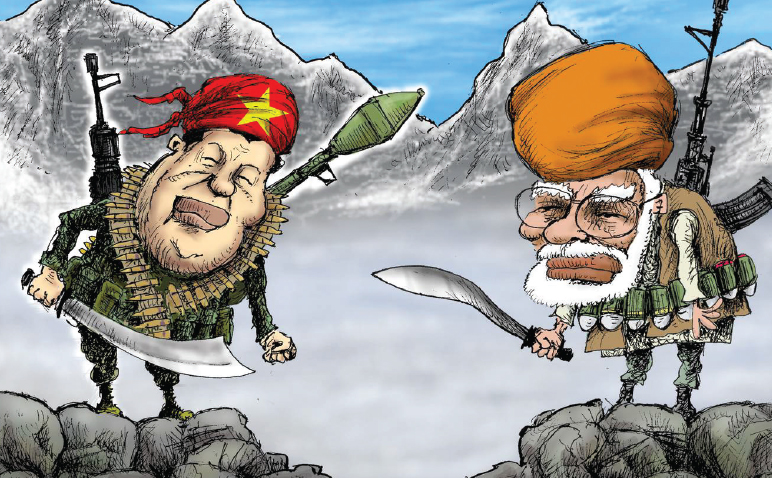
The relationship between the world’s two most populous countries — India and China - has a meandering history. If we look at the ties between the two countries since India’s independence from the British, it seems they experienced good relations. When the Chinese Communist Party (CCP) succeeded in gaining power from the nationalist Kuomintang party in 1949, the Indian communist leader M. N. Roy remained a trustworthy friend of Chinese communists and they used to invite him to China for guidance in their political moves. After power was secured by the CCP, the relationship between India and China remained very friendly. It was at this time that the term “Hindi Cheeni Bhai Bhai” was coined and was continuously used until major conflicts over border issues emerged.
According to Russell Goldman, senior editor on the International Desk of the New York Times, who wrote an article two days after the skirmishes occurred on June 15, 2020, “The conflict stretches back to at least 1914, when representatives from Britain, the Republic of China and Tibet gathered in Simla, in what is now India, to negotiate a treaty that would determine the status of Tibet and effectively settle the borders between China and British India. The Chinese, balking at proposed terms that would have allowed Tibet to be autonomous and remain under Chinese control, refused to sign the deal. But Britain and Tibet signed a treaty establishing what would be called the McMahon Line, named after a British colonial official, Henry McMahon, who proposed the border. India maintains that the McMahon Line, a 550-mile frontier that extends through the Himalayas, is the official legal border between China and India. But China has never accepted it”.
Although, Goldman traces the history of border conflict between China and India to 1914, the major issue that changed the relationship negatively was the Dalai Lama’s escaping from Tibet and getting asylum in India. Although historically Tibet did not remain part of China, but as the Chinese government got control of Tibet in 1951, some voices against the Chinese intrusion grew under the leadership of the current 14th Dalai Lama. His asylum in India was not acceptable to Chinese authorities because they considered the Tibet issue as an ‘internal matter’ in which India’s interference was seen as a hostile step towards China. India’s generosity towards the Dalai Lama and its supporting dissenting voices from Tibet against China ultimately led to the Sino-India war of 1962.


The writer has a PhD in World History from the College of Liberal Arts, Shanghai University, and teaches at the National Institute of Pakistan Studies (NIPS), Quaid-i-Azam University, Islamabad. He can be reached at qasim_shu2016@yahoo.com |
|
Cover Story
|
|
News Buzz
|
Update |
Leave a Reply