

Region
Freedom Lost
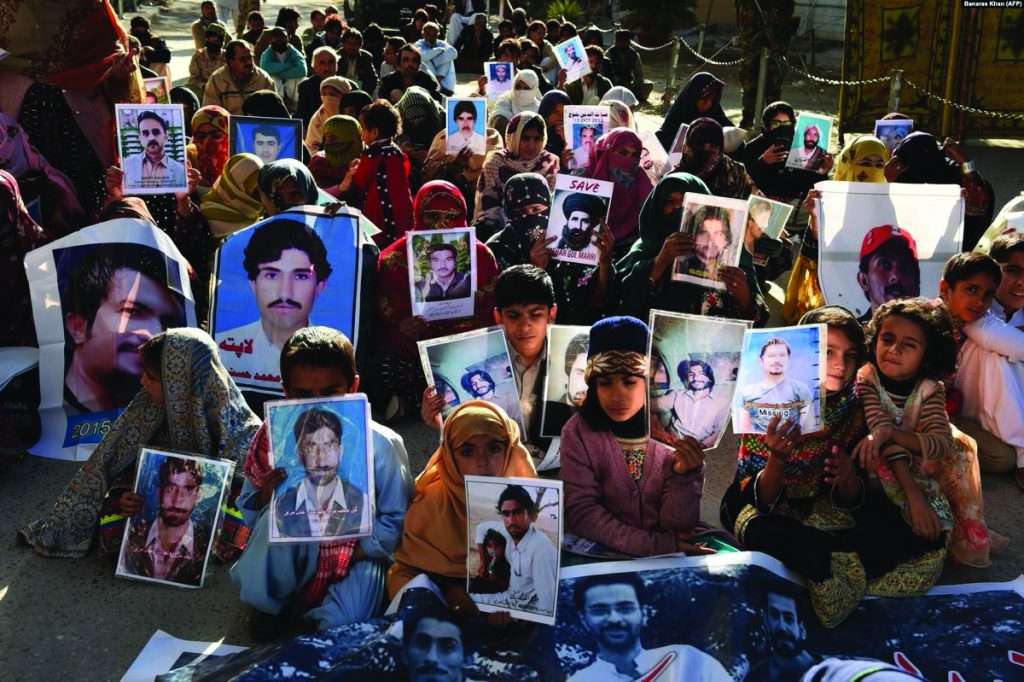
Enforced disappearances has been a persisting problem in Pakistan
and has attracted both domestic and international ire.

Enforced disappearance under international law is defined as arrest, detention, abduction or any other form of deprivation of liberty by agents of the state or by persons or groups of persons acting with the authorization, support or acquiescence of the state, followed by a refusal to acknowledge the deprivation of liberty or by concealment of the fate or whereabouts of the disappeared person. This places such a person outside the protection of the law.
Since the 1970s, there are reports that the practice of enforced disappearance has existed in Pakistan. Such cases were recorded in significant numbers in the early 2000s, after USA’s invasion of Afghanistan and Pakistan’s involvement in the US-led “war on terror” in late 2001. At that time, General Pervez Musharraf ruled the country. The practice of enforced disappearances continued during subsequent governments and the term ‘missing persons’ was sometimes used as a euphemism for enforced disappearances.
Since 2001, hundreds of people accused of terrorism-related offences, particularly in Khyber Pakhtunkhwa, have reportedly disappeared after being abducted by security agencies and detained in secret facilities. Many of them were then handed over to the United States authorities to be incarcerated there. From 2001 till to date, thousands of cases of enforced disappearances have been reported from all parts of Pakistan, A significant proportion of such cases is still unreported. A large number of such cases were also reported from Balochistan and Sindh, where the practice of forced disappearances was used against political activists and supporters of nationalist movements. In recent years, there have also been a number of ‘short-term enforced disappearances’, in which the victims include bloggers, activists and others who were seen to be critical of the state. After interrogation and torture in secret detention for weeks or months, they are released without being charged with any offence.
The International Convention for the Protection of All Persons from Enforced Disappearance (ICPPED) is an international human rights instrument of the United Nations. It came into force on 23 December 2010. The Convention provides a definition of the offence of enforced disappearance and outlines necessary state actions for its prevention and to allow states for the investigation and prosecution of those who perpetrate it. The convention also recognizes the right of families to know the truth regarding the circumstances and fate of the disappeared person, as well as the right of victims to reparation. To date, Pakistan has neither signed nor ratified this convention and no exclusive domestic legislation has been enacted in this regard. Pakistan’s criminal laws also do not currently recognize enforced disappearance as a distinct offence. However, the Supreme Court of Pakistan in a human rights case has upheld that principles of the ICPPED as applicable in Pakistan as the Convention was inextricably linked with the ‘right to life’, guaranteed under Article 9 of the Constitution of Pakistan.
In March 2011, Pakistan’s Federal Government constituted a Commission of Inquiry on Enforced Disappearances (COIED) under the Commissions of Inquiry Act, 1956. In 2017, the Commission of Inquiry Act, 1956, was substituted with the Commissions of Inquiry Act, 2017. At present, the COIED derives its mandate from the 2017 Act. The Commission’s mandate was among other things to trace the whereabouts of allegedly enforced disappeared persons, fix responsibility on individuals or organizations responsible and direct the registration of FIRs against those found involved in the disappearance of an untraced person.
Since 2001, hundreds of people accused of terrorism-related offences, particularly in Khyber Pakhtunkhwa, have reportedly disappeared.
In September 2020, The International Commission of Jurists (ICJ) released a briefing paper (Entrenching Impunity, Denying Redress: The COIED in Pakistan) about the assessment of the performance of the COIED since its formation. The ICJ’s findings were that the legal framework setting out the appointment and functioning of the COIED did not meet international standards for effective investigation, arrest, prosecution, etc. as set out in ICPPED.
The definition of enforced disappearance under COIED’s regulations is not compatible with the definition under international law and misses critical elements, leaving a potentially large number of victims outside its purview. COIED has enabled impunity instead of providing redress to victims. Impunity means the impossibility of making the perpetrators of enforced disappearances accountable. This encouraged perpetrators to carry on this practice without any fear. During the nine years tenure of COIED, it has done nothing to promote access to justice, remedy, reparation for the family of victims and accountability of perpetrators of the crime of enforced disappearance.
COIED has never directed for theregistration of FIRs against those responsible for concealing the whereabouts of the disappeared people who were eventually traced in detention centres. The COIED’s mandate was extended many times. It last expired on 14 September 2020. Despite the poor performance of the Commission and the ICJ’s recommendation not to extend its mandate, the Pakistan government has again extended its mandate for a further three years, up to 14 September 2023.
According to the Commission’s latest progress report for August 2020, it received a total number of 6752 cases from March 2011 to August 2020. The maximum number of cases received by the Commission were from Khyber Pakhtunkhwa (2862 – out of which 291 were reported from the former FATA), followed by Sindh (1618), Punjab (1406), Balochistan (509), Islamabad (291), Azad Jammu and Kashmir (57) and Giglit-Baltistan (9). Out of 6752 cases received, 4642 cases have been disposed of and 2110 cases are still pending with the Commission.
Cases which the Commission categorizes as “disposed of” include those in which people been traced in jails, internment centres or their homes, where they have been found dead. Some cases have been closed due to not being cases of enforced disappearance, incomplete address, withdrawal by complainants and non-prosecution, etc. Apart from its monthly progress reports that give updates on the cases received and disposed of by the Commission, the Commission has not published any in-detail report in its nine years of operations to make public its findings and recommendations.
The UN Working Group on Enforced and Involuntary Disappearances (WGEID), established by the UN Human Rights Council, undertook a country visit to Pakistan in 2012 and issued a report in 2013. The report expressed concerns at the continuing practice of enforced disappearances in Pakistan and inefficiency of COIED and made a series of recommendations to the government to address these issues. In 2016, in its follow up, the WGEID regretted that most of the recommendations contained in its country visit report had not been implemented and the practice of enforced disappearances was still widespread in Pakistan.
The WGEID has received 1144 cases of allegations of enforced disappearances from Pakistan between 1980 and 2019, with a particularly large number in 2015-16, of which some 731 remained unclarified at of the end of 2019. In 2019, the WGEID submitted its latest report to the UN Human Rights Council, in which it regretted that it continued to receive a large number of cases of enforced disappearances from Pakistan, including cases of reprisals against relatives and civil society actors working on behalf of the missing persons.
The rampage of enforced disappearances suggests that without substantial reform to the existing laws and practice, continued extension of COIED will not succeed in providing effective remedies to victims of enforced disappearances. A new Commission should be constituted after consultation with all relevant stakeholders, including victim groups and civil society organizations, with a mandate and constitution that fully addresses the deficiencies highlighted in the existing Commission. A mechanism of oversight and accountability of law enforcement and intelligence agencies should be formulated to address the problem of enforced disappearances. ![]()
The writer is a human rights lawyer and an advocate of the High Court, based in Islamabad. He can be reached at adv.wajahat.ali@gmail.com |
|
Cover Story
|
|
News Buzz
|
Leave a Reply Cancel reply |
Update |


The writer should compare the abduction with other countries with similar scenario. Like how many people were abducted by Sri Lankan govt during Tamil Tiger war or currently in occupied Kashmir or in 70s when IRA was at peak. Disappearnce is part of this game when there is unrest in country. In Pakistan BLA/After 9/11 Kpk and now pashtine movement. I would suggest HR activists to raise their voices on common rights like consumer laws. This niche has big scope to build your name