



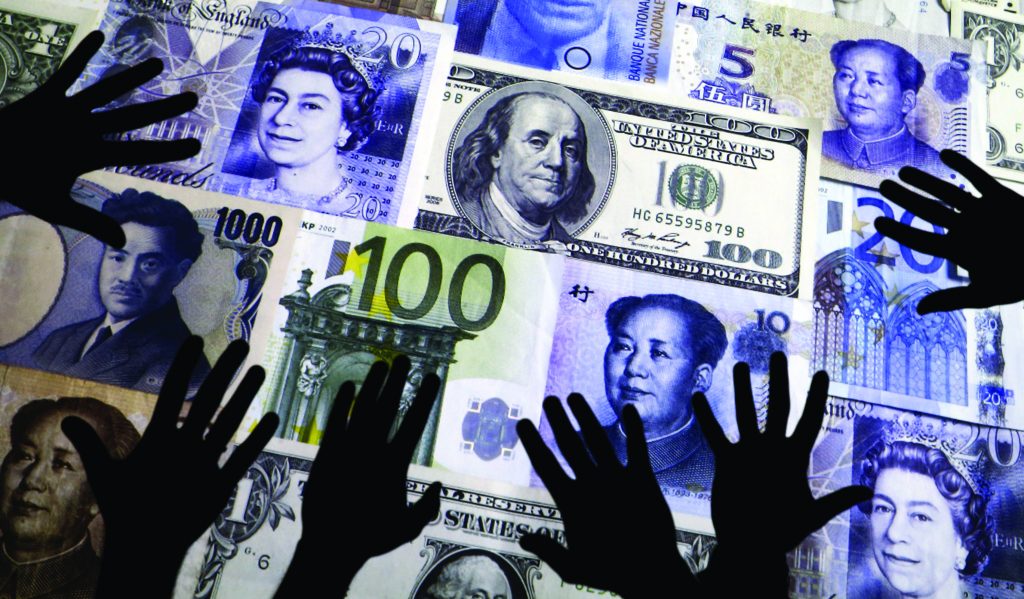
My article in the last quarter of 2019 asked if China would come out on top. Its crux revolved around the leverage the Chinese possess through their accumulation of US debt, their strategic importance from an economic warfare standpoint and the implications they would have for the developed world. As we come to the end of 2020, China’s US Treasury holdings have reduced for the third time this year; in total it has now cut 1.07 trillion USD.
China’s timing could not have been better, as the global economy reached the last phase of the current economic cycle, which coincided with the coronavirus-led global lockdown, leaving central banks from the developed world with no other option but to print money, to save their crippling economies and investor confidence in the stock markets. In the case of the US Federal Reserve, this has led to an initiation of a conversion from USD-denominated holdings into other currencies and assets across global markets, resulting in a) a rapidly depreciating US dollar b) capital flight to emerging markets c) signs of inflation creeping into the United States due to the decrease in the purchasing power of the currency, and d) appreciating exchange rate of currencies against the dollar. The only possible scenario in which the dollar could increase is a rapid growth in its demand; the momentum would require a selloff in equity-based funds.
These factors are now a concern for the developed world as they impact their economic development objectives. A depreciating dollar makes the Japanese yen, euro and Swiss franc appreciate, leaving China very strongly positioned to benefit from how these scenarios are unfolding in the modern form of economic warfare. It also gives credibility to the execution of a plan that could lead to the eventual demise of the dollar as a reserve currency. Between 2015 and 2020, the dollar appreciated due to the yield differential between the developed world and the US. So, will the Federal Reserve increase rates or will we be going into an era of negative yields? If they pursue their current monetary easing policies, fundamentally the dollar will embark on a trajectory that could mark its culmination as a global reserve currency and the United States experiencing high rates of inflation in the coming times. The lack of demand for US treasuries has resulted in the Federal Reserve floating bonds for liquidity injection in the system and procuring those bonds themselves as foreign investors shift their capital to emerging markets.
Historically, we have monetary systems change on average every 30 to 40 years, starting from the classical gold standard, then the demise of the gold standard, the Bretton Woods system, the demise of the Bretton Woods system and then the Washington consensus, eventually resulting in the current fiat currency system. According to the International Monetary Fund (IMF), more than 61% of all foreign bank reserves are currently denominated in U.S. dollars. Many of the reserves are in cash or U.S bonds (like U.S. Treasuries). However, things are changing, and the question on everyone’s mind (including my own) is just how long will the USD hold on to its status of Currency King? Whether this will materialize in the short-term or we have another economic cycle is a question and the answer needs to be monitored as this requires another catalyst. The seeds sown for an alternative system are beginning to develop but are not ready to be cultivated as yet.
The fiat currency system since the 1970s has allowed China to run chronic current account surpluses and the United States to run large current account deficits and their relations enter a phase where the probability of a peace deal can safely be eliminated since there is no turning back from the trajectories global superpowers have embarked upon, in a quest to mark their dominance. As we approach the second quarter of the 21st century, the question is whether China is strong enough to combat the offensive of the developed world, control India’s growing strength and still take step towards its vision of developing a corridor that strengthens its influence and dominance around the globe? The United States and it hegemony over the globe can be questioned as the Federal Reserve acts as a printing press for the globe while the fundamentals of economic activity are nowhere to be seen in the country, making one contemplate their next possible move as the country bleeds.
Has China won this leg? I suppose it has. The only hope is that the Tokyo Trial is a verdict in history that is seen as a strong precedent that works as a deterrent in the minds of influential leaders and saves the world from a catastrophe such as World War II.

The writer is a fundamental and technical analyst on gold and dollar, with an academic background in international business, He can be reached at sikander.taimoor@gmail.com |
|
Cover Story
|
|
News Buzz
|
Update |
Leave a Reply