



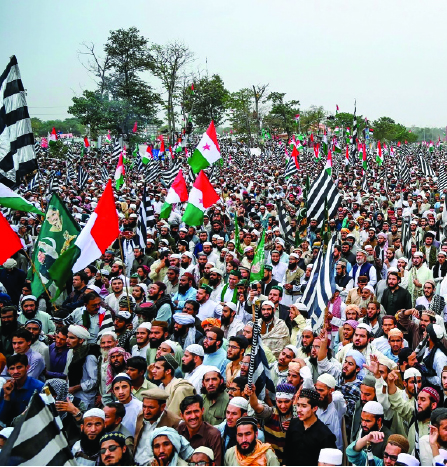
Maulana Fazlur Rehman’s much touted Azadi (Freedom) March morphed into a Dharna (sit-in) after reaching the outskirts of Islamabad, traversing from Karachi via Multan and Lahore. On November 10, which was also Eid Milad-un-Nabi, the Maulana converted the sit-in into a SeeratConference to pay homage to the Holy Prophet (PBUH) but refused to disperse. So far, he has kept his cards close to his chest besides saying he would bring the house of Imran Khan down.
The other political parties jumped on the Maulana’s bandwagon to serve their own interests but refused to be parties to the sit-in. They refused to storm the citadel or engage in any undemocratic means of removing the government. Apparently, the two major political parties the PML (N) and the PPP, whose top leaderships were incarcerated on corruption charges claimed their pound of flesh. Why did the Maulana, rooted in contradictions, choose this time to launch his protest? The answer perhaps lies in the history of his organization and its past record.
The Deobandi school of Islam was founded in the latter half of the 19th century in the aftermath of the 1857 War of Independence against the British. As part ofthe clampdown, the British had occupied religious sites in Delhi, the capital of the Mughal Empire, for several centuries. This caused many ulema (religious clerics) to migrate to various locations, such as the northern Indian town of Deoband, to preservetheir religious life and culture. In 1867, Darul Uloom was founded in the town of Deoband as one of the first major seminaries to impart training in Deobandi Islam. It is an interesting fact that the town of Deoband itself is located in Saharanpur district of Uttar Pradesh, where Hindus form 62.7% of the total population. Moreover, during the initial period of Darul Uloom’s establishment, the Hindus reportedly contributed to its operating expenses.
Jamiat-e-Ulema-e-Hind, which was founded in 1919 by a group of Deobandi scholars, was an active participant in the Khilafat Movement in collaboration with the Indian National Congress but it opposed the partition of India, taking the position that Muslims left behind in India will be weakened. The position hasn’t changed since the Jamiat-e-Ulema-e-Hind has welcomed the August 5 annexation of Kashmir and considers the issue to be an internal matter of India.


The writer is a practising journalist. He contributes to the print media, conducts a TV show and produces documentaries. He can reached at sultanm.hali@gmail.com |
|
Cover Story
|
|
Interview
|
|
Around Town
|
|
Tribute
|
Update
|
Leave a Reply