


In Kashmir, India rules through the visible hand of force: soldiers on every corner, curfews that choke daily life, and emergency laws that are the subject of serious human rights violations against the population. What the world witnesses in terms of optics is the guns and the barbed wire. It is a blatant display of control and force.
In Bangladesh, until the seismic events of August 5, 2024, the approach was subtler, yet arguably very effective. India operated for years through its political alignment with a favoured regime, deepening economic reliance, the securitisation of dissent, and a resulting public silence on uncomfortable truths. What India packaged as friendship was viewed by Bangladeshis as dominance. This asymmetry explains why India occupies such a central, often obsessive position in Bangladesh’s political discourse.
For decades, the relationship was portrayed in Dhaka’s official circles as one of “eternal friendship,” rooted in India’s role in Bangladesh’s liberation in 1971. The time frame and scope of that role, it must be stated, are disputed amongst many Bangladeshis. In any case, beneath the rhetoric and outward optics of friendship lay deep-rooted imbalances.
Trade and water-sharing
Bangladesh had massive deficits with India, importing far more than it exported, with non-tariff barriers limiting Bangladeshi goods. Transit agreements and connectivity projects benefited India’s northeastern states more visibly. Meanwhile, the vulnerabilities that Bangladesh faced, exemplified by the long-festering Teesta water-sharing dispute and the Farakka Barrage, left downstream agriculture and livelihoods at the mercy of Indian decisions. This situation was accepted unconditionally under the “eternal friendship” umbrella between Sheikh Hasina’s administration and India.
It must be noted that the significant trade deficit and water-sharing issues remain unresolved. The point is that there is no longer a political climate in Bangladesh in which the focus is solely on the benefit of its neighbours.
Politics
Politically, the alignment was even clearer. During Sheikh Hasina’s rule, which spanned 20 years and 8 months across two separate periods, India found a reliable partner that willingly cracked down on anti-India dissent and cooperated on security matters. In return, India offered crucial external backing.
Critics in Bangladesh, however, saw beyond this: a powerful neighbour invested in sustaining a government that increasingly centralised power, marginalised opposition, and suppressed uncomfortable questions about sovereignty. For many, Bangladesh was treading a dangerous path towards potential vassalhood.
Dissent on issues like border killings by India’s Border Security Force (BSF), interference, or imbalanced economic deals was often securitised—portrayed as anti-national or destabilising. In other words, the classic formula of masquerading as healthy political debate and dialogue about Bangladesh’s sovereignty was weaponised as being “anti-national.” This led to a culture of disciplined silence amongst Bangladeshis who valued their own autonomy, where questioning the relationship too loudly invited accusations of rocking the boat at best, but more often led to grave state-sponsored human rights violations.
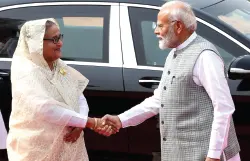 This was a classic case of hegemony. Unlike India’s overt militarisation in Kashmir, Bangladesh’s version relied on soft power tools: economics, diplomacy and the quiet understanding that challenging the status quo carried severe costs.


Based in Houston, United States, the writer is the executive director of a US-based human rights organization. She can be reached at scballand@thechrd.org
Leave a Reply