



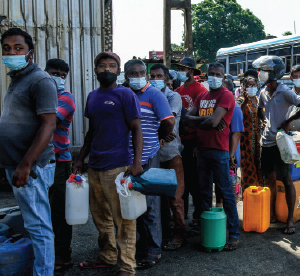
 The ongoing economic crisis in Sri Lanka is one of the worst economic disasters in South Asia’s contemporary history. To be sure, the interconnectedness in the global economy does not allow for an isolated view of the national economic emergency in Sri Lanka, a home to a population of some 22 million.
Key economic challenges that have created a proverbial perfect storm for Sri Lanka: the state of the domestic economy; Balance of Payments (BOP) crises; successive IMF loans; the unwarranted agricultural reforms contributing to foreign exchange scarcity and soaring inflation; the downfall of the tourism sector; and the country’s historical fetishism for sovereign debts.
According to the latest South Asia Economic Focus and the Sri Lanka Development Update, Sri Lanka’s real GDP is expected to fall by 9.2 percent in 2022 and a further 4.2 percent in 2023.
The fluid political situation and heightened fiscal, external and financial sector imbalances pose significant uncertainty for Sri Lanka’s economic outlook. The growth outlook is subject to high uncertainty and will depend on the progress in fiscal consolidation, debt restructuring, and growth enhancing structural reforms. Despite tightened monetary policy, inflation will likely stay elevated. The fiscal deficit is expected to gradually fall over the medium-term due to consolidation efforts. The current account deficit is expected to decline due to import compression. Additional resources will be needed in 2023 and beyond to close the external financing gap. Poverty is projected to remain above 25 per cent in the next few years.
Key downside risks include a slow debt restructuring process, limited external financing support, and a prolonged recovery from the scarring effects of the crisis. Fiscal consolidation needs to be accompanied by tighter monetary policy to contain inflationary pressures. Significant debt restructuring is essential to restore a sustainable debt level. The financial sector has to be managed carefully, given high exposures to the public sector. The necessary macroeconomic adjustments may initially adversely affect growth and poverty, but will correct the macroeconomic imbalances, help regain access to international financial markets, and build the foundation for sustainable growth. Mitigating the impacts on the poor and vulnerable will be critical during the adjustment. Reductions in poverty will require an expansion of employment in industry and services and a recovery in the real value of incomes. On the upside, a credible reform programme supported by financing from international partners could enhance confidence and attract fresh capital inflows.
Sri Lanka’s economy was already showing signs of weakness before the Covid-19 pandemic. Growth and poverty reduction had slowed down in the last five years. A restrictive trade regime, weak investment climate, episodes of loose monetary policy and an administered exchange rate had contributed to external imbalances. Sustained fiscal disparities, driven primarily by low revenue collections, combined with tax cuts in 2019, has contributed to high fiscal deficits, large gross financing needs, and a rapid growth in unsustainable debt.
Sri Lanka lost access to international financial markets in 2020, after credit rating downgrades. Without market access, Sri Lanka continued to service its external debt and pay for imports using official reserves and loans from the banking sector. Official reserves dropped from US$7.6 billion in 2019 to less than US$400 million (excluding a currency swap equivalent to US$1.5 billion with China) in June 2022. Net foreign assets in the banking system also fell to US$ -5.9 billion in June 2022. This severe forex liquidity constraint has been felt across the economy, particularly from the second quarter of 2022, with shortages of fuel, medicines, cooking gas, and inputs needed for economic activity. Amid depleted reserves, Sri Lanka announced an external debt service suspension in April, 2022 and later appointed legal and financial advisors to support debt restructuring.

Leave a Reply