


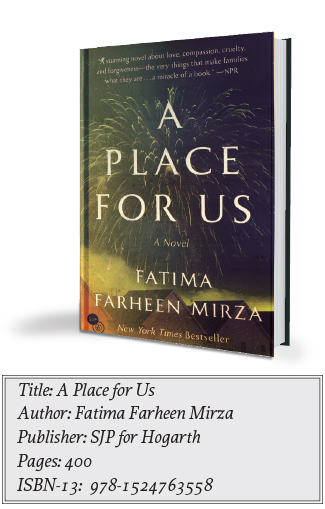
Any critical discussion on Fatima Farheen Mirza’s debut novel A Place for Us is indissolubly chained to an intense curiosity about the celebrity imprint that published the book. SJP for Hogarth is a literary imprint within the Crown Publishing Group that is run by American actor and producer Sarah Jessica Parker. Conventional wisdom would have us believe that an imprint whose editorial director enjoys celebrity status would prioritize well-known authors and overlook debut writing. However, SJP for Hogarth appears to be combating these stereotypical notions through its choice of titles.
With its decision to select Indian-American Muslim Mirza’s narrative as its maiden venture, SJP Hogarth has shown its commitment to spotlighting marginalized literary voices. The novel - which was originally published in 2018 - serves as a counter to the politics of a post-truth world at a time when a ‘Muslim ban’ was imposed in the US. As a result, A Place for Us should be viewed as a literary offering that dares to tread off the beaten path and unearth sizzling truths about a misunderstood community.
Mirza’s first novel opens a vista onto an Indian family that is preparing for a wedding. The presence of the bride’s brother - a prodigal child who has returned home after a long interlude - invites conflicting emotions. As the narrative unfolds, Mirza peels back the layers of mystery and examines how past events shaped and distorted the family’s internal dynamics.
At its core, the novel is an immigrant tale that brings to the fore the challenges and idiosyncrasies of an Indian-American family. A Place for Us acts as a literary counterpart to Jhumpa Lahiri’s novels and short stories, which have explored the subtle nuances of the immigrant experience for the Indian community. Mirza, like Lahiri, portrays characters who must skillfully negotiate their separate cultural identities in their effort to survive in their adopted land. At times, their allegiance to one culture conflicts with the other and results in both rebellion and conformity. Unlike Lahiri, Mirza explores an additional challenge that assails her - the lives of her characters: the stigma associated with their Muslim identity in a Western context.

Leave a Reply