
Book
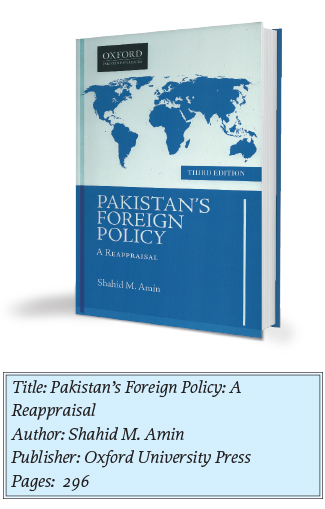
Pakistan’s Foreign Policy: A Reappraisal
Tragic Heroism

Senior and seasoned retired ambassador Shahid Amin revamps the first edition of his book on Pakistani foreign policy in this reissued third edition, published over twenty years after the book’s first release. He reproduces the introduction to the first edition, which is juxtaposed alongside a new introduction which summarizes that Pakistani diplomats in spite of facing many challenges and hurdles have, in aggregate, done a fairly sound job of consolidating the country’s position on the geopolitical stage. The book is a joy to read because of Amin’s superb writing skills and his considerable experience (to say the least) in handling matters such as the complex tensions between India and Pakistan, among other things. His views on the Soviet Union, particularly its presence in Afghanistan, comments on the Taliban, as well as his immense respect for the vision of the great M A Jinnah, are remarkably well-delineated and expressed in an opinionated but thoroughly informed manner. Amin served as ambassador to numerous important countries including, but not limited to, Nigeria, France and the Soviet Union. There are few authorities better placed to provide a balanced view of the history and potential future of the vexed Kashmir issue.
Pakistan’s relations with India make up a substantial portion of the text; this is hardly surprising, since the country’s very creation involved a relinquishing of Indian soil that India took very much to heart. But Amin notes that Jinnah was implacable in his intent that a separate homeland be created for the Muslims. In this matter he does not prescribe to the thesis propounded by other scholars that Jinnah did not want Pakistan: according to Amin, he did, and it was not simply created but has survived for over seven decades. He stresses Jinnah’s strong sense of ethics regarding matters of Partition: for example, Jinnah resolutely refused a clandestine deal whereby India would retain Kashmir and Pakistan would be granted Hyderabad. Amin shoots down the Indian argument that there was no need for Pakistan to be created since the two peoples share many commonalities of culture, cusine and dress. He underscores that the oppression of Muslims at the hands of a Hindu minority left Jinnah and the Muslim League (and ultimately even Lord Mountbatten) with no choice but to create a separate state, ‘moth-eaten’ though its divisions may ultimately have been.
The author is honest about claiming that West Pakistan’s abject failure to listen to Mujibur Rehman’s demands for East Pakistan’s rights eventually paved the way for India’s military intervention, that in certain political circles was even viewed as a humanitarian endeavour to assist the oppressed East Pakistanis, especially when the wives of East Pakistani prisoners of war aired their grievances on an international stage! Indeed, after 1971 Pakistan’s ‘big-brotherly’ influence over Saudi Arabia waned, and although Amin notes that China and Saudi Arabia have often lent support internationally to Pakistan, it currently remains subservient to them in a visible sense of the word and one should not expect military intervention by China on Pakistan’s behalf in future conflicts with India. However, he acknowledges that after the collapse of the Soviet Union, China no longer feels threatened by a superpower in proximity to it and is undeniably one of Pakistan’s most valuable allies, especially given China’s own past border clashes and historical tensions with India.
That Zulfiqar Bhutto saved face after the 1971 war by means of the Islamic Summit in Lahore in the early 1970s helps pave the way for Amin to discuss the general importance of Islamic countries on the geopolitical stage. He dwells on this matter extensively in a number of chapters, rightly noting the power of the OIC when it comes to influence in terms of its numbers and economic strength. Several oil-rich countries are part of it and there are over one billion Muslims in the world today, though Amin notes that the OIC’s tendency to act as a debating club on occasions results in it displaying less power at the UN level that it could assert were it a more actively united body.
Amin demonstrates a very nuanced knowledge of the history of warfare. One example of this is when he bluntly claims that the relatively unguarded city of Lahore could easily have fallen to the Indians in the 1965 war were it not for unexpected blunders on the Indian side (although he also credits the bravery of a few remarkably heroic Pakistani soldiers who finally saved Lahore). The Kashmir issue dominates key portions of the book, with Amin emphasizing how the always fractious matter acquired superlatively tense connotations once both countries became nuclear powers in the 1990s. He does appear to believe that Bill Clinton was right in noting that by carrying out nuclear demonstrations in retaliation to India’s doing so, Pakistan lost a priceless opportunity to leverage economic advantages from the West, but he concedes at other points that the military has exerted too much control over Pakistan for its ultimate mandates to be ignored with impunity by the government.
Amin laments that much of Pakistan’s foreign aid goes into maintaining military defences against India which has over the years resulted in the country suffering on the education front, among other things. However, when one reads deeper into his text, one finds that while it explicitly describes Indo-Pak tensions, it implicitly comments on the divide between civilian concerns and military might. A diplomat and pacifist at heart, it is sad to note that there are few bright or heartwarming points in the book; a couple that come to mind are the Indus Water Treaty and the Rann of Kutch Arbitration where India and Pakistan were able to put aside their differences, albeit briefly.
It is not that Amin cannot appreciate the importance of severe brute power; it is that he can do it only too well. For instance, he comprehensively describes the rise of the Taliban and their domination over Afghanistan, whereby they eventually controlled the majority of the country with Rabbani only being a puppet-like figurehead. He repeatedly underscores that only peace in South Asia can lead to a final resolution of the Kashmir issue, which has dragged on so long that many countries on the world stage can now no longer see past their ‘fatigue’ on the matter. His stances are quietly heroic, but it is a tragic heroism since his most important pleas have appeared to fall on deaf ears. But it cannot be said that Ambassador Amin lacks courage.![]()
|
Cover Story
|
|
News Buzz
|
Update |


Leave a Reply