



 The relationship between India and Pakistan remains complex and marked by a series of longstanding issues and recent developments, which can be summarised by various points, as detailed below:
Strategic Priorities and Perceptions
India’s foreign policy has been increasingly focused on China, leading to a decrease in the strategic importance of Pakistan in its foreign policy matrix. With its growing economy and defence capabilities, India tends to view Pakistan more as a nuisance than a significant threat. This perception is influenced by India’s self-perception as a leading global power and its reluctance to engage in peace talks with Pakistan.
Minimalist Engagement
India’s strategy towards Pakistan is described as “minimalist engagement,” it allows India to maintain stability along the Line of Control (LoC) while focusing on other strategic challenges and pressing issues. The lack of a common strategic threat and the perception of the incentive structure in the bilateral relationship contribute to this approach.
Impact of Domestic Politics
With India preparing for the 2024 parliamentary elections, initiating peace talks with Pakistan is considered a politically risky move. Creating a new narrative and gaining domestic support with no guaranteed returns would require a significant investment of time and resources. Moreover, any terror attack in India during the peace talks could have severe electoral implications.
Pakistan’s Political Crisis
The political crisis in Pakistan, including the arrest of former prime minister Imran Khan, has led to a state of deep division within the country. This situation has left India without a strong and credible political partner in Islamabad for dialogue. The political instability in Pakistan is seen as reinforcing India’s policy of aloofness or low-grade hostility.
Security Concerns and Kashmir
The security situation in Kashmir and accusations of Pakistan sponsoring terrorism continue to be major concerns for India. Efforts to resolve the Kashmir issue and improve the broader bilateral relationship have been challenged by terror attacks and political developments, such as India’s constitutional changes in Jammu and Kashmir in 2019. These changes have been critical points of contention for Pakistan.
Contexts of Relationship
The relationship between Pakistan’s general elections and its relations with India is deeply intertwined, reflecting the subcontinent’s complex political, historical, and social dynamics. Each general election in Pakistan can potentially influence the bilateral relationship between Pakistan and India by reinforcing existing policies or signalling a shift in approach. Here’s an analysis of how general elections in Pakistan can impact its relations with India.
In fact, the party or coalition that comes to power in Pakistan after a general election often dictates the tone and direction of its foreign policy, including the country’s relations with India. For instance, the post-2008 election saw civilian governments attempting to normalize relations with India through trade and dialogue. However, these efforts were often undermined by border skirmishes and terrorist incidents, although political parties in Pakistan often use India as a focal point in their election campaigns, either advocating for a hardliner stance or proposing peace initiatives. The commitments made in party manifestos regarding India policy generally influence bilateral relations post-election.
Pakistan’s general elections are a barometer for potential shifts in its India policy. However, the influence of other factors like the military, judiciary, and non-state actors must also be considered. There is no doubt that the election outcomes offer opportunities for a reset in relations, but the historical context of mistrust and unresolved issues like Kashmir continue to pose challenges. Apart from these, the influence of domestic politics, regional dynamics, and international relations often complicates this relationship.
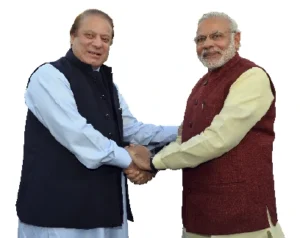
Premiership of Nawaz Sharif
Nawaz Sharif, a prominent Pakistani political leader, has served multiple terms as Prime Minister (1990-1993, 1997-1999, 2013-2017) on intervals. During his first term, the relationship between India and Pakistan was relatively stable but cautious, overshadowed by ongoing issues such as the Kashmir conflict and cross-border tensions.


The writer is Professor and Head of the Department of Political Science as well as Dean, Faculty of Social Sciences at the Bhupendra Narayan Mandal University in Madhepura, Bihar. He can be reached at rajkumarsinghpg@gmail.com
Leave a Reply