

Mumbai
General, Principal, and Periphery
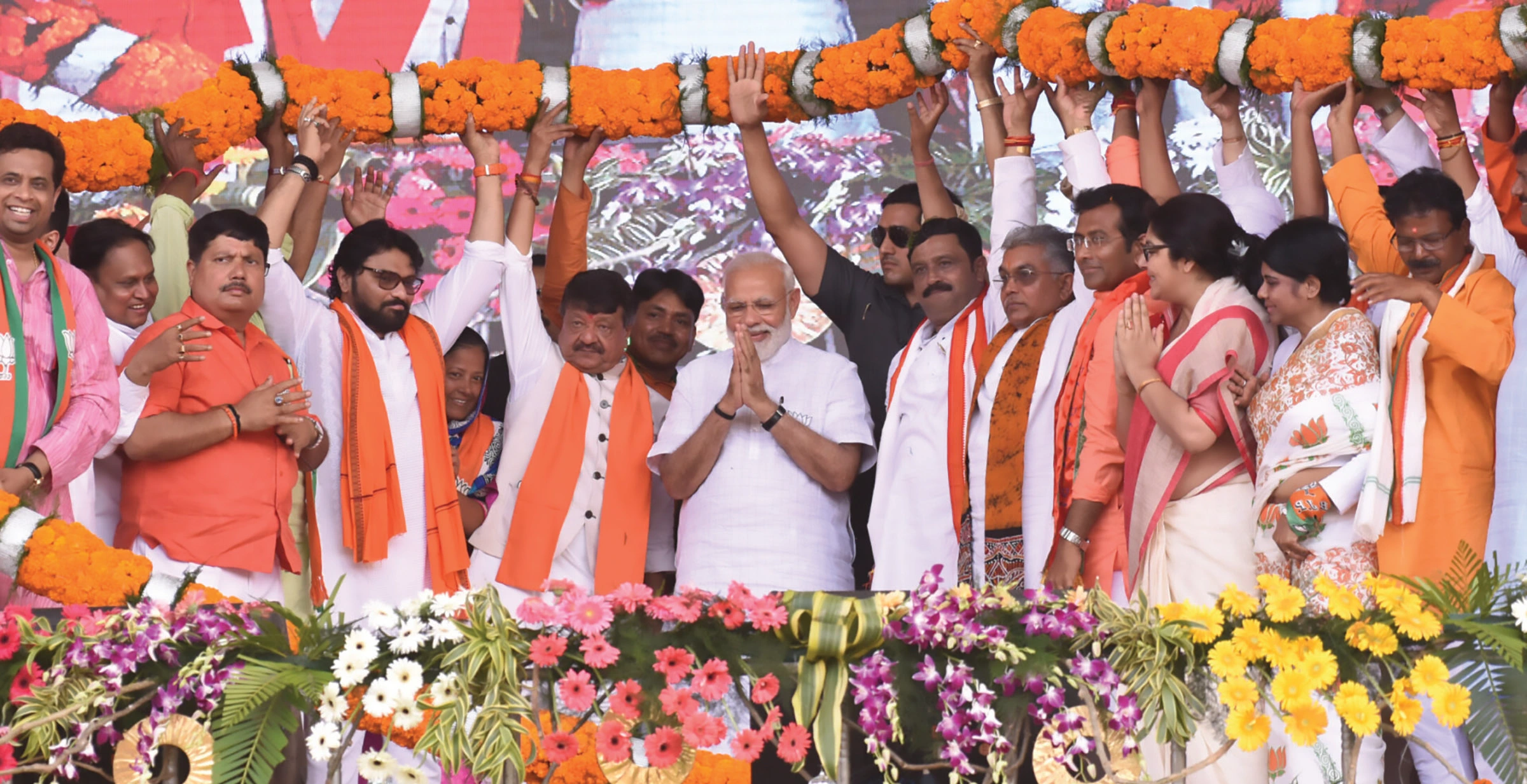
The BJP, led by Prime Minister Narendra Modi, is riding on a divisive right-wing agenda. INDIA, an alliance of over 25 major political parties, can offer its electorate an alternative, inclusive agenda for social transformation.

The recent state elections in five Indian constituencies, held in November and December 2023, culminated in a resounding victory for the Bharatiya Janata Party (BJP), which is led by Prime Minister Narendra Modi. These were the last state elections before the forthcoming Lok Sabha elections scheduled for April-May 2024.
In the recent state elections, the BJP swept the Hindi states of Madhya Pradesh, Chhattisgarh, and Rajasthan. The main opposition party, the Indian National Congress (INC), managed to woo just a single state of Telangana. The fifth state of Mizoram chose an independent candidate. It is evident from these results that the incumbent party will continue its winning streak throughout the forthcoming general elections.
Indian PM Narendra Modi is riding high. His highest-ever approval ratings are intact, and the party has deployed an air-tight election management strategy. State elections only further boosted the morale of already energized party workers. Things couldn’t be better for Modi and his allies. But are they?
State elections do demonstrate the electorate’s mood, but they cannot be taken as a final verdict. In the past, voters have upset election calculations based on state results. One example is the infamous 2004 election upset, which saw the Congress-led United Progressive Alliance (UPA) beat the BJP-led National Democratic Alliance (NDA). In 2004, every poll and prediction favored the incumbent BJP, but the final results saw a triumphant Congress attaining a decisive election victory.
Keeping this in mind and subscribing to the unpredictable nature of the Indian voter, can we expect to see a different result in the 2024 elections? Can Narendra Modi be stopped from claiming the premiership for a third consecutive term?
Last year in July, Modi’s political opponents formed an alliance. It was named I.N.D.I.A – an abbreviation for Indian National Developmental Inclusive Alliance. The stated goal of INDIA was to unseat Modi and his BJP in the 2024 elections.
INDIA is led by the Indian National Congress, which used to be the most popular party in the country till 2014 when it suffered a catastrophic defeat at the BJP’s hands. INDIA has put forward Rahul Gandhi as its prime contender against an immensely popular Narendra Modi. Gandhi’s 136-day ‘Bharat Jodo Yatra,” or ‘Unite India March’ carried out between September 2022 and January 2023, provided him with a much-needed political boost.
There are 28 major political parties in INDIA, including the Indian National Congress (INC), Communist Party of India (CPI), Aam Aadmi Party (AAP), All India Trinamool Congress (AITC), and Shiv Sena, among many others. A few members of INDIA hold immense political sway within their regional domains. The alliance seeks to combine INC’s country-wide appeal with the regional political strengths of allied parties and present a unified electoral platform.
Does INDIA have the potential and the ability to unseat Narendra Modi?
A look at the results of recent opinion polls reveals that it is not a possibility. The BJP-led NDA is firmly positioned to secure a majority in the forthcoming elections. An upset like 2004 is highly improbable. Yet, there are still 3-4 months until the voting starts. With political machinations, strategy, and a rock-solid political will, INDIA can still turn the tables in its favor. Let’s examine how.
The coming electoral war between the INDIA and the BJP is not a single showdown. Instead, it combines three separate clashes in three different arenas: General, Principal, and Periphery.
The right approach for INDIA in the periphery battlefield would be to stay focused on the seats where BJP won last time and make sure that the party cannot crack an opening into a single new constituency.
First of all, the Periphery. This includes the South Indian states of Tamil Nadu, Kerala, Telangana, and Andhra Pradesh. The BJP does not enjoy popular support here. Add Punjab, Kashmir, and Mizoram to the list, and you will get 120 seats. In the last elections, the BJP won just six seats from this entire electoral mix. During the past five years, Modi has been unable to crack open this formidable vote bank despite several attempts. In the current situation, the BJP does not seem to be able to retain its six previous seats and will be forced into alliances with regional political heavyweights.
The right approach for INDIA in the periphery battlefield would be to stay focused on the seats where BJP won last time and make sure that the party cannot crack an opening into a single new constituency. This will require persistent opposition political campaigning. Pre-emptive seat-adjustment negotiations with the BJP’s current and possibly future allies will obstruct last-minute surprise breakthroughs.
The second or general arena includes the entire Hindi heartland from Uttar Pradesh to New Delhi. It also includes other areas like Gujarat, Assam, Tripura, etc. This is Modi’s stronghold. Last time, the BJP made a clean sweep here with more than 80% of votes. Latest opinion polls suggest that the BJP still has a watertight stranglehold on this constituency, where it is set to repeat its spectacular performance. But this is precisely where the opportunity lies for INDIA. A marginal decline in the BJP’s vote within this arena will upset its entire election stratagem. INDIA should aim at a few soft constituencies where it can make headway with the help of regional parties. Tribals of Gujarat and farmers of Haryana may be chipped away from the BJP fold with careful political maneuvering.
The principal area consists of constituencies where the BJP performed exceptionally well during the last elections but has become vulnerable due to the changing political landscape. In Karnataka, Bengal, and Himachal Pradesh, BJP has seen its fortunes reversing in state elections. This is the real battleground where INDIA should throw its full weight through worker mobilization and persistent campaigning. The goal must be to grab as many seats from the BJP as possible.
The BJP is riding on a divisive right-wing agenda. INDIA can offer its electorate an alternative, inclusive agenda for social transformation. Indian political discourse must shift from majoritarian rule to social democracy that values the tenets of the constitution.
If INDIA convinces the electorate that it is a viable alternative to the BJP, it may still turn the table and save the country from further polarization.![]()

The writer is a freelancer and an investment banker based in Karachi. He can be reached at syedatifshamim@hotmail.com
7th Engro LRBT Golf Tournament Drives Success for Vision Restoration
Nestlé inaugurates Solar Power Plant at Sheikhupura Factory
Sadia Rashid honoured by KPC
PRL Unveils Vision for a Sustainable Energy Future
China, Maldives upgrade ties with infrastructure deals
Afghan women detained over ‘improper’ hijab
Pakistani among recipients of Religious Freedom Award
OIC denounces temple opening at Babri Mosque site
Bangladeshi Nobel winner convicted of violating labour laws
Pakistan Launches Three Groundbreaking Initiatives
PTI Senator appointed as CEO of vaccine alliance Gavi
German brand makes strong statement for Palestine
Harvard president to resign over allegations of plagiarism
Indian state stops funding to Muslim religious schools
Saudi Arabia to allow alcohol sales
Muslim world urged to support South Africa in icj
Deepfakes deceive voters in India, Pakistan before elections
Lack of snow sparks worry for drought-hit Afghanistan


Leave a Reply