Region
Police Brutality
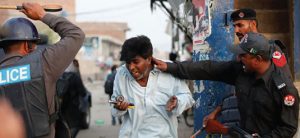
The tendency of the Pakistani police to resort to violence can be attributed to an authoritarian police culture and the lingering effects of security operations that encourage excessive use of force to control terrorism.

Illegal confinement, torture, custodial death and rape by police and other law enforcement agencies is a common practice in Pakistan. These abuses are accepted as an inevitable part of law enforcement and perpetrators are granted immunity through a combination of socio-cultural acceptance mechanisms, lack of accountability of the police force, widespread powers of arrest and detention, procedural loopholes, ineffective safeguards, and the failure to criminalize torture, custodial death and rape by public officials.
Pakistan has ratified the UN Convention Against Torture and Other Cruel, Inhuman or Degrading Treatment or Punishment (UNCAT) and the International Covenant on Civil and Political Rights (ICCPR), both of which forbid illegal confinement, torture and cruel, inhuman, or degrading treatment. The two treaties obligate the country to take effective measures for prevention of such abuses.
Article 156(d) of the Police Order 2002 provides penalties against any police officer who inflicts ‘violence or torture’ upon any person in his custody. However, the statute only penalizes acts by police officers and does not extend to other public officials. It contains no definition of torture, and fails to satisfy Pakistan’s obligations under UNCAT. In addition, it is only applicable in Punjab.
The implementation of the Police Order 2002 remains ineffective, because there is not a single precedent where any police official was held accountable for committing illegal confinement, torture, custodial death or rape, whereas such cases are reported on a daily basis. For example, in March 2021, a case of custodial torture and death of a 14 years old child ‘Shahzaib’ was reported in Peshawar. Shahzaib was a grade-7 student and was found dead in the lock-up of the West Cantonment police station after he was arrested following a clash with shopkeepers and for pointing a gun at them.
Police took the plea that the victim had committed suicide, but the victim’s father said his son was tortured to death by police. Similarly, in August 2019, the case of Salahuddin Ayubi is another example, where the victim died in the custody of police. Salahuddin was arrested after a video of him – allegedly stealing from an automated teller machine in Faisalabad – went viral on the social media. Salahuddin died in the custody of the Rahim Yar Khan police. Salahuddin’s family claimed that he was suffering from a mental condition and died from custodial torture. Later, a forensic medical report of the incident proved that Salahuddin was tortured.
There is no credible data availableabout cases of illegal confinement, torture, custodial death and rape by police in Pakistan, but human rights groups estimate a spike in such cases. The culture of police brutality is more prevalent in Punjab than in other parts of the country. Marginalized communities are particularly at risk of police abuse.
Justice Project Pakistan (JPP) and the Yale University produced a series of reports on wide-scale abuse and torture by the police in Faisalabad from 2006 to 2012. These reports were based on the evidence that Faisalabad police arrested – mostly on the basis of false allegations – individuals as young as twelve and engaged in extortion, abuse and torture as a principal means of interrogation. When children and their families complained about the abuse, they were subjected to retaliation. The reports further reveal that JPP examined 1867 Medico-Legal Certificates (MLCs) and conducted interviews with individual victims identified in the MLCs which are medical records that government-appointed physicians issue after individuals file official complaints of police abuse with local magistrates.
In 1424 of the 1867 cases, physicians found medical evidence confirming alleged abuses. Of these 1424 victims, 58 were children and 134 women. Police used various forms of brutality, including beating victims, suspending them in various painful ways and sexually abusing them, etc. The rate of sexual violence for child victims was double the rate as compared to adult victims. This data is a tip of the iceberg because unreported cases are high in number across the country.
The failure of authorities to conduct an impartial investigation in these cases, even after evidence was made public in March 2015, is not only a violation of Pakistan’s commitment to UNCAT, but illustrates the fact that torture is accepted by the authorities as routine during criminal investigations.
To address police brutality, there is a need to introduce police reforms. These reforms can be in the form of training to sensitize cops on respecting fundamental rights and use non-violent methods and modern technologies to investigate cases. Police officials who commit abuses should be held accountable through a transparent and efficient mechanism. Alongside the police reforms, there is a need to enact a comprehensive law to criminalize all kinds of torture, custodial death and rape, institute legal safeguards for the protection of victims and witnesses, and form independent bodies to investigate such cases.
In recent years, several draft bills to criminalize torture, custodial death and custodial rape were introduced in parliament but lapsed. On 10 February 2020, The Torture and Custodial Death (Prevention and Punishment) Bill 2020 was introduced in the Senate by Senator Sherry Rehman; it was approved by the Senate Functional Committee on Human Rights in July 2020, but is yet to be passed by parliament. The Bill defines torture in accordance with definition of torture under UNCAT. It protects all genders of any age from illegal detention, physical and mental torture as well as custodial death and sexual violence by law-enforcement agencies and provides strict penalties for perpetrators. Had the Bill been passed by parliament and become law, it would have been Pakistan’s first step towards eliminating police brutality to fulfill its international obligations. ![]()

The writer is an advocate of the high court based in Islamabad and a human rights lawyer. He can be reached at Twitter: @Adv_WajahatAli or at adv.wajahat.ali@gmail.com


Leave a Reply