



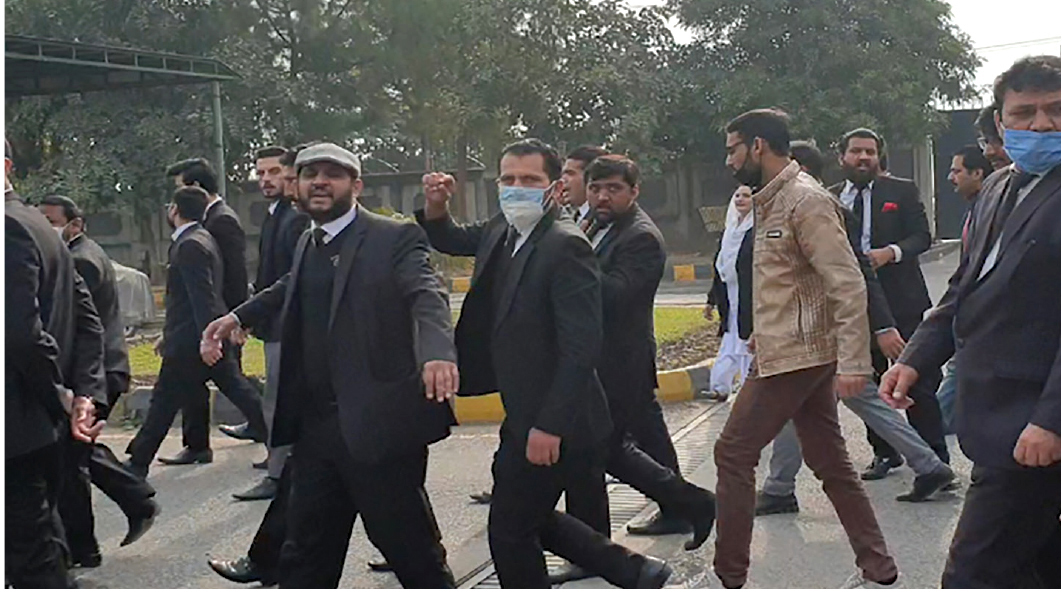
The rule of law acts as a sacred institution everywhere. Its application does not favour one man over another but rather no man is above the law; “Be you ever so high, the law is above you.” (as enunciated by Thomas Fuller). However, in Pakistan the term “Wukla-gardi” has been coined, mostly by the media, to describe the flagrant disregard for and continuous breaches of the law by its very guardians. Similar to smuggling, extortion, robbery, ghundagardi , etc., the term 'Wukla-gardi' has now a part of the common man’s lexicon. Just in a few years, the rampant hooliganism of the lawyers' community has become a new normal they are now seen as the most corrupt and thuggish elements of society, supposed-to-be professionals who are prone to violence, aggressive behaviour and even blackmail.
The term was first used in 2019 in the wake of the legal eagles besieging the Punjab Institute of Cardiology in Lahore and attacking doctors, other staff members and committing arson. In 2020, social media was flooded with “#Wukla-gardi” to illustrate the public’s disapproval of lawyers involved in celebratory open-air gunfire after the announcement of the results of the Punjab Bar Association office elections.
The actions of lawyers in the past should have foretold the nation of their actions on February 8, 2021. On this day, the entire legal fraternity was disgraced by the actions of some lawyers protesting against the demolition of their chambers by the Capital Development Authority (CDA) in Islamabad. This led the lawyers subjecting the Islamabad High Court to a tyrannical display of illegal actions by laying siege of the Chief Justice’s chambers, holding the Chief Justice in captivity for several hours, chanting slogans against the judiciary and seriously damaging public property.

In response, the Chief Justice of the Islamabad High Court, Athar Minallah addressed the encroachment of public property by lawyers in the case Ms. Shehnaz Butt v. Islamabad Bar Association and Others. The judgment began with a tribute to Quaid-e-Azam Mohammed Ali Jinnah, the Founder of Pakistan and a legal professional, as an exemplary model for an enrolled advocate. The judgment described the obligation of the lawyers of Pakistan to display high standards of conduct associated with the profession. Yet, it said, the “conduct of a few enrolled lawyers has caused reputational damage to the entire legal fraternity”.
The Chief Justice ruled that the demolition of the District Court must be carried out by the Bar Association and, if not, by the Capital Development Authority (CDA) by March 23, 2021. The judgment also mandated that the state provide a district court complex in Islamabad.
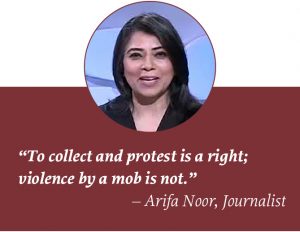 The frustration faced by the affected lawyers was understandable as it was no fault of theirs and their source of income was snatched. Yet, to entice and be part of a mob convicted for attacking a constitutional foundation, rested on democratic beliefs and protection of fundamental rights. After the attack, contempt of court proceedings were launched against some identified lawyers with charges issued under the Pakistan Penal Code and Anti-Terrorism Act. It was odd, though not surprising, that the Islamabad Bar Council, Islamabad High Court Bar Council and the District Bar Association called for the cases against the lawyers to be withdrawn. The lawyers’ belief that they were invincible and immune to the application of the law for the very reason they were versed in its application, was disappointing. The view that the law was malleable at whim undermined the paramount purpose for which it was designed. The ideology was intrinsically captured by the masses when they talked about Wukla-gardi.

The writer is a legal consultant and an animal rights activist. She can be reached at |
|
Cover Story
|
|
News Buzz
|
Update |
Leave a Reply