



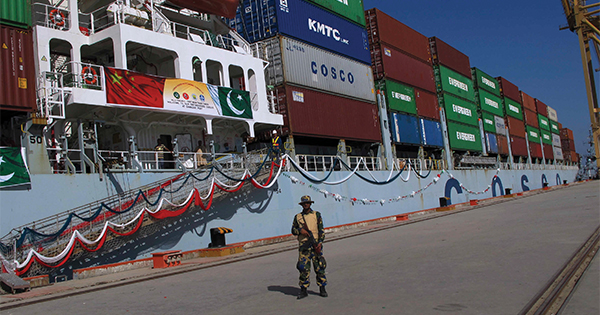
 The COVID-19 snowball has gathered a huge amount of diseased moss by visiting almost all nations on earth since it began rolling from Wuhan in December 2019. It has negatively affected all spheres of life and raised unprecedented challenges. As the nature, pace and scope of all businesses has been altered in near and longer terms, so have the Belt and Road Initiative (BRI) activities and their flagship project CPEC (China Pakistan Economic Corridor). The opponents of BRI and CPEC are criticizing these temporary alterations and trying to build a narrative that China’s dream of becoming an economic giant might topple and BRI-CPEC will never reach their completion. First and foremost, this is an irrational and non-justifiable argument. There is no stopping China’s progress and no closure of BRI and CPEC; rather, COVID-19 may further incentivize China to adopt a more collaborative model towards its BRI allies and CPEC beneficiary.
Since 2013, China has refocused its efforts on its global development strategy now known as BRI and formerly known as the Silk Road Economic Belt and the 21st-century Maritime Silk Road. This connects 70 countries in three continents. The very purpose of BRI is to enhance regional connectivity and embrace a brighter future. The western observers, mostly the Americans, British and their allies, say BRI will push Chinese dominance in global affairs with a China-centered trading network. Whatever the impact of COVID-19 on the global economy, BRI will remain a priority with the possibility that China may divert official attention and resources from BRI over the next 12 months or potentially longer for managing its in-house unsettling circumstances. This may mean reducing investments in BRI’s smaller, critical markets where there are limited opportunities to connect such investments to the global supply. Central Asia, sub-Saharan Africa and Eastern Europe will accordingly see a short-term dip in BRI related activity, relative to Southeast Asia, where supply chain linkages with China are stronger and investment returns more predictable.
Despite the challenges to manufacturing and supply chain activity, the pace of digital BRI activity has ramped up. There are abundant opportunities for a full digital value-chain for digital BRI activities from ICT companies to e-commerce platforms, comprising firms that are well established throughout the BRI geography such as Tencent, Huawei and Alibaba. Moreover there will be an actual fit for Chinese tech companies such as Tencent’s WeChat Work, Alibaba’s DingTalk and Huawei’s WeLink to attempt for market share outside China, particularly in the BRI region. The Chinese MedTech market is the third largest in the world, therefore the MedTech sector of China may also find opportunities abroad because, in the past few months, online medical consultation platforms (Alibaba Health, Ping An Good Doctor) have observed a considerable rise in online medical consultations. Similar technologies may be successfully implemented abroad if staffed by locals, given health sector shortfalls in many BRI countries. It seems that COVID-19 will supercharge the ongoing momentum of digital BRI activities or China’s tech industry.


The writer is a columnist and broadcast journalist. He teaches at UVAS Business School in Lahore and can be reached at mali.hamza@yahoo.com |
|
Cover Story
|
|
Tributes
|
|
Special Editorial Feature
|
|
News Buzz
|
Leave a Reply |
Update |
Well said sir.
CPEC project will play a vital role in Pakistan’s future development and hope it will form a strong relationship Pakistan and China. Our neighbor is providing protection aid to Pakistanis in such condition (covid-19). Pakistan’s respect for the Chinese government and their public will increase more.