

Dogs of War
Gun powder, nuclear weapons and now Artificial Intelligence. Weapons systems in advanced militaries around the world are moving into areas where war tactics will be taken over by robots.

Technological innovations represent an exponential change in the conduct of future wars. The rapid evolution and adoption of new technologies in the military sphere for several reasons is posing severe challenges in various forms. Artificial Intelligence (AI) is one area in the contemporary technology that militaries are heavily investing in. They are getting involved in a global arms race that could result in the gradual robotization and algorithmization of military operations. The initial invention of gun powder followed by the development of nuclear weapons brought first and second revolutions in warfare, whereas the use of AI is probably the third revolution.
Modern militaries are in pursuit of Lethal Autonomous Weapons Systems (LAWS) also known as robotic weapons or killer robots. They can work with minimal to no human intervention and can select and engage targets by themselves. They are considered as independent agents in the theatre of war which makes them even more dangerous for human beings if used against them. They have operational capability in the air, on land, on water, underwater, or in space. These intelligent and smart machines are perceived as a substitute for humans in the future.
These robotic weapons are categorized as human-in/on/out-the-loop, each having a distinct quality. Drones are mostly branded in the human-in-the-loop system because there is human involvement in their operations that are controlled by an operator via remote control, while autonomous weapons are often classified as out-of-the-loop systems as they select and attack targets without human control. At present, no fully autonomous weapon is deployed. However, semi-autonomous weapons have been developed by different states including the U.S.A, China, Russia, Germany, Israel, South Korea, Norway and the United Kingdom.
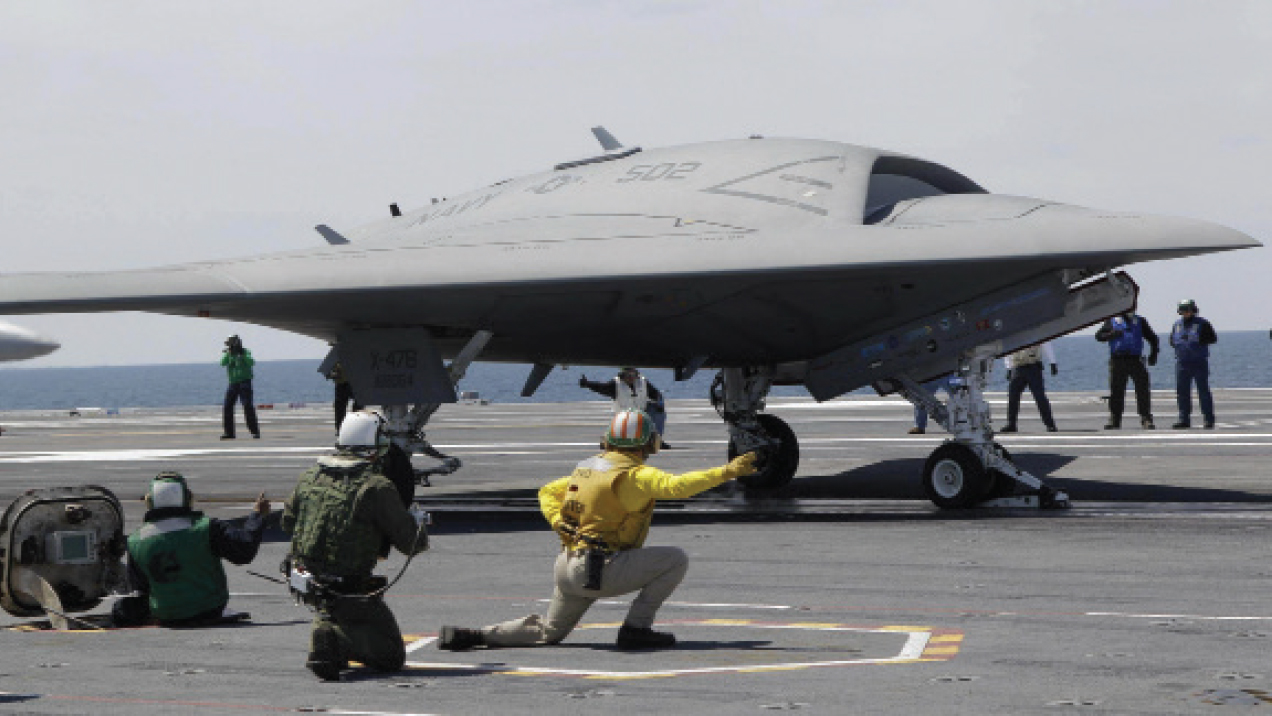
The use of land and naval mines are the earliest evidence of automatically triggered autonomous weapons. More contemporary examples of such systems include the US Phalanx Close-In Weapon System (CIWS), the Israeli Trophy and Iron Dome, Russian Arena-M, the German AMAP Active Defence System (ADS), UK’s Brimstone, the South Korean Harpy and Norway’s Joint Strike Missile (JSM). Although autonomous intelligence systems (AIS) are not fully developed but they have been incorporated in a few weapons. One is South Korea’s Samsung Techwin (now Hanwha Techwin) Company’s SGR-Al, the U.S. Navy’s X-47B and a few others.
The development in artificial intelligence and lethal robotic weapons primarily in the context of military, pose some security, ethical, legal and moral implications because they can destroy the enemy on a massive level. There is a bunch of intellectuals who believe that machines might be more ethical and are prone to lesser mistakes and are more productive than humans. Moreover, the biggest advantage for militaries regarding such weaponry is the result of less man casualties. However, many states and recognized international bodies believe that the effects of fully autonomous weapons could be much worse on humanitarian grounds as the target would be innocent people who are not part of the war. This is because robots lack situational awareness, contextual understanding and moral reasoning.
The technical aspects include malfunctioning, software coding errors, communication degradation and many others. One of the eminent risks revolve around the cybersphere that increases its possibility of being hacked, jammed, or spoofed. They tend to escalate the pace of war and ignite an arms race, therefore making it a security issue at large. One of the biggest political challenges regarding killer robots is the issue of accountability. Once these weapons are deployed, it will be hard to blame a military commander, the programmer, the manufacturer or the robot.
The development in artificial intelligence and lethal robotic weapons pose security, ethical, legal and moral implications.
Such issues drag the debate to the legal platform. The Protocol VI of the Convention of Chemical Weapons (CCW), along with the Arms Trade Treaty (ATT) and the First Additional Protocol of Geneva Convention 1949, supports the restrictions and banning of such lethal weapon systems. Apart from them, a separate treaty is required in the pre-emptive ban on killer robots to which more or less thirty states have shown their willingness in curbing the menace of LAWS (Lethal Autonomous Weapons Systems).
Pakistan has called for a ban on LAWS while China believes in a ban on the use of killer robots but not on their development. On the contrary, Russia and the U.S. have no interest in supporting the cause and they tend to legitimise killer robots. Not banning lethal weaponry may have national, regional and international implications. India is a key player in South Asia and in maintaining intricate relations with Pakistan, it considers the need for development of such weapons as this will help deterrence purposes and will increase strategic options in future missions.
The use of lethal weaponry in Jammu & Kashmir by India is a shred of evidence in itself. The U.S. and Russia are proposing a treaty against killer robots. But, in a way, this encourages India in its race towards robotic weaponry. Given Pakistan’s defence policy and its unique security situation in the region, the options regarding development of these weapons remain open as the induction of LAWS seems inevitable in the military strategy of major international players.
In a nutshell, with few advantages associated with killer robots, it is highly discouraging to opt for such technologies that pose a threat to humanity. There is a need for a separate treaty governing LAWS and an internationally recognized definition is the need of the hour. The South Asian region is highly influenced by the hegemonic designs of India. Its acquisition of such weapons will increase the arms race and will further disturb peace in the region.
The issue of LAWS, by taking all the members on board, must be discussed on multilateral platforms and a collective approach (rather than individual views) should be encouraged so as to highlight the effectiveness of the issue. Global transparency to create the stigma around LAWS, adequate resources and knowledge-sharing among the people will ameliorate regional stability.![]()
The writer is an M.Phil. Fellow in the Department of Defence & Strategic Studies (DSS), Quaid-i-Azam University, Islamabad. She can be reached at mubeen.0727@gmail.com |
|
Cover Story
|
|
Virus
|
Forum
|
|
News Buzz
|
Update |


Leave a Reply