
Art on Wheels
Flamboyantly coloured trucks, buses and rickshaws have become
prominent cultural symbols of Pakistan. The designs on each vehicle
are different in their own way.


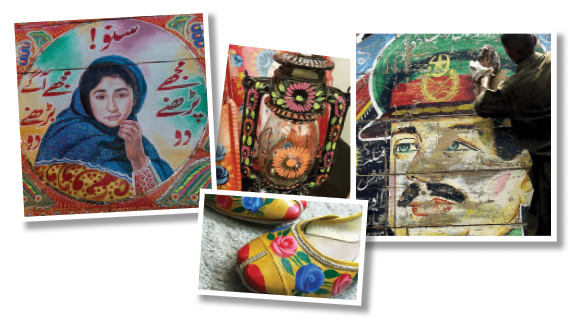
Truck art is becoming a popular art form in Pakistan and is pursued by the local transporters with diligence and pride. This is the reason why it is turning into a national identity. In the 1950s, when Bedford trucks were first imported in Pakistan, the trend of decorating these trucks started. The truck drivers would embellish their trucks with bells, patterns, drawings of animals and birds and portraits of their favourite leaders (Ayub Khan) or film heroes/heroines; attach wooden frames, write romantic couplets (of unknown rural poets), and paint various graphic motifs.
Decorated like brides, these trucks were used to carry goods within Pakistan or to Afghanistan. Due to the distinctiveness in choice of colours, motifs and rough brushwork lacking finesse and basic training, truck art gradually caught the fancy of people coming to Pakistan from the world over and it became Pakistan’s identity in Europe, America and other countries.
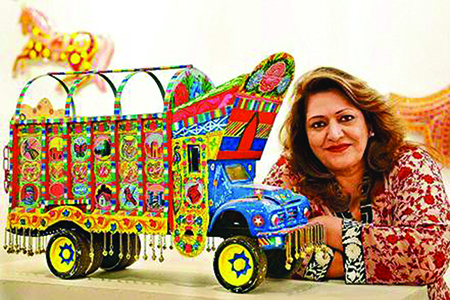
One person who has done wonders to popularize Pakistan’s truck art form is Anjum Rana. She has an eye for the extraordinary in ordinary everyday life. She has made it her goal to bring this art into the mainstream, into homes, and give it the recognition it so richly deserves. It is her discerning eye that has always made her appreciate what most of us dismiss or even ridicule or take for granted.
Anjum has employed master truck painters and directs them in painting their richly textured motifs on everyday objects such as kettles, lanterns, oil-lamps, boxes garden furniture, walls, fans and object d’art.
Truck owners, drivers and artists spend a lot of time working on the trucks and buses, embellishing them profusely before taking them out on roads. Every brush stroke is nimble and detailed and shows the love and devotion of the artists. The colour theme and imagery is the magnetism of this art. It’s usually drivers from the north of Pakistan who decorate their trucks with vibrant artwork comprising red and blue and flashy orange as they catch the eye and make the vehicle ever more attractive. It usually takes an artist around 20 days to cover the truck with paintings. But this depends on the kind of paintings and textures the owner wants. The real beauty of truck art has more impact at night when the beautiful vibrant colours glow! The truck artists spend a lot of time to learn the drawing and painting techniques from the masters who have excelled before them. From the side petrol tanks to the truck body, there is no space left uncovered by the painted art.
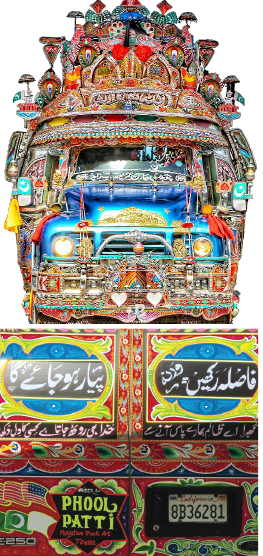
The body parts of the truck are given names by the truck drivers. The front top part of the truck is called taj (crown) that is shaped like a crown, the windscreen is called matha (forehead) while the bonnet is known as lips.

Regrettably, most people in Pakistan have failed to notice the beauty of truck art and that is why it was neglected in the past. When artists from Pakistan went abroad in the 90s, they realized how the genre was praised and was flourishing in western countries. Iftikhar Dadi and Durriya Kazi were the ones who promoted the country’s truck art abroad. Kazi did a lot of work to promote truck art and made people recognize the genre as a local art form of Pakistan. Gradually it became the identity of Pakistan around the world.
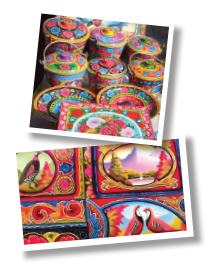
There are two famous groups who are currently working on truck art - Phool Jee and Phool Patti. These groups are the ones who have brought out the best in truck art for the world by keeping to the traditional style and originality of the art.

Haider Ali, a famous truck artist who owns Phool Patti, has been working for 28 years to promote truck art. The verses and poetry written on the trucks may not seem in very good taste but these lines hold true sentiments and reflect personal stories of the truck artists.
These painters are not considered ‘artists’ but artisans although a lot of truck artists have diplomas in painting and have been learning the skills since they were small. Perhaps the only difference between most regular artists and a truck artist is a degree.
Truck art has always been considered ‘cheap’ and the ‘art of the poor’ and perhaps that is why it has never created the ‘wow’ effect as the trucks and buses are run by the ‘unsophisticated’.
A few truck art workshops have been held in recent years by such non-profit non-government organizations as Alliance Francaise de Karachi. Syed Munawar Ali, an artist and art activist, says that truck art is flourishing in Pakistan on its own and without any government support. I personally belong to a group that has been doing truck art on the walls of Karachi in different projects like 'Re-imaging the walls of Karachi'. The purpose was to make the world understand the power of this local art form and invite companies to become involved.
At the Islamabad Airport, truck art has been presented on the walls in the baggage claim area which is striking to the people who never thought that truck art could reach this far. This is the hard work and struggle of many truck artists and craftsmen. Now truck art is also seen on clothing brands, jewellery, shoes and furniture.
There is also the fear that it may become too commercialized and lose its traditional style. There is already a change visible in the art style on trucks and buses. Truck artists now don’t work much on fancy decorations and are gradually converting to a modern style.
A lot of people are utilizing truck art in focusing on social issues. For instance, truck art has become a fascinating way of culturally raising awareness about social issues in Pakistan. Messages relating to life values, particularly from a female perspective, which are often not in the limelight, have been displayed positively on trucks. Many trucks in Pakistan now showcase floral patterns with bright colours, poetry lines, and women empowerment messages. As it is, truck art in Pakistan is well-known for its traditional patterns and colours.
Samar Minallah, a film-maker and anthropologist, is currently working on spreading awareness about social issues, especially related to children and women by changing the truck’s rear images from celebrities to girls holding books and looking hungry for education. Samar has been actively driving the project to replace the celebrities with other positive messages.
This also shows that there is a lot of room in truck art to create new styles and portray messages. This change in imagery and style is welcome as it is helping connect truck art with the public as well as helping in gaining cultural and social attention.
Truck artists take pride in calling their art a local art form but lament that the art and artists do not have international recognition and lack government facilitation.![]()
The writer is a free-lance journalist. She covers a range of subjects including art, culture, entertainment, travel and women’s rights. She can be reached at |
|
Cover Story
|
|
Virus
|
Forum
|
|
News Buzz
|
Update |


Leave a Reply