



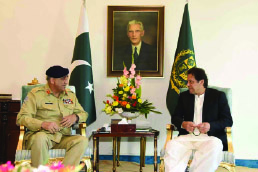
Pakistan has experienced military rule many times likes several African and Latin American countries. The debate about civil and military rule and causes of the failure of democracy in Pakistan are as old as Pakistan. A view is held by group that people in Pakistan lack the genius required for democracy and therefore, either ‘controlled democracy’ or a ‘good dictator’ are required to bring peace and stability that will lead to prosperity. The basis for this view seems to be the turbulent years of the early fifties of the last century when the political leadership in Pakistan failed to frame a constitution in seven years (1947-1954). This created distrust in democracy. The late Chief Justice Muhammad Muneer in his judgement on the dissolution of the Constituently Assembly (1954) made a reference which sounded like an indictment against politicians. The existential threat from India also contributed to this view, which urged for a strong and stable government in Pakistan to meet challenges. The short democratic experience from 1947 to 1958 was not very assuring. The biggest defence of democracy is its success. That was lacking.
It is clear that Muhammad Ali Jinnah, the founder of Pakistan, and the Muslim League, which led the Pakistan Movement, were clear in their vision of the future setup in Pakistan. Jinnah’s speech in the Constituent Assembly on 11 August 1947 articulated the salient features of the political future of Pakistan and its constitutional framework. The constitution-making process for the new republic as mandated under the Indian Independence Act, 1947 and the arduous process that followed and intrigues and debacles it faced, bears witness to the fact that the road leading to a democratic Pakistan was not very smooth. Moreover, the assimilation of Islamic ideology and western liberal values were hard to put in a constitution. Their conflict was inevitable as both reflected different sets of values and civilizations. It has been a constant problem in the constitution-making process in Pakistan. Subsequent events and experiments and the history of democracy and civilian rule only strengthened the disbelief in democracy.
The state of Pakistan remains under a constant threat from its neighbour. The ‘establishment’ in Pakistan, which claims to be the guardian of its ideological and physical frontiers, is unwilling to trust the political leadership whose corruption and incompetence cannot be overlooked in view of the apparent evidence of their wealth and lifestyle. Apart from the external threats, there have emerged internal dangers from the extremist forces that have animus for the state. The failure of the civilian institutions to address the grievances of the masses, unending economic crises and the burgeoning foreign debt only add to the gloomy future of a constitutional rule and democracy in Pakistan.
The disbanding of civilian governments and military interventions have been a repeated saga. The constitutional and democratic ideals and political realities remain in conflict. The legal order in Pakistan, however, despite these interruptions and deviations, remains fully rooted in the grund norm of parliamentary democracy. The military rule, howsoever, stable and benign it may be and the prosperity and economic wellbeing it may bring, the afore-referred grund norm was founded in the social contract arrived at in 1973 in the form of the Constitution of Pakistan and agreed upon by the political leadership from all the provinces and areas. It remains the hallmark of the political history of Pakistan and it keeps kindling a hope for a bright future. A constitution is a political document and it is usually the result of compromises. This is also true of the Constitution of Pakistan. But the salient and basic features of the Constitution are identifiable and parliamentary democracy stands out as its most distinguishing feature.


The writer is an advocate of the Supreme Court and former additional attorney general of Pakistan. He holds an LL.M. degree from Harvard Law School and is the co-author of a book ‘Comparative Constitutional Law.’ He can be reached at mwaqarrana@yahoo.com |
|
Cover Story
|
|
One-on-One
|
|
News Buzz
|
Update |
Leave a Reply