



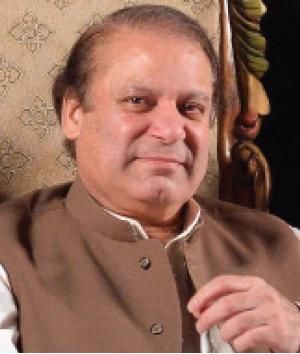
 Mian Nawaz Sharif is back at the helm of the Pakistan Muslim League-Nawaz (PML-N) after spending seven years in the political wilderness since his disqualification by the Supreme Court of Pakistan in August 2017 in the wake of the scandalous Panama Leaks’ revelations that disgraced and dethroned many leaders all over the world. In the case of Nawaz Sharif, will his bid for political rehabilitation pay off in the current daunting politico-economic conditions that remain to be seen? However, the PML-N, with its political fortune at its lowest ebb, cannot find a more able leader and unifying figure like him.
The political career of Sharif Senior has seen many highs and lows since his introduction as Finance Minister in his provincial administration of Punjab by General Jilani in 1982. Under the shadow of Gen. Zia-ul-Haq, he leapfrogged to the chief ministership of his province as a result of the non-party general elections of 1985. The establishment continued to patronize him in the subsequent years as Prime Minister Muhammad Khan Junejo had taken defiant stances on many political issues to the annoyance of Gen. Zia-ul-Haq. Precisely for these reasons, Mr. Sharif chose to cold-shoulder Prime Minister Junejo.
The return of Benazir Bhutto from exile to a mammoth public welcome in Lahore in April 1986 created ripples in the muddy waters of Pakistani politics. Since the Junejo regime had relaxed the restrictions on political activities after lifting martial law, Benazir travelled freely in the country to the jubilant welcome of big adulatory supporters, building pressure for fresh elections. Gen/ Zia-Ul-Haq looked at the developing political scenario with trepidation. He was not enamored with democracy and noisy political activities that may have posed a formidable threat to his authoritarian regime.
The differences between Gen. Zia and his handpicked prime minister came to a head-on collision following the signing of the Geneva Accords between Islamabad and Moscow and the appointment of a high-powered Commission by Mr. Junejo for investigation into the Ojhri Camp accident. In May 1988, Gen. Zia, exercising the powers vested in him by the 8th Amendment, dismissed the Junejo regime and dissolved all the Legislative Assemblies. Given his track record, no political leader was hopeful for elections soon. However, this fast-changing political scenario did not impact the political position of Mian Nawaz Sharif, sitting on the right side of the fence and well-lodged in power.
He felt the unsettling shock for the first time when Gen. Zia perished in a plane crash in Bahawalpur in August 1988. The veteran bureaucrat-turned-politician Ghulam Ishaq Khan took over as the acting President and announced elections in November 1988. At that time, Benazir was at the peak of her political popularity. The Establishment put all its eggs in the basket of Mian Nawaz Sharif; the Islami Jamhoori Ittehad (IJI) was hurriedly put in place thanks to Islamist General Hamid Gul and his team and an intense campaign of vicious propaganda against the Bhutto ladies unleashed. The PPP emerged victorious with the largest number of National Assembly seats. However, it failed to secure a simple majority in the Punjab Assembly.
The independents in the Punjab Assembly were holding the decisive balancing vote. The PPP cobbled a coalition with the erstwhile Mohajir Qaumi Movement (MQM) in the centre. However, it failed to win over the independents in Punjab because of the infamous Changa Manga adventure. This generated a new political game of musical chairs, alternating political power between these two young leaders directed behind the scenes by the powers that be. The musical chair by the takeover by General Pervez Musharraf in October 1999 and the ensuing arrest of Mian Nawaz Sharif. He was tried for hijacking the PIA plane in the air and endangering the lives of the army chief and other passengers onboard. He was sentenced to life imprisonment. Later, due to a deal brokered by a friendly country, the entire Sharif family was allowed to go into exile.
Mian Nawaz Sharif came to power again, becoming the country’s Prime Minister for the third time after winning the controversial elections of 2013, which triggered the political sit-ins of August 2014. Though Mian Nawaz Sharif always ascended to power at the back of the Establishment, he never had a functional relationship with army chiefs - from General Asif Nawaz Janjua to Abdul Waheed Kakar, Jehangir Karamat, Pervaiz Musharraf, Raheel Sharif, and Qamar Javed Bajwa barring Ashfaq Pervez Kiani. After signing a deal with Benazir Bhutto, which was brokered by the then U.S. President George W. Bush Jr. and U.K. Prime Minister Tony Blair, General Musharraf paved the way for Benazir’s return to the country in October 2007. The move also compelled Mian Nawaz Sharif to end his exile and return to Pakistan.


The author is a former member of the Foreign Service of Pakistan and has served as Ambassador for seven years.
Leave a Reply