



When I ask Ibrahim about the most heart-wrenching memory he finds hard to push aside, he narrates in a solemn tone the desperate and hauling efforts of a pregnant woman searching for a hospital to deliver her child but she unfortunately suffered a stillbirth. “It was a beautiful baby”. He couldn’t help mournfully glancing at the little body placed in a carton which he carried in his car for burial.
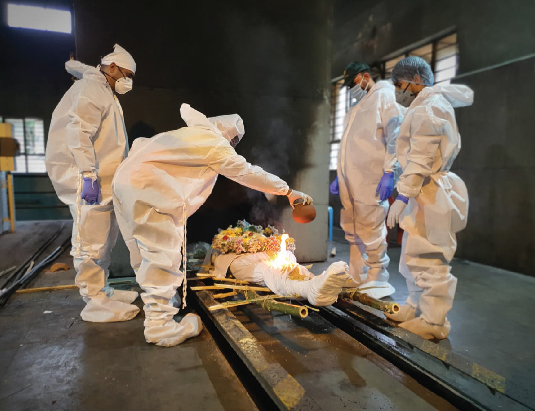
Though the pandemic unleashed monstrous fear and misery, it has also opened floodgates of compassion and magnanimity that have been brought people together in the fight to crush the virus-annihilating lives ceaselessly. Mohammed Ibrahim Akram, a business graduate and owner of a chain of restaurants in Bangalore, has been juggling his time and resources since last year to ensure people dying of Covid-19 are consigned to the grave with respect. Having witnessed innumerable demises, he writhes in pain as he talks about the dreadfulness which now accompanies death. “Earlier people used to cry when they lost a loved one, now they are pushing away the bodies fearing the virus.” He laments that families abandon their aged parents who test positive as they feel scared of contracting Covid-19. He too had tested positive, but that does not deter him from the service as he moves around the city in his car-turned ambulance, wearing a mask and carrying a bottle of sanitizer.
 Working as a volunteer for Mercy Angels (see box), Ibrahim in his mid-forties and a father of three kids, feels the service of sending people on their final journey exemplifies the true spirit of humanity and secularism. “It is a duty that must be performed irrespective of the religion of the person - we bury, we cremate with all due solemnity.” He illustrates the statement with his experience of performing the last honours of a Hindu boy from West Bengal who had no relatives in Bangalore. “They sent a letter with instructions and I hired a priest to carry out the ceremony.” Ibrahim later carried his ashes to Arkavathi River, about fifty eight kilometres away from Bangalore for immersion as lakes within the city were closed due to the lockdown.

The author is a freelance writer based in Bangalore. She can be reached at shazmanshariff@gmail.com
Leave a Reply