



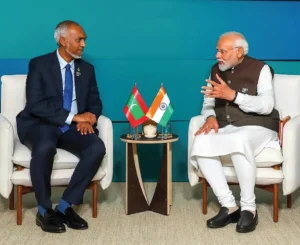
 India’s geopolitical aspirations have long been intertwined with its neighboring nations, particularly the small island nations in the Indian Ocean. One such instance is India’s strategic interests in the Maldives, where it has maintained a hegemonic presence to exert influence in the garb of safeguarding its economic and security concerns. Nevertheless, as of now, the echoes of concern over India’s diminishing influence in South Asia have become increasingly audible.
India’s historical ties with the Maldives can be traced back to ancient times, marked by cultural, economic, and maritime connections. However, the shift in dynamics gained momentum during the Cold War era when geopolitical rivalries shaped nations’ strategic objectives. In its pursuit of regional dominance, India sought to establish a strong presence in the Indian Ocean, ostensibly on the pretext of global trade and security. India’s presence in the Maldives has been driven by maintaining meaningful control over crucial sea routes in the Indian Ocean rather than anything else.
In recent years, India has been wary of China’s increasing influence in the Indian Ocean region. By maintaining a hegemonic presence in the Maldives, India aims to counterbalance China’s expansionist efforts and prevent its encroachment into what India considers its sphere of influence. The Indian Ocean, being a vital conduit for global trade, propels India to capitalize on its advantageous position. Dominating the Maldives provides India with a vantage point to not only monitor but control key maritime trade routes while at the same time ensuring the free flow of goods and securing its economic interests.
India’s attempts to assert dominance in the Maldives are fraught with strained diplomatic relations. The perceived interference in the internal affairs of the Maldives has led to tensions, challenging the delicate balance between sovereignty and regional influence. India’s strategic moves have not gone unnoticed by China, which views the Indian Ocean as a key arena for its Belt and Road Initiative. The competition between India and China for regional influence has escalated, contributing to a complex geopolitical landscape. The hegemonic presence of a larger neighbor can evoke resentment among smaller nations. In the case of the Maldives, India’s actions have been met with mixed reactions, with concerns raised about sovereignty and the potential for economic dependence.
Indian military installations in the Maldives, such as the radar systems on certain atolls, have raised concerns about India’s intentions. While officially stated as collaborative efforts to enhance maritime security, some perceive these moves as attempts to establish hegemony in the region, potentially impacting the sovereignty of smaller nations.
The recent demand from the Maldivian government to withdraw Indian military forces has added a new dimension to regional dynamics. This call reflects the Maldives’ desire to assert sovereignty and pursue an independent foreign policy. The move can be seen as a response to growing concerns about being drawn into the power struggles between larger nations in the region.
The evolving situation in the Maldives has repercussions for Pakistan, particularly in terms of regional alliances and strategic balance. Indian strategy makers, however, think that if India complies with the withdrawal request, it could create a power vacuum in the Maldives, potentially opening doors for other external actors to establish their influence. Alternatively, if India maintains or strengthens its presence, it may lead to heightened regional tensions, prompting smaller nations to seek alliances to counterbalance India’s dominance.
Pakistan must adopt a cautious and pragmatic approach in response to these developments. Islamabad should better prioritize diplomatic engagement with India and the Maldives to understand the motivations behind the recent call for withdrawal. Strengthening bilateral ties with the Maldives can allow Pakistan to build trust and offer support based on shared economic and strategic interests.


The writer is a historian and a critical analyst. He can be reached at arslan9h@gmail.com
Leave a Reply