

Interview
‘Writers across cultures have often faced the challenge of preserving their authentic voice against censorship, distortion, manipulation, or pressure to conform.’
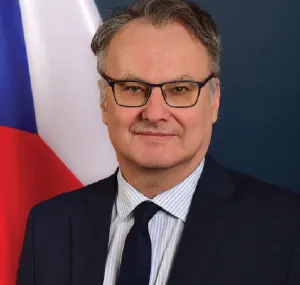
Dr Tomáš Kafka, Director of the Central European Department at the Ministry of Foreign Affairs of the Czech Republic, talks to SouthAsia Magazine in this exclusive interview with Mariam Khan.

In a world riddled with conflicts, can literature offer a worldview, allowing us to peek through a fictional keyhole to help build a world of peace? What power does literature hold in today’s political climate? Can literature become a space where those who hold power encounter characters who mirror them—and perhaps laugh at or even detest those mirror images?
In this exclusive interview with SouthAsia, Dr Tomáš Kafka, Director of the Central European Department at the Ministry of Foreign Affairs of the Czech Republic, talks about how literature shapes political imagination and civic resilience at a moment of global democratic backsliding, and how it preserves an unmanipulated collective memory in times of censorship.
SouthAsia: Do you believe literature still possesses the power to shape societies, or has that influence been eclipsed by social media and the 24-hour news cycle?
Dr Tomáš Kafka: Literature, unlike the other genres mentioned above, fulfils a rather different function. This does not necessarily make it more relevant, but it certainly makes it unique. Its primary domain is the human imagination. Imagination is, of course, not the only characteristic that distinguishes human beings as a species, yet without it, much of what we are and what we do would lose its meaning. In the context of the current, fervent debates about whether AI may eventually eclipse human-written texts, it is worth emphasizing that human imagination serves not only to make sense of the world around us. It also enables us to create nonsense, to play with ideas, and to make fun of the things that surround us. This capacity is, at least occasionally, of great importance for our understanding of both the world and our own lives.
SouthAsia: You recently wrote that literature and art ‘should not moralise’ but instead ‘help us find the right perspective from which to continue our efforts’. Could you expand on this?
Dr Tomáš Kafka: In response to this question, I would like to quote our former president, Václav Havel, who once said that hope is not the conviction that something will turn out well, but the certainty that something makes sense, regardless of how it turns out. Literature should play the role of an engine, or at least the fuel that keeps this engine running in our minds and hearts. It should prevent us from giving up, even when the prospects of a happy ending, whether in private life or in politics, seem exceedingly remote. Moralising cannot help us in such situations. Ultimately, everything depends on us and on the way we choose to engage with the world around us. Literature cannot solve our problems, but it can help us appreciate this world a little more deeply than the routines of everyday reality often allow. It can help us to overcome our disillusionment.
SouthAsia: You also spoke of ‘political nostalgia’ being as dangerous as any other form of nostalgia. How can literature help societies resist that nostalgia without asking them to abandon hope or memory altogether?
Dr Tomáš Kafka: Speaking of nostalgia as a danger is, of course, somewhat of an exaggeration. For my part, I tend to be quite nostalgic myself. Yet my own experience has taught me that nostalgia, if allowed to run free and remain unchecked, can distort our perception of future opportunities and sometimes even paralyse our willingness to engage with the world as it is. We should therefore treat nostalgia with the same caution that we now apply, for example, to sugar. Both are delightful in moderation, but both can become harmful when consumed in excess.
SouthAsia: History offers many examples of literature challenging authoritarianism. What makes literature uniquely capable of resisting political power in ways that journalism or political discourse sometimes cannot?
“Literature undoubtedly helps us gain and maintain a critical distance from political doctrines of all kinds.”
Dr Tomáš Kafka: Literature undoubtedly helps us gain and maintain a critical distance from political doctrines of all kinds. In this respect, it resembles democracy. Both literature and democracy create a space in which, drawing on their respective capabilities, we can laugh not only with those who hold power, but also at them. This ability is particularly important, of course, when political leaders lose their sense of proportion, perspective, or self-awareness.
SouthAsia: You have spent much of your career in diplomacy while also engaging deeply with literature. How have these two worlds informed one another in your professional life? Has literature made you a different diplomat?
Dr Tomáš Kafka: Diplomacy is too important to be taken only seriously, to paraphrase Oscar Wilde. In my own case, literature has been an invaluable companion and guide throughout my diplomatic career. It has helped me navigate the world without becoming trapped by an exaggerated sense of my own importance.
SouthAsia: Governments often speak of culture as an instrument of soft power. In your view, where does literature fit within contemporary diplomacy?
Dr Tomáš Kafka: They surely can. The only caveat raised by this question is how many novels, collections of poetry, or essays will still be read in the future. The competition posed by other media is indeed formidable and, at times, quite intimidating. Yet the relationship is not a one-way street. The role of literature in the future will depend not only on the willingness of readers to engage with it, but also on the quality of what will be written. But only fools will give up on their hope, especially as we know what hope, according to the former president Havel, is about.
SouthAsia: Political systems often seek to shape collective memory, while writers frequently preserve uncomfortable truths. How important is literature in protecting historical memory against revisionism or political narratives?
Dr Tomáš Kafka: Literature is, of course, also important when it comes to preserving genuine, unmanipulated collective memory. It helps us resist individual oblivion and meaningless ignorance. Yet the struggle against those proverbial black holes that swallow our memories and erase our understanding of the past should not be entrusted primarily to works of fiction. Literature cannot be a front-line force in this regard. The main responsibility lies with non-fiction writing and especially with journalism.
SouthAsia: South Asia has its own rich tradition of literature that has challenged colonialism, dictatorship, religious extremism, and social injustice. Do you see parallels between the experiences of Central European writers and those of writers from South Asia?
Dr Tomáš Kafka: I am unfortunately not sufficiently versed in South Asian literature to offer a strong opinion on the subject. However, I am convinced that the experiences of authors in Central Europe are anything but unique. The historical circumstances and the forms of expression may differ from one region to another, yet the essence remains remarkably similar.
Writers across cultures have often faced the challenge of preserving their authentic voice against censorship, distortion, manipulation, or pressure to conform. They may, of course, fail. But Samuel Beckett famously wrote: ‘Ever tried. Ever failed. No matter. Try again. Fail again. Fail better.’ That should serve as an imperative for every genuine author.
SouthAsia: If you were to recommend one book, or one writer, that best captures why literature remains politically relevant today, what would it be, and why?
Dr Tomáš Kafka: I would recommend Ian McEwan’s novel What We Can Know. With this book, McEwan makes a convincing case for literature to help people like this world more than they may otherwise be willing to. It actually provides the best illustration of all the thoughts I have been privileged to share with you in this interview.
SouthAsia: Has there been a novel, poem, or play that changed your own understanding of politics?
Dr Tomáš Kafka: It may not be a single poem or novel that has influenced me most. Rather, I would speak of an attitude embodied by the late German poet and publisher Hans Magnus Enzensberger, which has left a lasting impression on me and shaped my perception of both politics and literature. Enzensberger was often regarded as a kind of guru of postwar German culture. Regardless of which intellectual or political trend happened to dominate the zeitgeist, even when those trends appeared mutually exclusive, he always found a way to make the best of what was on offer. In one interview, he reflected that his success might have stemmed from his ability not to be overly or exclusively serious. His capacity to observe himself from a certain distance helped him weather the worst excesses and illusions of his time. Perhaps this is a lesson for all of us: not to take ourselves too seriously. We can leave that privilege to others. If they feel the need, they are welcome to take us seriously.
SouthAsia: Can literature prevent conflict, or does it mainly help societies make sense of conflict after it occurs?
Dr Tomáš Kafka: It is hard to say. Your question reminds me of an old joke about a young English gentleman who was generally believed to be mute until, one day, he complained that his soup was not properly seasoned. Can literature prevent conflicts, or is it only capable of helping us make sense of them after they have already broken out? Perhaps the future will surprise us and present literature as the perfect troubleshooter. For the time being, the soup was salty enough.
SouthAsia: If Václav Havel were writing today, what do you think he would be writing about?
Dr Tomáš Kafka: I can only hope it would be something funny. We should not forget the hymn composed by the British comedy group Monty Python: ‘Always Look on the Bright Side of Life.’
The writer, who is based in Karachi, is a communications professional and a dedicated UN Volunteer. Feel free to reach out to her at mariaamkahn@gmail.com.


Leave a Reply