



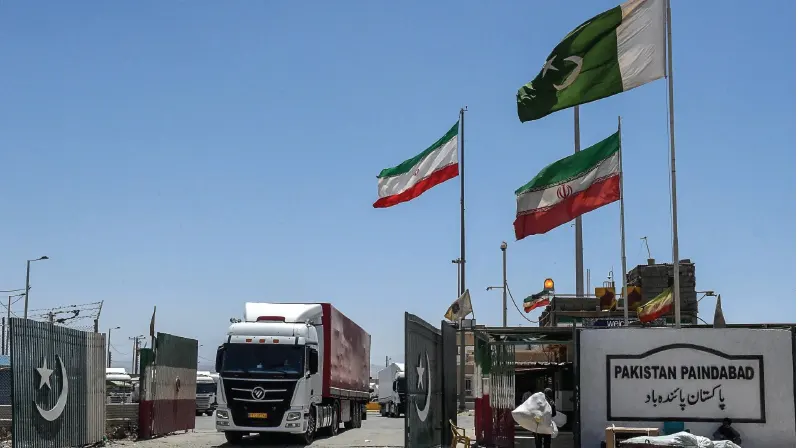
The first truck that recently departed Karachi for Tashkent was carrying frozen meat. But the route it opened is carrying something far heavier: Pakistan’s ambition to place itself at the centre of a new Asian trade geography, one built on proximity, diplomacy, and infrastructure rather than aspiration alone.
The operationalisation of the Pakistan-Iran-Central Asia transport corridor marks one of the most consequential connectivity developments in the region in years. Combined with the expansion of the China-Pakistan Economic Corridor (CPEC), renewed ceasefire diplomacy in the region, and rapidly growing trade engagement with Central Asia, Islamabad is signalling a clear strategic direction, positioning Pakistan as the linchpin of South-to-Central Asian trade connectivity.
For decades, Pakistan’s location was viewed largely through a geopolitical and security lens. Today, policymakers increasingly seek to transform that geography into an economic advantage linking South Asia, China, Central Asia, and the Middle East through an interconnected logistics network.
The question is whether this vision can overcome the substantial political, technical, and economic obstacles that have historically undermined regional integration projects.
Pakistan is now operationalising two parallel connectivity corridors simultaneously, one through China’s western region and the other via Iran, both increasingly presented as more reliable and scalable alternatives to the uncertain Afghan transit routes.
To the north, Islamabad is leveraging improved infrastructure under CPEC and expanded year-round access through the Khunjerab Pass to connect with Kyrgyzstan, Kazakhstan, and Tajikistan via China’s Xinjiang region. Officials argue that routes towards Bishkek and Almaty are not only shorter but also significantly more secure and predictable than traditional Afghan transit pathways, which have long been disrupted by instability and border closures.
The Chinese corridor benefits from comparatively modern infrastructure, streamlined customs systems, and deeper institutional coordination with Beijing. More importantly, it expands the commercial logic of CPEC beyond a purely bilateral China-Pakistan framework and transforms it into part of a broader Eurasian connectivity architecture.
On Pakistan’s Western flank, the activation of the Gabd-Rimdan border crossing with Iran in April 2026 has created a second operational corridor extending toward Turkmenistan and Uzbekistan. The first shipment towards Tashkent has already been dispatched, formally launching the Iran route.
Although routes through Iran may, in some cases, involve marginally longer distances than transit through Afghanistan, officials emphasise that consistency, lower insurance premiums, and reduced cargo risk make the corridor more cost-effective in practice. In modern logistics, predictability often matters more than theoretical speed.
Taken together, the Pakistan-Iran Corridor, CPEC’s expansion, ceasefire diplomacy, and growing Central Asian trade volumes point to a single strategic objective: Pakistan’s attempt to reposition itself from a security-centric state into a regional trade and logistics hub.
This shift reflects a broader transition in Pakistani foreign policy thinking, where geo-economics increasingly complements, and in some areas supersedes, traditional geopolitical calculations.
This strategy is rooted in a simple reality. Central Asia is searching for diversified access to global markets. China seeks stable Western trade routes. Iran wants to strengthen its role as a Eurasian transit state despite sanctions pressure. Meanwhile, Pakistan requires regional integration to expand exports, attract investment, and sustain long-term economic growth.
In this evolving equation, Islamabad sees itself not as a peripheral actor but as the connective bridge linking multiple regions.
The significance of these corridors extends beyond bilateral commerce. If effectively integrated, Pakistan’s routes to China and Iran could eventually connect several major regional initiatives into a unified Eurasian logistics framework. CPEC already links western China to Gwadar and Karachi, while Iran remains central to the International North-South Transport Corridor, which connects South Asia to Russia, Central Asia, and Europe.
A functioning Pakistan-Iran-Central Asia corridor could therefore bridge South Asia, the Middle East, western China, and Central Asia into a more coherent trade system stretching across Eurasia. For Central Asian republics, this diversification is strategically important. Landlocked states such as Uzbekistan and Tajikistan have long sought alternatives to dependence on Russian infrastructure or unstable Afghan transit corridors. Pakistan’s ports offer a potentially valuable southern outlet to global markets.


The writer is an Associate Research Fellow at the Sustainable Development Policy Institute (SDPI). He can be reached at asifjaved@sdpi.org
Leave a Reply