



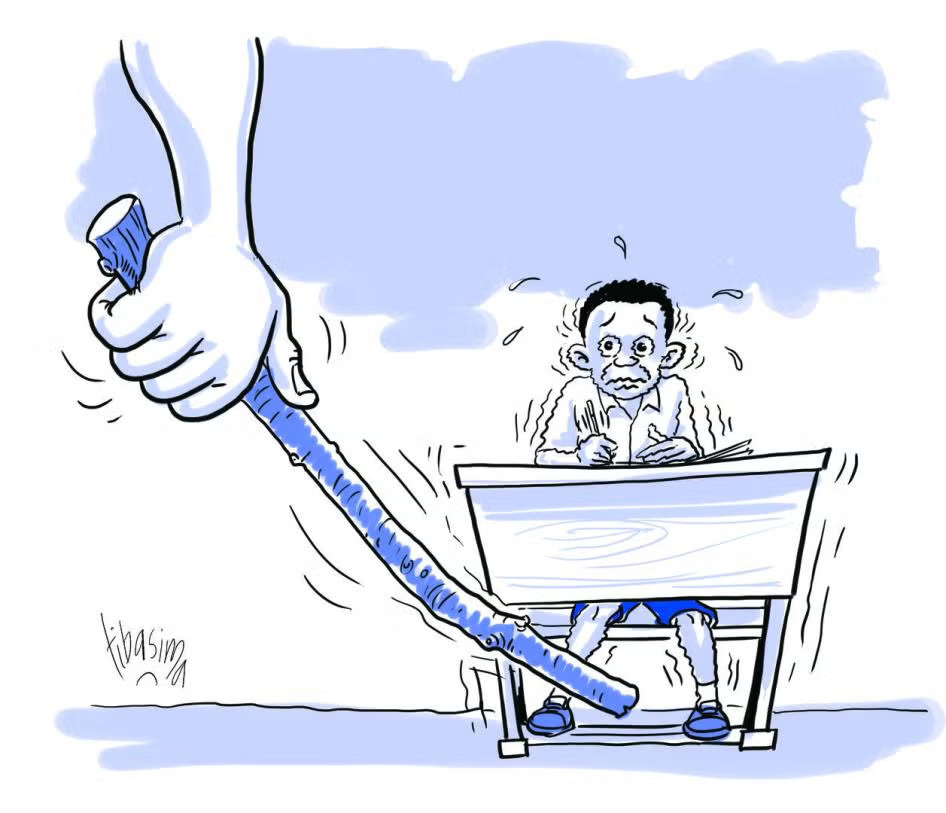
Well-known, experienced writers have written several articles on corporal punishment in these pages. Many writers have offered thoughtful recommendations on how to bring corporal punishment to an end permanently. However, the concerned departments have yet to take meaningful action, leaving this serious issue unresolved.
It is a fact that, along with having harmful effects on children, corporal punishment also contributes to a large number of children dropping out of school. Muhammad Zain-ul-Abidin from the Criminology Department at the University of Sargodha cautions against the frequency of corporal punishment in schools. According to him, "Recent research conducted by one of my students revealed that pupils are still caned by teachers in some schools to maintain classroom discipline. However, this can cause immense physiological damage to the child, so it should be totally outlawed through proper legislation and an effective implementation mechanism."
The scribe still vividly remembers a teacher physically punishing a student at Larkana Cadet College about five to seven years ago. The student received such a severe thrashing that he had to remain in a hospital bed for two and a half months because his condition deteriorated further afterwards. As a result, he was taken to Karachi and then to America for proper treatment. Even though the incident was highlighted in different newspapers, no concrete steps were taken. The medical reports of the boy stated that his jugular veins had been severely damaged, due to which he was unable to hold his neck.
This clearly shows the severity of the punishment the affected student may have endured. Undoubtedly, corporal punishment is not a rare occurrence in Pakistan. Many such cases make headlines almost every week or month, yet the concerned authorities have made little to no attempt to enact proper laws or strengthen existing ones to prohibit physical punishment of students.
However, existing laws have several loopholes. For instance, Section 89 of the Pakistan Penal Code allows for the use of physical punishment; it encourages parents, guardians, and teachers to physically chastise children. Although the Islamabad High Court (IHC) has suspended Section 89 of the PPC, provinces have not followed suit yet. These provisions need to be homogenised across all four provinces if Pakistan truly wishes to adopt a cohesive framework aimed at eradicating all forms of punishment.
Problems and confusion arise when provisions vary from region to region. Article 33 of the Khyber Pakhtunkhwa Child Protection and Welfare Act 2010 says, "Corporal punishment stands abolished in all its kinds and manifestations and its practice in any form is prohibited as provided under section 89 of Pakistan Penal Code, 1860." On the other hand, Article 35 of the Punjab Destitute and Neglected Children Act 2004 states, "Provided that where some punishment is administered to a child by the person having lawful control or custody of the child, for any good or sufficient reason, it shall not be deemed to be an offence under this section."
The Islamabad Capital Territory (ICT) and Sindh promulgated the Capital Territory Prohibition of Corporal Punishment Act, 2021 and the Sindh Prohibition of Corporal Punishment Act in 2016 to prohibit corporal punishment in all settings, including educational institutions, child care institutions, rehabilitation centres and the Juvenile Justice system. In 2018, the Punjab government also issued a notification that, in addition to banning corporal punishment in schools, defines the term as punishment involving the use of physical force to cause some degree of pain and discomfort, however light.
However, this notification has two significant caveats. First, it uses a ministerial directive instead of proper legislation to curb corporal punishment. Second, the notification applies only to five- to 16-year-olds in private schools. Thus, it fails to cover all children in Punjab and, due to inadequate enforcement, corporal punishment has increased in Punjab schools.
Syed Ishtiaq Gilani, chairperson of the National Action Coordination Group (NACG), an apex body of the South Asian Association for Regional Cooperation (SAARC), stresses that provincial legislation to protect children from corporal punishment should be implemented across all provinces. It is very important that adults are told about the lasting and harmful implications of corporal punishment by organising workshops on the subject. They must know that it is very effective to have an open conversation with children in the event of misbehaviour instead of resorting to physical violence.
However, child protection cannot be assured without the active involvement of highly trained teachers. Unfortunately, despite extensive media coverage of several incidents of corporal punishment in educational settings, the relevant governments have failed to provide complainants with relief, owing to the absence of effective legislation, implementation, and oversight. Such neglect will not only harm Pakistan's children but also irreparably damage the nation's future.

The writer is an independent analyst and educationist based in Larkana, where he currently operates a private school. He can be contacted at babaralikhuhawar3@gmail.com.
Leave a Reply