



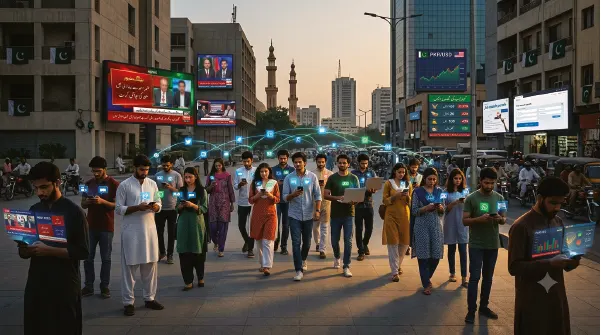
Digital democracy has become a defining feature of contemporary youth-led movements, facilitating counter-narrative campaigns and initiatives on social media. In July, for instance, young people across India took to the streets to protest alleged exam leaks. They combined street demonstrations and hunger strikes with social media campaigns to amplify their demands. According to Amnesty International, as the movement gained momentum, the government responded with internet shutdowns and arrests. Following 36 days of sustained youth-led protests, the education minister resigned.
Gen Z campaigns rely heavily on media visibility, attracting global attention to domestic issues. However, they are also prone to reducing politically complex demands to algorithm-driven optics and hashtags. The ‘meme-ification’ of protests also increases the risk of reducing protests to entertainment content, thereby trivializing their underlying causes. This raises a fundamental question: does the removal of a government leader lead to lasting institutional reform, or does it merely replace one set of leaders with another while leaving the underlying power structure unchanged?
This question is equally relevant to Pakistan’s Gen Z, who are digitally connected and face political polarization and economic pressures. These conditions could provide fertile ground for collective action; however, several factors continue to inhibit such mobilization.
According to the Pakistan Bureau of Statistics, nearly two-thirds of Pakistan’s population is under the age of 30. This demographic profile creates favourable conditions for youth mobilization, while social media has transformed how information is consumed, public opinion is shaped, and young people are organized. During the 2022 floods, thousands of young activists mobilized relief efforts through volunteer work and social media fundraising campaigns. Similarly, in response to Pakistan’s growing climate vulnerability, the Gen Z-led campaign ‘Fridays for Future Pakistan’ helped mobilize public debate on climate justice.
These examples demonstrate that, rather than being politically disengaged, Pakistan’s Gen Z is capable of collective mobilization and active participation in civil society.
Yet transforming civic engagement into a nationwide political movement remains a daunting challenge because of deep polarization among young people. Because many members of Gen Z are shaped by ethnic divisions and populist partisanship, they often identify more strongly with political personalities and parties than with policy platforms or issue-based politics. As a result, activism remains fragmented, making it difficult to build broad youth coalitions, while institutional reform remains elusive. Ultimately, institutional shortcomings remain the greatest barrier to Gen Z’s ability to reform Pakistan’s political landscape.
Pakistan’s governance challenges, ranging from weak public service delivery and judicial inefficiency to a struggling economy, are rooted in institutional structures rather than individual leaders. Consequently, replacing governments seldom produces lasting institutional change. Moreover, just as democracy in both letter and spirit requires political literacy, digital democracy likewise demands both digital and political literacy.
In the age of artificial intelligence and misinformation, malicious actors can exploit social media algorithms through coordinated disinformation and data manipulation. In 2024, the student-led protests in Punjab over an alleged sexual assault case at a private college demonstrated Gen Z’s political awareness and capacity to mobilize in pursuit of accountability, justice, and safety. At the same time, they also highlighted young people’s vulnerability to misinformation.


Based in Lahore, the author is a graduate of Kinnaird College for Women, with a degree in English Literature and Political Science. She can be reached at nayabnurshaikh@gmail.com.
Leave a Reply