



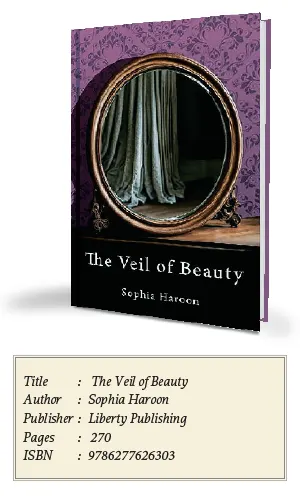
Rediscovering the past has emerged as a popular motif in South Asian fiction. Sophia Haroon’s The Veil of Beauty has used this trope to great advantage, albeit by defying the time-honoured conventions of writing.
The novel is centred on eleven-year-old Maryam, who inhabits a decrepit haveli with her maternal grandmother, Baji Jan, and a domestic named Nazira. The house appears to be crumbling under the weight of its traumatic history, and the bedridden matriarch is incapable of assuaging the girl’s anxieties about the past. Troubled by the silence surrounding her parents’ death, Maryam asks her grandmother probing questions that aren’t greeted with straightforward, cogent answers. She eventually finds her mother’s diary and unveils distressing secrets about family members who once lived in her grandmother’s home. But this isn’t any ordinary tale where the hidden layers of the past are simply brought to the fore. After every chapter, the protagonist assumes the second-person voice and addresses an enigmatic presence, sharing her most intimate concerns and sentiments with it. This technique compels readers to speculate whether this mysterious conversation partner is a magnified reflection of Maryam’s insecurities or an optimistic force that steers her towards spiritual fulfilment.
At first glance, Haroon’s debut novel might give readers the impression that they are confronting a brick wall. Filtered through Maryam’s poetic and philosophical first-person account, the prose appears to be slightly dense and ornate. However, discerning readers are advised to persevere, as this supposed barrier is a clever device that reveals a crucial dimension of Maryam’s personality. The protagonist’s tendency to disclose an excessive amount of detail reflects an earnest attempt to trust the blank page, hoping that it can bear the weight of her emotional confusion, trauma, and disjointed memories. Trusting her canvas isn’t easy, especially for a protagonist who is sceptical of the versions of history she is told by her grandmother. The wall of words is, therefore, a shield – indeed, a veil – against an uncaring world. As the narrative moves forward, this wall steadily falls away, and the prose becomes more accessible.
The crowning glory of The Veil of Beauty is its women-centric narrative, where men surface as a supporting cast. Be that as it may, the men aren’t passive forces and often come across as architects of the carnage the women characters have to reckon with. The women in Haroon’s novel are depicted in realistic hues and often come to life as full-blooded characters. Through this varied cast of female characters, Haroon reveals the unsettling effects of intergenerational trauma.
From the outset, the novel offers tell-tale signs of the author’s creative influence. The first paragraph of the opening chapter carries faint echoes of Arundhati Roy’s The God of Small Things. Above all, the narrative bears a striking resemblance to Anita Desai’s Fire on the Mountain, which also features intergenerational dynamics in a household marred by silent chaos.
The first- and second-person narrative perspectives are rendered with utmost care and grace. Another noteworthy aspect of the novel is the flair with which the author employs words to paint a landscape of ideas. Language transcends its merely functional purpose and becomes the lifeblood of the novel, drawing readers into the texture of its intricate sentences.
At its core, The Veil of Beauty inspires readers to bravely confront their past, even if it opens the portal to unpleasant truths and shocking realisations. Haroon must be commended for taking creative risks, even if they may initially appear to be unconventional. Her stylistic experimentation shouldn’t be flagged as verbiage but construed as an exploration of the unique possibilities of the written word.
Leave a Reply