



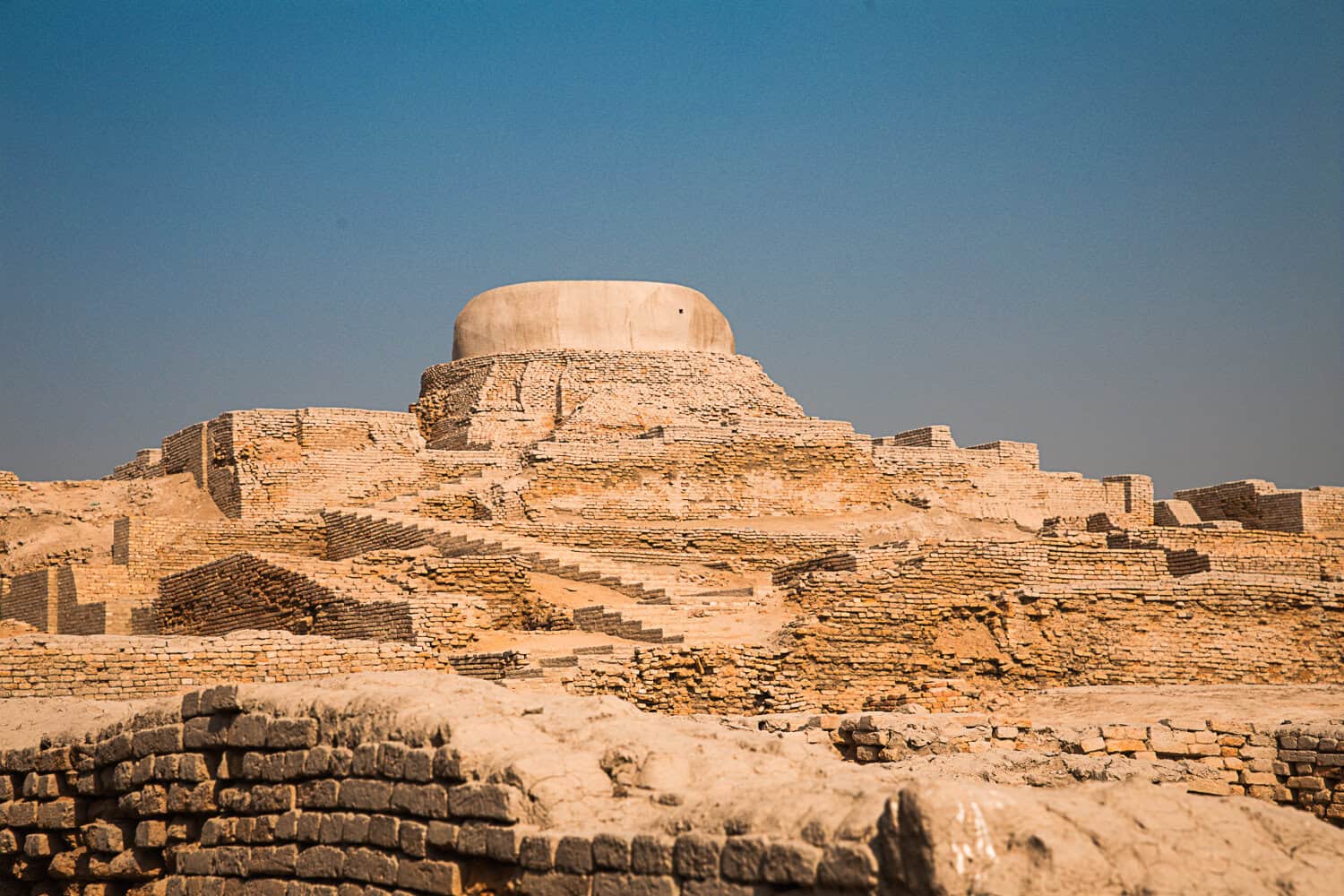
On a recent visit with friends to one of the oldest cultural monuments, Mohenjo-Daro in Sindh, I found the heritage site on the verge of complete collapse due to the Sindh government's total disregard, under whose rule the site remains. As detailed below, the caretaking staff at the site shared some astonishing facts when a friend of mine asked.
Almost as soon as the ancient city was excavated in the 1920s, its exposed ruins began to deteriorate rapidly. The mineral salts in the soil around Mohenjo-Daro dissolve in rising groundwater, which seeps upward into the brick walls. The water evaporates there, leaving a crust of white salt crystals known as Glauber’s salt crystals, which severely damage the bricks' capillaries. Under certain conditions, this salt absorbs water—morning dew, for example—increasing the crystals' volume by 300 percent. These enlarged crystals exert tremendous pressure on the brick capillaries and eventually destroy them.
Mohenjo-Daro is in danger of vanishing.
The latest countermeasure, launched with additional support from the United Nations Development Programme (UNDP) and the Japan Trust Fund (JTF), involves an intensive mud-capping treatment for the affected wall surfaces. The idea is to coat the brick surface with a “sacrificial layer” of mud on which the salt crystallizes, preserving the brick underneath.
At present, an estimated $5 million has to be acquired to complete the rescue operation to save one of the greatest cultural monuments in human history from final ruination
But this is not enough. Other factors have contributed to the city's decay over the years, including wind and water erosion. The site is further endangered by the mighty Indus River itself. The river flows past only 2 km to the east, close enough to wash away the ruins in a flood.
With UNESCO's support, a large-scale rescue project has operated at the site since 1973. Since 1979, efforts have focused on systematically lowering the groundwater level and preventing salts from rising further into the brick walls by inserting a damp-proof insulation course near the base.
More than 50 km of walls need preservation and require further urgent treatment. In 1993, all the walls were given the mud-capping treatment as part of the UNDP rescue programme. Walls in danger of caving in were propped up provisionally, true to the year’s chosen motto: “No further wall should collapse.”
They also replaced over-salinated soil and sealed it under a layer of mud bricks.
By far the most extensive measures, however, were those carried out on the banks of the Indus. In recent years, sections of the earthen bunds have been stabilised and reinforced with quarried stones. Extra breaker dams have been built to prevent the river from suddenly bursting its banks. But much more remains to be done. The rescue operation is financed by funds totalling approximately $6.8 million donated by 21 countries and held in trust by UNESCO, supplemented by approximately $7.9 million made available by the government of Pakistan.
These funds are now practically exhausted. Currently, an estimated $5 million is needed to complete the rescue operation and save one of the greatest cultural monuments in human history from final ruination.
Leave a Reply