History explains the tensions between Afghanistan and Pakistan, but it does not explain away terrorism
ByDr. Farah Naz | November 2026
Afghanistan and Pakistan share a long, volatile border and decades of intertwined history. Yet tensions repeatedly erupt into violence, diplomatic crises, and mutual recriminations. From the disputed Durand Line to cross-border militancy, refugee movements, and competing geopolitical interests, relations between the two neighbours remain among the most fragile in South Asia. While Afghanistan emphasizes sovereignty and non-interference, Pakistan prioritizes security and counterterrorism. Understanding the recurring conflict requires examining both perspectives. However, any honest assessment must also acknowledge that the strongest immediate driver of instability today is Pakistan’s concern that militant groups are using Afghan territory to attack Pakistani targets.
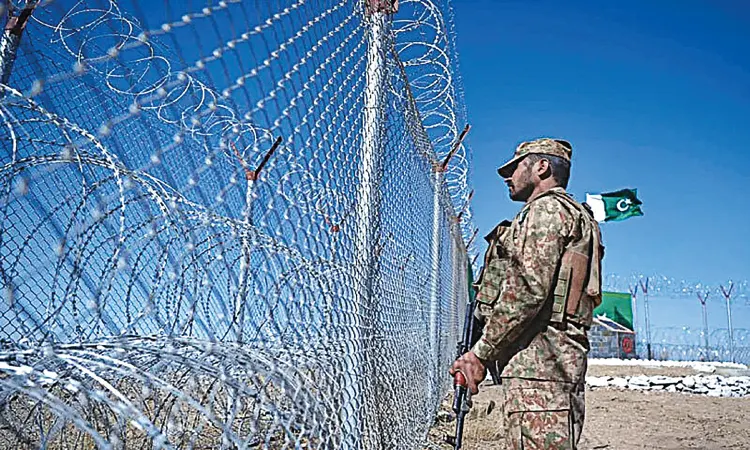
The historical roots of the dispute lie in the Durand Line, a 2,640-kilometre border established in 1893 between Afghanistan and British India. Pakistan considers the border internationally recognized and legally inherited upon independence in 1947. Afghanistan, however, has traditionally questioned its legitimacy, arguing that it was imposed under colonial circumstances and divided Pashtun communities whose social, tribal, and economic ties predated modern state boundaries. The dispute has never been fully resolved, creating a persistent source of friction whenever either side attempts to strengthen border controls or military deployments.
Despite this historical disagreement, the current conflict is driven less by border demarcation than by security concerns. Pakistan argues that the principal threat comes from Tehrik-e-Taliban Pakistan (TTP), an insurgent organization responsible for attacks against civilians, security forces, and state institutions inside Pakistan. According to United Nations monitoring reports, the TTP has carried out hundreds of attacks in Pakistan while maintaining thousands of fighters inside Afghanistan. Multiple international assessments have noted an increase in terrorist attacks launched from Afghan territory and identified Afghanistan as a continuing operational base for the militant group.
From Islamabad’s perspective, these facts justify concern. Pakistan argues that no state can be expected to tolerate armed groups operating from across an international border while conducting attacks against its population. International monitoring reports have supported Pakistan’s claim that TTP attacks increased significantly after the Taliban returned to power in Afghanistan in 2021 and that cross-border violence has repeatedly led to military exchanges between the two countries. Pakistan therefore presents border fencing, stricter migration controls, and military operations as defensive measures rather than acts of aggression.
The Afghan position is markedly different. Kabul denies providing support to the TTP and insists that Pakistan’s insurgency problem is primarily domestic. Afghan authorities argue that Pakistan routinely attributes its internal security failures to Afghanistan while ignoring political, social, and governance issues that contribute to extremism within Pakistan itself. More importantly, Afghanistan frames the conflict as a question of sovereignty. Pakistani airstrikes and cross-border operations are portrayed as violations of Afghan territorial integrity and contrary to international law. From Kabul’s perspective, no security concern can justify unilateral military action inside another sovereign state.
Legally, both countries possess plausible arguments, though not equally strong ones. Pakistan’s position regarding the legal status of the Durand Line enjoys greater international support. Most states and international institutions treat the border as settled under the principles of state succession and territorial continuity. Pakistan also invokes the right of self-defence under Article 51 of the United Nations Charter when responding to terrorist attacks by militant groups operating from across the border. Afghanistan’s strongest legal argument rests on the principles of sovereignty and non-intervention, which prohibit the use of force within another state’s territory except under narrowly defined circumstances. Consequently, Pakistan’s legal case appears stronger regarding the status of the border, while Afghanistan’s argument is stronger when challenging unilateral military actions conducted on its territory.
In my view, Pakistan’s security concerns deserve greater recognition than they often receive in international discussions. The evidence is no longer based solely on Pakistani government claims. Multiple United Nations monitoring reports have documented the presence of thousands of TTP fighters in Afghanistan, increasing cross-border attacks, and continuing concerns among member states regarding militant safe havens. While Afghanistan may reject these findings, they provide substantial external support for Pakistan’s argument that the threat is both real and serious. No government would view hundreds of terrorist attacks and thousands of casualties as a manageable or acceptable security challenge.
The human consequences of the conflict reinforce this reality. According to official figures released by the Pakistan military in July 2026, the country experienced 3,145 terrorism-related incidents during the year, resulting in the deaths of 819 Pakistanis, including 303 members of the armed forces and 194 police and civil armed personnel. International monitoring teams have also documented the growing lethality of TTP attacks and the increasingly complex nature of militant operations targeting Pakistan. Pakistan security forces responded with more than 40,000 intelligence-based operations nationwide, underscoring the scale of the challenge facing the state.
At the same time, Afghanistan has legitimate humanitarian concerns. International observers have documented significant civilian deaths and injuries resulting from cross-border attacks and military operations. Reports of civilian casualties from Pakistani airstrikes have fuelled anger within Afghanistan and strengthened arguments that military responses can impose severe costs on non-combatants. These figures demonstrate that counterterrorism operations, even when driven by genuine security concerns, carry serious humanitarian consequences.
Beyond casualties, millions of civilians continue to suffer from the wider consequences of instability. Refugee deportations and repatriations have placed immense pressure on communities already struggling with poverty and weak infrastructure. Border closures regularly interrupt trade, separate families, and disrupt livelihoods in communities that depend on cross-border movement. Fighting in border districts has also displaced thousands of civilians from their homes. The people most affected by the conflict are often those who do not influence the policies that sustain it.
Ultimately, the Afghanistan-Pakistan conflict persists because each side prioritizes a different security concern. Pakistan views the challenge primarily through the lens of terrorism and border security, while Afghanistan views it through the lens of sovereignty and territorial integrity. Both concerns carry weight and cannot be dismissed lightly. Yet the evidence increasingly suggests that the immediate catalyst for contemporary tensions is not the century-old dispute over the Durand Line but the continuing threat posed by the TTP and other militant groups operating from Afghan territory. As long as these concerns remain unresolved, military clashes, diplomatic crises, and mutual mistrust are likely to continue.
History explains the tensions between Afghanistan and Pakistan, but it does not explain away terrorism. Borders can be debated, treaties can be disputed, and political narratives can differ. Yet, one principle remains clear: no sovereign state can reasonably be expected to remain passive while armed groups use foreign territory to kill its citizens. Pakistan has endured decades of refugee pressures, economic disruption, and terrorist violence linked to instability across the border. Faced with hundreds of attacks and thousands of casualties, Islamabad’s demand for effective action against militant sanctuaries is neither excessive nor optional. The path to peace does not begin with another argument over the Durand Line. It begins when Afghan territory can no longer be used as a base for violence against Pakistan. Until that reality changes, Pakistan’s pursuit of stronger border security and counterterrorism measures will remain a matter of necessity, grounded not in expansionist ambition, but in the fundamental responsibility of every state to protect its people.





Leave a Reply