



There is a woodpecker I will probably never stop thinking about. It was doing what woodpeckers do, hammering away at an Amaltas tree on campus, minding its own business, chiseling out a living the way its kind has for thousands of years before us and, if we’re lucky, will for thousands more.
Nearby stood a group of boys, ten or eleven years old, small enough that their school bags probably still had cartoon characters printed on them. They picked up stones. Not to shoo the bird away. Not out of fear. Just to see what would happen if they hit it.
I stood there for a second, not fully processing what I was watching. Some part of me kept waiting for someone—a teacher, a guard, anyone—to walk over and say, No, we don’t do that. No one did. Even if I had tried to stop it myself, I doubt it would have mattered—the moment had already passed before I could reach them. And that, more than the stones themselves, is the part I can’t shake.
Somewhere between being small children who once cried over a cartoon animal getting hurt and standing beneath that tree with rocks in their hands, something had already been unlearned.
Children are not born knowing to reach for stones. That instinct is taught, quietly and constantly, by everything around them—by what adults ignore, by what gets a laugh instead of a correction, by every rare, living thing that is treated as a target rather than a neighbour.
Psychologist Albert Bandura’s work on social learning helps explain how this happens: children absorb behaviour, including aggression, by watching it modelled around them, particularly when that behaviour is rewarded or goes uncorrected. Somewhere in their surroundings, these boys had already absorbed the lesson that a creature too small and too voiceless to fight back was fair game. Nobody sat them down and taught them this outright. They simply watched, and learned.
That same instinct does not disappear as we grow older—it simply changes shape, and research suggests that repeated exposure can deepen our desensitisation to violence. “Studies by Carnagey, Anderson, and Bushman, examining physiological responses to real violence after repeated exposure to violent media, found that such exposure can blunt the body’s natural emotional response to violence. Over time, what once provoked distress can begin to feel ordinary.
It becomes the urge to capture rather than witness. A rare bird, a stray cat, an unusual sighting: instead of watching quietly and letting it be, we corner it, film it, hold it up for an audience. There is no shortage of blurred videos online of animals being hurt for the camera—clear enough that we understand exactly what is happening, blurred just enough that no one has to fully own it.
Somewhere along the way, cruelty became content. Suffering became something to capture and keep, rather than something to stop.
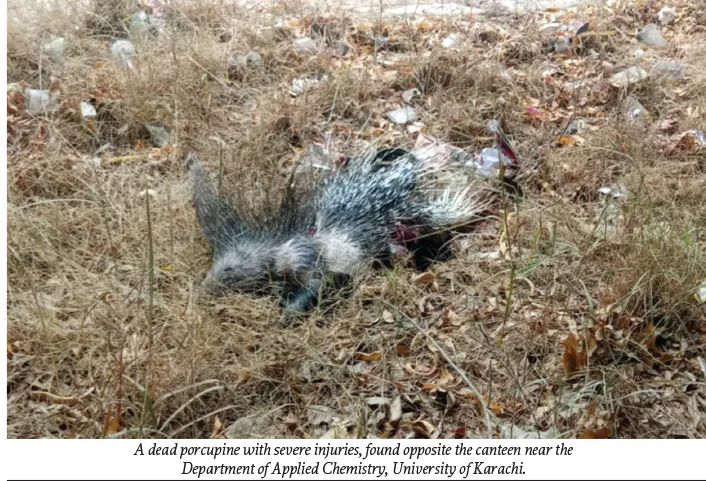
A few days ago, I found a porcupine near the chemistry canteen on our university campus—an Indian crested porcupine, a creature I had only ever encountered in textbooks and had half-believed I would never see in real life, lying beside a stretch of concrete and dead grass that I walk past most days.
It was dead.
“Not the kind of death that comes quietly with age, but the kind that makes you crouch down and look twice because something doesn’t add up. There were wounds—not the crushing signs of a vehicle, not the tearing you might expect from a stray dog, but something sharper, more deliberate. I stood there for a long time trying to convince myself I was wrong.
I wanted to be wrong.
What unsettled me almost as much as the wound itself was everything happening around it. Students walked past that same patch of grass all day—to class, to the canteen, to meet friends behind the trees where no one could see them. Life carried on exactly as it does every day, a few feet from a rare, dead animal lying in the dirt.
I was the only one who stopped. Not because I noticed something no one else could have—anyone could have. But nobody had the time. They were busy with mochas and conversations and the small, ordinary business of being twenty years old on a Tuesday.
And I understand that busyness is not the same as cruelty. But it can become its quiet accomplice. Indifference does not need malice to do its damage—it only needs enough people to keep walking.


The writer is a second-year student pursuing a Bachelor of Science (BS) in Environmental Studies at the Institute of Environmental Studies, University of Karachi. She can be reached at fairysharf@gmail.com.
Leave a Reply