



International
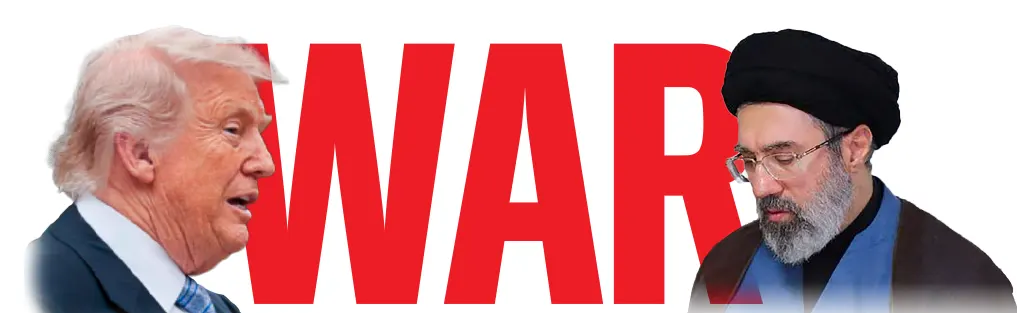
for War’s Sake
The US-Iran conflict increasingly appears trapped in a cycle where military action continues without a convincing explanation of what success would actually look like
What political objective could justify such a staggering human and economic toll? It is a question that policymakers in Washington and Tehran have conspicuously failed to answer. More than 9,000 lives lost and over US$120 billion consumed by a conflict that offers neither victory nor peace. These are not simply tragic by-products of war. They are the consequences of a confrontation that has become increasingly detached from any clear and achievable end-state. War has traditionally been understood as a tool of policy, a means of achieving political goals when other options fail. Yet the US-Iran conflict increasingly appears trapped in a cycle where military action continues without a convincing explanation of what success would actually look like. Months of escalation have produced enormous destruction, but little evidence that either side is any closer to securing its fundamental aims.
Recent events underscore this reality. Reports linking military operations to civilian casualties in locations such as Kuhestak and Minab have become emblematic of a conflict whose costs continue to mount. A wedding celebration transformed into a scene of mourning. Schoolchildren were killed in what should have been a place of safety and learning. Such incidents are more than humanitarian tragedies; they highlight the growing disconnect between military operations and meaningful political outcomes. Neither Washington nor Tehran appears capable of imposing its preferred outcome on the other. The US has maintained military pressure without securing decisive concessions, while Iran has shown little willingness to accept arrangements perceived as products of coercion. As a result, both sides remain locked in a costly stalemate. Military operations generate headlines, but they have yet to produce a viable pathway towards a durable settlement.
The human consequences are immense. Independent estimates suggest that more than 9,000 people have been killed across the wider regional conflict, including thousands of civilians, while many thousands more have been injured or displaced. Beyond the statistics are families, communities, and futures irreversibly altered by violence. The scale of suffering raises unavoidable questions about proportionality, accountability, and purpose. The longer the conflict continues, the more difficult it becomes to justify these sacrifices. Democratic governments are expected to explain how military action advances identifiable goals and serves the public interest. Yet discussions surrounding the conflict increasingly focus on operational developments rather than the broader political vision they are intended to advance. This inversion is deeply troubling. Military force should support a political strategy, not substitute for one.
Moreover, civilian casualties rarely produce the results their architects expect. Rather than compelling submission, they often intensify anger, reinforce grievances, and strengthen resistance. Every civilian death carries consequences that extend far beyond the battlefield. Families mourning loved ones today can become communities hostile to reconciliation tomorrow. In this sense, the humanitarian toll is not only a moral tragedy but also a strategic liability that can undermine prospects for future peace.
The conflict’s repercussions extend well beyond Iran and the US. Shipping routes have faced repeated disruptions, regional tensions have intensified, and energy markets have experienced significant uncertainty. The involvement of regional actors and proxy groups has widened the conflict’s impact, creating security concerns across the Gulf and beyond. What began as a bilateral confrontation has evolved into a source of instability with global implications.
The financial burden is equally alarming. Estimates indicate that direct military expenditures, disruptions to maritime trade, infrastructure damage, and broader economic instability have imposed costs exceeding US$120 billion. Modern wars no longer affect only those on the battlefield. Their economic consequences ripple across supply chains, energy markets, businesses, and households worldwide. Consumers pay more, governments spend more, and development priorities are pushed aside. Perhaps the starkest measure of warfare’s futility is the scale of reconstruction that follows. Discussions surrounding post-conflict recovery have included proposals worth hundreds of billions of dollars to rebuild damaged infrastructure, restore public services, and revive economic activity. Resources devoted to destruction eventually have to be matched, and often exceeded, by resources devoted to rebuilding. It is a costly cycle that leaves societies weaker and opportunities squandered.


The writer is associated with the National University of Sciences and Technology, Islamabad as an Assistant Professor at Department of Government and Public Policy. She can be reached at farahnaz@s3h.nust.edu.pk
Leave a Reply