


The Arabian Peninsula has two doors to the sea, and those two doors are two of the world’s most significant chokepoints. When the Strait of Hormuz closed in early March 2026, the price of crude oil rose to around $120 a barrel, disrupting around 20% of the world’s oil supply. The Kingdom, however, had built a pipeline described by Aramco as a lifeline, running across the country precisely as an exit strategy given decades of rivalry with Iran. In June 2026, the Saudi port of Yanbu on the Red Sea was loading roughly 3.5 million barrels of crude a day. A year earlier, the figure had been around 240,000. The increase was not commercial. It was an evacuation.
Then, on 20 July, the Houthis declared a maritime blockade of Saudi shipping in the Bab al-Mandeb. Within a week, daily transits through the strait fell by more than half. Tankers turned around at sea. Saudi Arabia’s escape hatch and its front door were shut at the same time.
This is the fact that should reframe how the Kingdom’s security is discussed. The problem is not that a chokepoint closed. Chokepoints have been threatened for fifty years. The problem is that the contingency plan for the first one ran directly through the second.
The decades of American presence as a security guarantor have forced the Kingdom to rethink its strategy, because that reliance on the US security umbrella has itself become a source of exposure rather than protection.
Why Saudi Arabia does not build an army that could defend it
The obvious response is to ask why the largest defence spender in the Middle East cannot protect its own exports. Saudi Arabia is consistently among the top five military spenders in the world in absolute terms, and among the highest anywhere as a share of national income. That money buys advanced platforms. It has not bought the ability to defend a coastline.
The reason is political, and it is deliberate.
The Saudi armed forces are not a single institution. The regular army, navy and air force sit under the Ministry of Defence. Alongside them stands the Saudi National Guard, recruited historically from tribal constituencies loyal to the ruling family and answering through its own separate chain of command. This is a design intended to protect the monarchy from coups.
To maintain its strong influence in the world, as well as a trillion-dollar economy in a region with military dictators and uprisings, the monarchy formally reorganised SANG to prevent internal insecurity. The rise of the Arab Spring is a case study for the monarchy. Egypt in 2011: a nationally recruited army with its own institutional interests removed a president. The entire Arab world was being hit with a wave of revolutionary ideas, and a single unified army with ambitious generals is a plausible instrument of the monarchy’s own overthrow.
The consequence follows directly. Forces designed to watch each other are poor at working together. They struggle with joint operations, with integrated air and missile defence across a large territory, and with sustained campaigns far from home. The war in Yemen after 2015 exposed all three weaknesses over several years.
Thus, to have security externally, the monarchy has outsourced it to guarantors. It is not a failure of will or budget, but a design to keep internal stability while maintaining deterrence in a geography that leaves the Kingdom exposed to threats and held hostage by two global economic chokepoints. The United States secured that role in the 1970s, when the petrodollar arrangement tied Saudi oil revenues to the American financial system and gave both sides a stake in the other. What changed in 2026, however, is whom to trust and to whom to outsource that security , after the events leading to the US–Iran war.
The guarantor that fights on its own schedule
For eight decades, the answer to Saudi vulnerability was American. The wider debate about American conduct in the Middle East can be left aside here. The question that matters for this argument is simpler, and it is whether the guarantee worked when the Kingdom was actually attacked.
Begin with September 2019, when drones and cruise missiles struck the processing facilities at Abqaiq and Khurais and took around 5.7 million barrels a day offline, roughly half of Saudi production. This was the most heavily defended energy infrastructure on earth, sitting under an American security umbrella, and there was no meaningful American military response. Two years later, Patriot batteries were withdrawn from the Kingdom while Houthi missiles were still being launched at it. In September 2025, Israel struck Qatar, a state hosting the largest American airbase in the region, and the umbrella did not cover that either.
Then came February 2026. American and Israeli strikes on Iran began a war that Saudi Arabia neither started nor was consulted on. The retaliation did not land only on the country that launched it. Iranian missiles and drones struck Saudi territory in large numbers, refineries were hit, the petrochemical complex at Jubail was damaged, and by March the American embassy had ordered non-essential staff out of the country.
The war also changed what the American presence meant. Having started the fighting, Washington then tried to reopen the Strait of Hormuz on its own terms. An air campaign against Iranian naval targets began on 19 March 2026, and Trump had already said publicly that he wanted to take control of the waterway from Iran. When talks in Islamabad collapsed in April, the United States blockaded Iranian ports. American forces have since intercepted dozens of commercial vessels, seized several, and redirected 55 ships by early August, with Washington claiming this cost Iran 500 million dollars a day. The strait has now been shut for more than five months, with only a handful of ships passing on a given day. Iran keeps it closed and wants the blockade lifted first. The United States keeps the blockade and wants the strait opened first. Caught between them is a waterway carrying a quarter of the world’s seaborne oil, and a group of Gulf states that neither side consulted and that cannot ship their exports while the argument goes on.
The Bab al-Mandeb tells a different story. In May 2025, after seven weeks of strikes on Yemen, Washington accepted a ceasefire with the Houthis brokered by Oman. The terms, as Oman described them, were that neither side would target the other, including American vessels, and that this would keep international shipping moving freely. It did not. The Houthis said at once that the deal excluded Israel in any form, and attacks on other shipping carried on. In July 2025 they sank the Liberian-flagged Magic Seas and killed three of its crew. No American vessel is known to have been attacked since the ceasefire. What Washington secured was an exemption for its own ships. What it did not secure, and did not stay to enforce, was the freedom of navigation it had spent eighteen months calling the whole point of the operation.
The Saudi objection is not that Washington is unwilling to use force. In 2026 it used a great deal of it. The objection is that the United States fights on its own timetable, for its own objectives, and that the Kingdom pays the bill in either case.
The Mecca Agreement, and what each partner actually brings
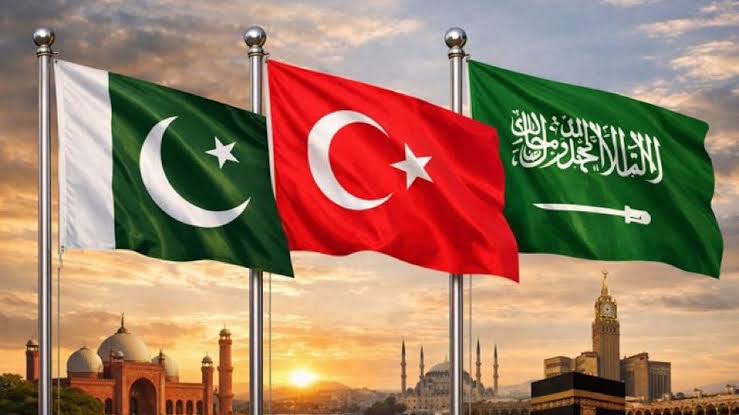
A sequence of events led to this pact. On 17 September 2025, days after the Israeli strike on Qatar, Saudi Arabia and Pakistan signed a Strategic Mutual Defence Agreement in Riyadh. By April 2026, Pakistani aircraft and personnel were reportedly operating from King Abdulaziz Air Base. In June, Pakistani mediation produced the Islamabad Memorandum that ended the main phase of the war. On 30 July, Saudi Arabia convened 43 of 51 invited states in Riyadh and announced a multinational maritime coalition to secure the corridor running through the southern Red Sea, the Bab al-Mandeb and the Gulf of Aden, with fourteen states signing the founding statement and Riyadh hosting the permanent headquarters. On 7 August, Saudi Arabia, Pakistan and Türkiye signed the Mecca Joint Defence Agreement, under which an armed attack on one is treated as an attack on all.
These strategic moves, however, do not replace the US security umbrella. They are a diversification of Saudi defence partnerships. Each state in the agreement brings something to the table. Pakistan is a nuclear power with a long service history in the Arab world, both militarily and diplomatically. Türkiye is a major NATO power with a giant military-industrial complex, and it offers Saudi Arabia a way to achieve its Vision 2030 objective of building an indigenous industry of its own. That programme sits under the PIF and is called SAMI, Saudi Arabian Military Industries, which has an agreement with Türkiye’s Baykar to produce drones inside the Kingdom.
This so-called “Muslim NATO” goes further than religious partnership. These countries have aligned because they are on the same page, and that includes being on the same page as the United States. Pakistan and Türkiye are both American partners, which means the arrangement takes away the risk of a Chinese or Russian military presence in the region rather than inviting one in.
Saudi Arabia sits at the centre of a region that is swaying away from bloc loyalty and moving towards national interest. We saw this in 2017, when the Saudi-led coalition removed Qatar from the Yemen campaign and blockaded it for its closer ties with Iran. Now we see a new rivalry emerging between the UAE and Saudi Arabia. In 2025, the Emirati-backed Southern Transitional Council, a separatist militia, came close to controlling both the Bab al-Mandeb and the Socotra archipelago. In December 2025, Saudi Arabia struck STC supply shipments and UAE weapons shipments in southern Yemen, as Riyadh saw this as a red line being crossed. We can also see the UAE as part of the Abraham Accords, shifting towards Israeli defence architecture. More diplomatic rifts between the GCC nations are visible in Sudan, Libya and Somalia.
Pakistan has also been reported to be aiding Saudi allies in Africa. We saw Field Marshal Asim Munir visit the Benghazi-based authorities in Libya, where Pakistan finalised its largest-ever arms export agreement, valued at more than four billion dollars, with Field Marshal Khalifa Haftar’s eastern-based Libyan National Army, as reported by Reuters. Sudan followed the same pattern. In January 2026, Reuters reported that Pakistan was in the final stages of a deal worth around 1.5 billion dollars to supply the Sudanese Armed Forces with drones, light attack aircraft and air defence systems. The deliveries are visible on the ground. In August 2026, a hundred Pakistani-made Mohafiz armoured vehicles were paraded in Khartoum. Analysts describe a coordinated Saudi, Egyptian and Turkish effort to strengthen the Sudanese army against the Rapid Support Forces, on the shared judgement that a state of Sudan’s size falling to a non-state armed force would be a dangerous precedent for the region. The alignment that produced the Mecca agreement is already at work on the Red Sea’s western shore.
How the new alliances will be tested
Although this goes beyond a “Muslim NATO,” the agreement has still drawn positive opinion within the Muslim world. It has been framed as a deterrence and is not directed against any country, which invites further regional collaboration. Iran sent mixed messages. The parliamentarian Ebrahim Rezaei stated that a document with Ankara and Islamabad will no more secure Riyadh than decades of dependence on Washington. However, Foreign Minister Abbas Araghchi welcomed it, treating regional collaboration on the region’s own security, away from the United States, as a positive sign.
Although officially welcomed by Iran, the agreement does not undo decades of Saudi–Iranian cold war, nor the spread of Iranian proxies across the region, from Hezbollah in Lebanon to the recent escalation between the Houthis and Saudi Arabia.
The NATO-style Article 5 was tested within days. On 11 August, four days after the signing, the Houthis struck an Egyptian-owned cargo ship near the Bab al-Mandeb, killing six people. A second strike hit the vessel as rescue workers were evacuating it. Three of the dead were Pakistani nationals, and these were the first reported fatalities from Houthi attacks on shipping since the war began in February. Pakistan’s response was diplomatic rather than kinetic. Deputy Prime Minister and Foreign Minister Ishaq Dar condemned the attack on a non-combatant commercial vessel, calling it a violation of international law and a threat to freedom of navigation, and instructed the mission in Riyadh to coordinate with Saudi authorities and Yemen’s internationally recognised government on repatriating the remains. This raises the question of whether Pakistan would involve itself in kinetic action in Yemen, while already conducting operations against militants along the Afghan border, where it has seen little involvement from Riyadh. It also has analysts questioning whether such involvement would undo the mediation Pakistan conducted between the United States and Iran, given that it shares a border with Iran and has a great deal to gain from diplomatic ties across the region.
The same agreement raises the question of whether Riyadh would involve itself in an escalation between India and Pakistan, particularly after India placed the Indus Waters Treaty in abeyance following the tensions of April and May 2025.
Similar questions apply to the rivalry between Türkiye and Greece, especially over Cyprus. Would this draw Pakistan and Saudi Arabia into a front in the Eastern Mediterranean?
Speculation about Egypt joining has raised the question of whether Cairo would choose the Saudi or the Emirati camp. Middle East Eye reported that Saudi Arabia opposed Egypt’s inclusion, citing three Saudi sources who described growing frustration with President Sisi’s government and unease at Cairo’s alignment with Abu Dhabi. Turkish officials had pushed for Egypt to be included. Other reporting suggests Cairo itself held back, unwilling to choose between emerging blocs while it balances ties with Israel and the UAE.
With all of this in mind, the larger threat remains Israel: its genocidal campaign in Gaza, its bombardment of Lebanon, and its position in the occupied Golan in Syria, where Colombia recently became only the second state after the United States to recognise Israeli sovereignty over the Golan Heights. Add the Abraham Accords and the Israeli presence in Africa through its recognition of Somaliland, which sits on the approaches to the Red Sea, and the states in the Mecca Agreement face an unstable region with dire consequences if their actions are not handled rationally.
However, the framing of the pact as a deterrence that targets no specific country allows it to avoid being read as aggressive. Furthermore, the condemnation from Pakistan’s Foreign Office after three Pakistanis were killed shows that Islamabad treats the Houthis as distinct from Iran, and it has condemned attacks in both directions throughout the war. Türkiye, meanwhile, cannot rely on NATO alone in the face of Israeli threats. A large military and considerable strategic weight in the Red Sea, including its presence in Somalia, gives Israel and Greece reason to think twice before acting. This pact has therefore kept a balance of power between all these nations while allowing each to pursue its own national interest. While an attack triggers a mutual defence obligation, the accord does not automatically dictate the exact form of military action. Instead, it reportedly binds the members to a framework in which collective responses are decided by consensus.
Why this is not a Gulf story
The case for regional security arrangements is usually made in regional terms. However, this is not a regional story at all.
Roughly 83% of the crude leaving the Strait of Hormuz is bound for Asia, with China, India, Japan and South Korea as the principal destinations, while the United States drew only about 2% of its petroleum liquids consumption through the same waterway. We saw this clearly when Hormuz closed in 2026, as the Japan-Korea Marker for LNG rose by 51% and European gas by 35%, while the American benchmark actually fell by 9%. This difference explains the entire argument, as the United States, which has been securing these waters for eighty years, has been able to insulate its own energy supplies from their closure, while the economies that depend on them cannot.
The same is true of goods. The Bab al-Mandeb carries around a third of east-to-west container traffic and a third of European imports, which makes it a Eurasian trade corridor that happens to run past the Arabian Peninsula.
Furthermore, less developed nations fall under higher pressure from these closures. Japan can draw on reserves measured in hundreds of days, whereas Bangladesh entered this crisis with days’ worth of fuel. Ethiopia cannot acquire a coastline, and a farmer in Sindh or Punjab cannot postpone a planting season simply because urea prices have risen. Pakistan’s own energy imports, its trade, and a large share of the goods and supplies it depends on all pass through these waters.
With all of this in mind, we can see that Asia consumes the security of these straits while contributing almost none of it. Their protection therefore goes far beyond the Kingdom. Being held hostage on two fronts has driven oil and consumer prices high, posing a more immediate threat to the global economy than Iran’s so-called nuclear weapons programme ever did. The crisis is not fixed by bypassing these threats, or establishing deterrents, or having ships go dark while passing through. These prices are high simply because a threat exists in the first place. Once risks exist, the insurance on these shipments rises, and that all falls to the consumer.
Saudi Arabia’s two sea exits had never been closed at the same time before. The United States, with its own wars to fight and an economy that does not suffer when these straits close, cannot protect a state whose weakness is permanent and geographic.
Whether what Riyadh is building turns into real security or becomes another forgotten agreement will be decided by ordinary things: who commands what, what they buy together, what their forces are allowed to do, and whether anyone ever says what actually triggers a response. But the direction is now clear. Reclaiming the region’s security through its own arrangements, alongside diplomatic engagement, matters more than relying on a declining superpower that creates instability under the pretence of providing it. And the people who most need this to work are not in Riyadh, Islamabad or Ankara. They are in the refineries and ports of Asia.

The writer is a freelance journalist and can be reached at khalid.hassan3000@gmail.com
Leave a Reply