


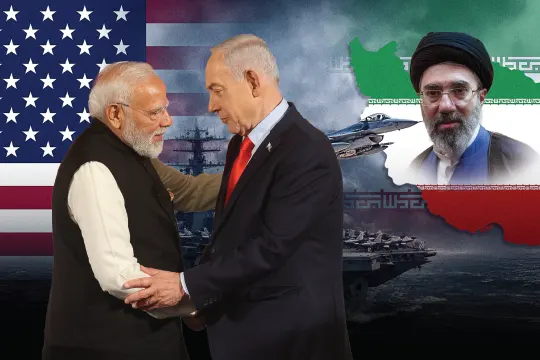
International politics has never been governed by emotion, morality, or historic friendship alone. Nations ultimately act in accordance with their strategic interests, economic priorities, and long-term geopolitical calculations. Yet there are moments in history when silence itself becomes a statement. India’s muted response during the recent Iran–U.S.–Israel tensions was one such moment — a moment that exposed the complex and often transactional nature of international alliances.
For decades, India cultivated exceptionally close relations with Iran. The two countries expanded trade, cooperated in energy projects, developed the Chabahar Port, and frequently projected themselves as strategic partners in Asia. India often portrayed Iran as a gateway to Central Asia and as a civilizational partner with whom it shared centuries of interaction through commerce, language, and regional diplomacy. Yet when Iran found itself under severe military and diplomatic pressure amid escalating confrontation involving the United States and Israel, India’s response remained cautious, restrained, and almost invisible.
This silence has raised an important geopolitical question: was India exercising strategic neutrality, or quietly abandoning a long-standing partner in favor of a broader strategic alignment with Washington and Tel Aviv?
To understand this situation properly, one must examine India’s foreign policy tradition not merely through official statements, but through historical conduct. Indian diplomacy since independence has consistently displayed one defining characteristic: the ability to align itself with stronger or strategically useful powers whenever its national interests demanded it. Whether dealing with neighboring countries, regional powers, or global superpowers, India has repeatedly demonstrated a willingness to reshape partnerships in response to evolving strategic needs.
Historically, India projected itself as a leader of the Non-Aligned Movement during the Cold War. Officially, it claimed neutrality between the Western bloc led by the United States and the Soviet bloc led by Moscow. However, in practice, India gradually tilted towards the Soviet Union, particularly after the 1960s. Moscow became India’s principal supplier of arms, diplomatic cover, and political support. During the 1971 India-Pakistan War, Soviet backing proved crucial for India, especially when the United States openly leaned towards Pakistan.
This was one of the earliest major examples of India’s pragmatic foreign policy. Ideology was secondary; strategic advantage came first.
After the collapse of the Soviet Union, India rapidly adjusted its orientation. The same India that once criticized Western influence began building deeper military, economic, and technological ties with the United States. Over the past two decades, India has emerged as one of Washington’s closest strategic partners in Asia. Defence agreements, intelligence sharing, nuclear cooperation, and Indo-Pacific security arrangements brought the two countries into unprecedented proximity.
Simultaneously, India also developed exceptionally close ties with Israel. This relationship expanded far beyond agriculture or technology into defence cooperation, intelligence coordination, and security collaboration. Israel became one of India’s largest suppliers of sophisticated weaponry, surveillance systems, and military technologies. Indian leaders who once cautiously avoided visible proximity with Israel began openly embracing the partnership.
In international politics, such shifts are not unusual. States evolve according to interests. However, the Iranian case appears particularly striking because of the depth of India’s earlier engagement with Tehran.
For years, India invested enormous diplomatic energy in strengthening relations with Iran. The Chabahar Port project was repeatedly presented as a symbol of India-Iran friendship and strategic cooperation. Energy imports from Iran formed a vital component of India’s economic planning. High-level visits, trade agreements, and regional connectivity projects created the impression of a durable partnership.
 Yet critics, especially in Pakistan, have long argued that India’s outreach towards Iran was never purely economic or cultural. According to this perspective, India viewed Iran primarily through the prism of Pakistan. Since India lacked direct land access to Afghanistan and Central Asia due to Pakistan’s geography, Iran became strategically valuable as an alternative route. Chabahar Port was often discussed in contrast with Pakistan’s Gwadar Port, symbolizing a wider regional rivalry.


Based in Lahore, the writer is a historian and a critical analyst. He can be reached at arslan9h@gmail.com
Leave a Reply