


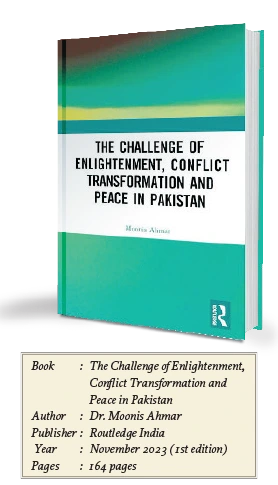
 The book titled “The Challenge of Enlightenment, Conflict Transformation and Peace in Pakistan” by Dr. Moonis Ahmar is a culmination of years of scholarly research and first-hand academic exposure in the field of conflict resolution and peacebuilding. Offering a thorough examination of Pakistan’s multifaceted challenges, Dr. Ahmar presents a compelling vision for a more harmonious and enlightened future, unravelling the intricate layers of conflicts and proposing pathways towards peace and enlightenment.
“It is utterly opposed to enlightenment as it will empower people to make a distinction between reason and ignorance. Culture will not change unless the thought process changes from conservative and dogmatic to liberal, moderate, and enlightened,” writes Dr. Moonis Ahmar, a renowned Karachi-based academician, prolific author, and a leading scholar in the field of international relations.
Through his insightful narrative, Dr. Ahmar navigates the tumultuous landscape of Pakistan’s socio-political sphere, enriching the discourse on the nation’s enduring challenges since its inception. His work stands as a testament to his commitment to comprehending and confronting the complexities of his homeland, with the overarching goal of fostering peace and enlightenment through concerted efforts and transformative actions. The book’s principal objective revolves around the notion that peace and enlightenment are ideals while tangible goals can be achieved through concerted efforts and transformative actions. Dr. Ahmar.argues that Pakistan’s journey towards peace is inherently tied to its ability to overcome internal and external conflicts, foster inclusive dialogue, and embrace progressive ideologies.
Utilizing a blend of theoretical frameworks and real-life examples, Dr. Ahmar constructs a cohesive narrative, supplementing his arguments with personal anecdotes and case studies to engage readers at a personal level. His intellectually stimulating writing style targets scholars, policymakers, activists, and general readers alike, offering nuanced analyses of Pakistan’s myriad conflicts, ranging from historical and cultural roots to socio-economic dimensions.
Dr. Ahmar’s writing style is intellectually stimulating and is primarily aimed at grabbing the attention of scholars, policymakers, political activists, and general readers. One of the book’s notable strengths lies in its nuanced analysis of Pakistan’s various dimensions of conflict. Dr. Ahmar explores conflict’s historical, cultural, and socio-economic roots, shedding light on the complex interplay of factors contributing to instability. From ethnic tensions to religious extremism and geopolitical rivalries, Ahmar provides a comprehensive framework for understanding the intricacies of Pakistan’s challenges.
Dr. Ahmar underscores the pivotal role of dialogue, tolerance, and pluralism in nurturing peace and prosperity, drawing inspiration from historical precedents and contemporary political dynamics. While acknowledging the inherent challenges on the path to peace, he remains steadfast in his belief that sustainable solutions are within reach, offering concrete policy recommendations and practical strategies to empower readers in their pursuit of peace and civil negotiation. Despite its strengths, the book “The Challenge of Enlightenment, Conflict Transformation and Peace in Pakistan” is not without its limitations since the book attempts to address a wide range of issues within a single volume.
While the author comprehensively analyses the key challenges facing the cash-strapped nation, some readers may crave a more in-depth exploration of specific topics coupled with their long-term solution written in plain words devoid of verbiage and platitude. Taking a pragmatic approach to conflict resolution, the author acknowledges the inherent difficulties and obstacles on the path to peace but remains steadfast in his belief that sustainable solutions are achievable despite all the odds. The author offers concrete policy recommendations and practical strategies, empowering readers to actively pursue peace and civil negotiation.
Dr. Ahmar’s expertise and passion shine through on every page, offering hope and positivity to those committed to realizing a truly new Pakistan amidst its complex challenges. In a word, the book is a thought-provoking and insightful contribution to the discourse on peace and conflict resolution. As Pakistan continues to navigate its complex challenges, the book emerges as a beacon of hope and guidance for all those committed to building a Naya Pakistan in the real sense 
Leave a Reply