


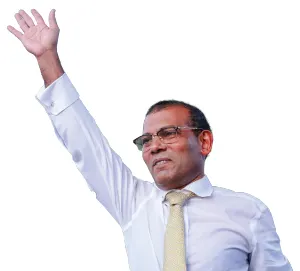
The return of Mohamed Nasheed to the Maldives after completing his tenure as Secretary-General of the Climate Vulnerable Forum has reignited speculation about the future of Maldivian politics. Nasheed’s cryptic message calling on supporters to “return to the nest” has been widely interpreted as more than a symbolic homecoming. It signals a possible political comeback by one of the Maldives’ most influential and controversial democratic figures.
As the Maldives slowly approaches the 2028 presidential elections, Nasheed’s re-entry into domestic politics raises an important question: can he once again become the central force in Maldivian politics, or has the country moved beyond the era when he dominated the national conversation?
Nasheed’s political legacy in the Maldives remains significant. Rising as the face of democratic reform against decades of authoritarian rule, he became the country’s first democratically elected president in 2008. His presidency transformed him into an international symbol of democratic transition and climate activism. Globally, he became known for bringing attention to the existential threat climate change poses to low-lying island nations like the Maldives.
This reputation only expanded during his tenure leading the Climate Vulnerable Forum, an organization established in 2009 during his presidency, with the support of climate-vulnerable nations. The forum sought to strengthen international awareness about climate change, encourage sustainable environmental policies, and help member states transition toward renewable energy. Nasheed’s role as Secretary-General elevated his global profile and enabled him to maintain international relevance even as he stepped away from frontline domestic politics.
In December 2023, when Nasheed announced that he would take up the CVF position, he also declared that he was stepping back from active political engagement. At the time, Maldivian politics was deeply fractured, especially within the Maldivian Democratic Party, the party Nasheed had once led to power. Internal disputes and leadership struggles pushed him to resign from the party and from his role as Speaker of Parliament. His eventual alignment with The Democrats, a splinter group formed by his supporters, reflected the growing fragmentation within the opposition. However, Maldivian politics rarely remains static for long.
Over time, tensions within the MDP eased, and Nasheed eventually returned to the party. His rejoining of the MDP is politically important because it reunites the country’s largest opposition force with its most internationally recognized figure. He has reportedly taken on an advisory role focused on party management, strategy, and long-term electoral preparation, particularly with the 2028 elections in mind.
Nasheed’s recent statements suggest that he views his return as part of a broader mission to bring about “big change” in the Maldivian political environment. Supporters interpret this as an effort to revitalize the MDP and restore it as the dominant opposition force capable of challenging the government in future elections. Yet while Nasheed’s return has energized many of his supporters, the political environment he is returning to is very different from the one he left behind.
The Maldives today is more politically fragmented and competitive than during Nasheed’s earlier rise. The opposition space is no longer solely centred around his personality, and newer political actors have emerged with their own power bases and support networks. Even within the MDP, there may be resistance to Nasheed’s attempt to fully reclaim leadership. During his absence, alternative centres of influence developed within the party, and some members may prefer a newer generation of leadership rather than a return to old political rivalries. This is perhaps Nasheed’s greatest challenge.
While Nasheed remains charismatic and influential, his political career has also been marked by repeated confrontations not only with opponents but sometimes with allies. His earlier split from the MDP weakened opposition unity and contributed to voter fatigue among some sections of the electorate. Critics argue that his leadership style can be polarizing, while supporters believe his energy and political instincts are unmatched in Maldivian politics.
Another important factor is the shift in voter priorities. During Nasheed’s peak political years, democracy, political reform, and institutional freedom were dominant themes in public debate. Today, many Maldivians are more focused on economic issues such as inflation, tourism recovery, housing, employment opportunities, and foreign policy balancing between regional powers. This means Nasheed must adapt his political messaging to contemporary concerns rather than relying solely on his legacy of democratic reform.
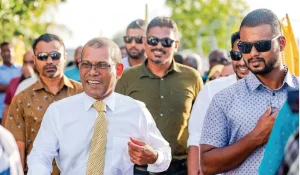 Still, dismissing Nasheed would be politically unwise. Few Maldivian politicians possess the domestic popularity, international credibility, and campaign experience that he claims. His global climate diplomacy work may even strengthen his domestic image, allowing him to return not simply as a former president but as a statesman with international standing. In a country increasingly vulnerable to climate change, his environmental advocacy remains highly relevant. Moreover, Nasheed’s symbolic importance within the opposition remains enormous. His call for supporters to “return to the nest” appears aimed at rebuilding opposition unity after years of fragmentation. If he successfully reunites different factions within the MDP and reconnects with younger voters, he could once again become a decisive political force, even if not necessarily the uncontested leader he once was.


The writer, based in Islamabad, holds a Master’s degree in Defence and Strategic Studies. He can be contacted at daniyaltalat2013@gmail.com.
Leave a Reply