



 SSome adages are rooted in clichés and fail to capture the complexities of human experience. This is especially true of the stereotypical belief that marriages are predetermined in heaven. At its core, such assumptions offer a rose-tinted view of the institution, obscuring its potential to become a maze, if not a battleground. The problem, though, arises when spouses lose faith in the delicate workings of their relationship and treat infidelity as a convenient pretext for escape. Much to the consternation of those with conservative sensibilities, extra-marital affairs aren’t just the stuff of soap operas but a reality in some relationships.
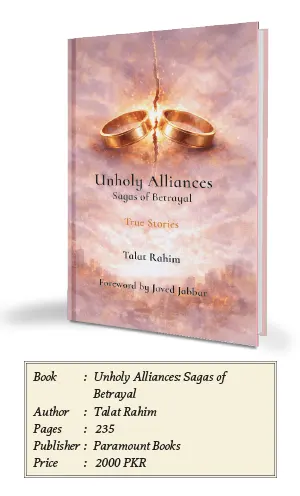
Talat Rahim’s Unholy Alliances: Sagas of Betrayal peels back the layers of complexity surrounding this subject through an anecdotal lens. At first glance, this appears to be a pertinent issue in the Pakistani context. In addition to being a social taboo, adultery is legally prohibited, and there are no official statistics on the subject. Any attempt to dissect this topic must, therefore, involve treading cautiously through moral, social and legal terrain to arrive at some uncomfortable yet illuminating truths.
Using the experiences of 34 individuals as a springboard, Rahim offers a searing exploration of the turmoil and tragedies arising from extra-marital relationships. However, the author does not merely paint a bleak portrait of the heartbreak caused by infidelity; she also shares some poignant stories of resilience and triumph. In her epilogue, Rahim clarifies that the people she spoke to aren’t defined solely by the betrayal and trauma surrounding a broken marriage. “Many who opened their doors and hearts to me have found healing, strength and a renewed sense of purpose,” she writes. “They have rebuilt their lives from the ground up, weaving new identities that are stronger and more self-aware than before.”
By circumventing the doomsday scenario, Rahim moves beyond melodramatic excess. As a result, her narrative relies on keen insight and remarkable wit to present stories that are, by turns, terrifying and profoundly true. Owing to this approach, the book resists easy categorisation as ‘misery literature’ and instead emerges as an insightful, earnest and revealing exploration of marital discord. Rahim resists the temptation to focus on the psyche of either spouse involved or the interloper who disrupts their wedded bliss. In her view, the fault lies squarely with all parties involved.
Curiously enough, the book has an intriguing genesis story that casts a revealing light on its treatment of the subject matter. Unholy Alliances: Sagas of Betrayal has its roots in the dramatic fallout surrounding a news event from August 2024, in which an intoxicated woman driving a four-wheeler mowed down a motorcycle on one of Karachi’s major thoroughfares. A middle-aged man and his daughter, who were riding the motorcycle, lost their lives in the accident. Shaken by the incident, Rahim later overheard that the beleaguered driver was ostensibly grappling with “anger and frustration” after discovering that her husband was involved in an extra-marital affair. This prompted her to examine this social problem in greater depth.
Given the context that inspired the book, a few cynical readers might be tempted to view it as tabloid-style drivel that runs the risk of becoming moralistic. However, Unholy Alliances: Sagas of Betrayal looks beyond the veneer of gossip and attempts to understand the intricacies of a “devastating ill prevalent in societies all over the world.” With refreshing candour and a clinical eye for detail, Rahim dissects the chilling breach of trust that shatters marital homes. While the emphasis is not on undertaking a sociological analysis, the author’s findings could lend themselves to a deeper academic exploration of the topic.
Leave a Reply