Since a mature democracy allows disagreement, Pakistan’s democratic stability does not require PPP and PML-N to love each other
ByShakeel Ahmed Shah | July 2026
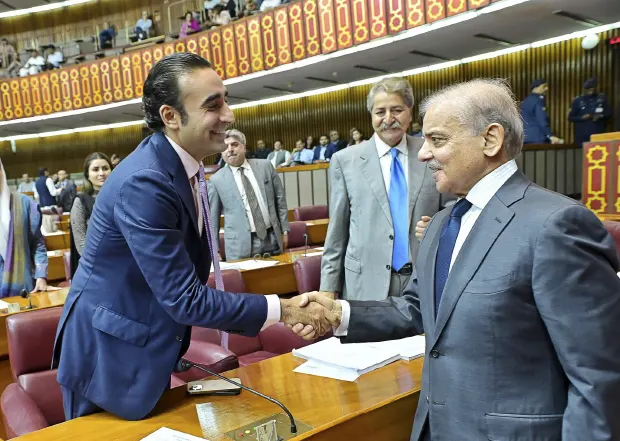
Pakistan’s ruling alliance is not facing its first disagreement, nor will the controversy around the proposed 28th Constitutional Amendment necessarily be its last. The important question is not whether cracks exist between the Pakistan People’s Party (PPP) and the Pakistan Muslim League-Nawaz (PML-N). They clearly do. The real question is whether Pakistan’s democracy can afford a coalition that survives not because its partners trust each other, but because they fear separation more than they value genuine partnership.
The phrase “managed political tension” has become familiar in Islamabad. A disagreement surfaces; party leaders issue warnings; committees are announced; meetings are arranged; compromise is hinted at; and the system moves on. But this choreography should not be mistaken for stability. Sometimes it is evidence of a political order in which survival has replaced vision, negotiation has replaced accountability, and constitutionalism has become vulnerable to elite bargaining.
The PPP’s hardening posture over the 28th Amendment must be read in this wider context. On the surface, the dispute may look like routine coalition pressure politics: one party signalling displeasure, another seeking numbers, both calculating costs before the next budget or legislative vote. But beneath the routine lies a deeper institutional anxiety. If the amendment touches provincial autonomy, fiscal federalism, judicial power, or the balance between elected and unelected institutions, then the matter is not merely procedural. It goes to the heart of Pakistan’s fragile constitutional compact.
For the PPP, constitutional politics is not abstract. The 18th Amendment remains central to the party’s democratic identity. It gave political expression to the idea that Pakistan’s unity cannot be built through administrative centralisation alone. It recognised provinces as constituent units of a diverse federation, not subordinate departments of the centre. Any attempt to dilute that settlement will naturally trigger resistance from a party whose strongest power base lies in Sindh and whose political memory is shaped by struggles against centralised authority.
For the PML-N, the logic of governance has often moved differently. It has preferred executive control, administrative efficiency, large infrastructure, and a strong centre capable of delivering visible outcomes. This is not inherently undemocratic; states need coherence. But in Pakistan, where centralisation has often been justified in the name of efficiency, security, or reform, even technical changes can carry heavy political meaning. A constitutional package presented as administrative tidying may be experienced by provinces as political encroachment.
This is why the dispute is more serious than a routine coalition quarrel. It exposes the absence of a shared constitutional imagination between the two largest parties in government. The PPP and PML-N may agree to keep the system running, prevent collapse, and manage budgets, offices, appointments, and parliamentary arithmetic. But they do not appear to agree on what kind of democratic state Pakistan should become.
Gilgit-Baltistan offers a small but revealing mirror. PPP and PML-N contested the recent GB election separately, with PPP emerging as the single largest party, yet post-election politics quickly moved towards coalition possibilities. This is not unusual in parliamentary politics, but it is instructive. It shows how rivalry and dependence now coexist within the same political grammar: parties oppose each other before voters and negotiate with each other before power. When elections are fought without programmatic clarity, and coalitions are formed without shared commitments, politics becomes less a contest of visions and more a choreography of access to office.
Coalitions in parliamentary democracies are not marriages of ideological purity. They are often compromises between competing interests. But a sustainable coalition requires a programme, credible consultation, and enough trust that partners will not ambush each other on foundational questions. Pakistan’s present coalition appears weak on all three. It is less a programme-based alliance than a risk-sharing arrangement, bound not by a common reform agenda but by fear of what may happen if it lets go.
The irony is that Pakistan’s ruling coalition may be strongest precisely where democracy is weakest: in its capacity to survive without public enthusiasm
The result is a strange political theatre. The PPP wants influence without full ownership. The PML-N wants authority without full dependence. Both want to avoid instability, yet both also want enough distance to blame the other when unpopular decisions arrive. This may be tactically clever, but it is institutionally corrosive. It creates a parliament where numbers exist, but conviction is thin. It turns major decisions into negotiations over survival rather than debates over the public good.
The greater danger is constitutional. Pakistan has witnessed a troubling acceleration in constitutional engineering. Amendments that should require patient deliberation, parliamentary seriousness, and public explanation have too often been treated as instruments of immediate political management. Whether the subject is the judiciary, the civil-military balance, provincial powers, or institutional appointments, constitutional reform increasingly appears less like nation-building and more like an adjustment of power among elites.
This is where both parties face a democratic test. The PPP cannot credibly defend federalism only when Sindh’s interests are affected; it must defend constitutional consultation as a principle. The PML-N cannot claim democratic authority merely because it leads the government; it must show that major reforms are not shaped in secrecy and then pushed through by pressure. Constitutional amendments are not ordinary bills. They are generational acts. Their legitimacy depends not only on the votes they secure but on the trust they command.
Can this coalition survive the storms ahead? Probably, at least in the short term. Mutual fear is a powerful adhesive. The PPP may fear that leaving the alliance could open the door to forces it cannot control. The PML-N may fear that losing PPP support could paralyse governance and expose its numerical weakness. Both may fear fresh elections, public anger, economic uncertainty, and unelected power centres. In that sense, the coalition may continue because collapse is too expensive for all involved.
But survival is not the same as stability. A coalition that endures without trust can keep parliament functioning while hollowing out democratic substance. It can pass budgets while weakening public confidence. It can produce constitutional amendments while damaging constitutional culture. It can claim continuity while deepening the uncertainty it seeks to manage.
Pakistan’s democratic stability does not require PPP and PML-N to love each other. A mature democracy allows disagreement. What it cannot afford is a ruling arrangement in which disagreement is never resolved by transparent principles, but is only managed through tactical accommodation. If the coalition is to remain, it must agree on red lines: no constitutional amendment without full consultation; no rollback of provincial autonomy through ambiguity; no use of parliament as a rubber stamp for decisions made elsewhere.
The irony is that Pakistan’s ruling coalition may be strongest precisely where democracy is weakest: in its capacity to survive without public enthusiasm. That is not a compliment. It is a warning. A façade can remain in place for a surprisingly long time when all stakeholders fear the cost of removing it. But façades do not shelter nations from storms. They merely delay the moment when the cracks become impossible to hide.
The PPP and PML-N can still turn this moment into an opportunity. They can publish the contours of any constitutional proposal, invite serious debate, reassure provinces, engage opposition parties, and treat parliament as a deliberative institution rather than a counting machine. Or they can continue with the familiar script: denial, leak, pressure, meeting, compromise, celebration, and renewed mistrust.
If they choose the latter, the coalition may survive. Pakistan’s democracy may not.





Leave a Reply