



In your first and second years of medical school, you are taught human anatomy. And that is where I first learned how the female body is treated as an anomaly. The default body is always male. You are taught where everything in the body is on the male mannequin. You are taught the different landscapes of the human body on a male mannequin. And then, as an exception, you are told how different women’s bodies are. It tells you everything you need to know about the way the female body is treated.
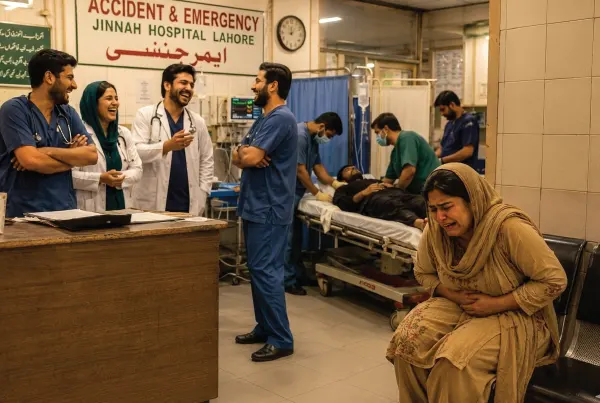
This is not simply an issue of classroom instruction or outdated models in anatomy labs. This reflects a deeper problem that shows up in clinical practice every day. Women enter OPDs and emergency rooms describing severe pain, exhaustion, nausea, or discomfort, only to be told that they are exaggerating, overreacting, or being emotional. Their pain is routinely interpreted through the lens of hysteria rather than pathology. The consequences of this are not abstract. They result in delayed diagnoses, failures in treatment, worsening disease progression, and ultimately, compromised safety and quality of life for women everywhere.
The problem becomes especially evident when you look at how research itself is funded. If you examine the allocation of medical research funding globally, you will find glaring disparities. Roughly nineteen times more funding is allocated to prostate cancer than ovarian cancer, despite ovarian cancer carrying devastating mortality rates due to late diagnosis. This imbalance is not merely financial; it reflects whose suffering is prioritized and who is told to endure silently.
On a larger systemic level, there is still only a surface-level understanding of the way certain pathologies manifest in women simply because most scientific and medical efforts continue to be directed towards the male body. Historically, clinical trials overwhelmingly used male participants as the default research subjects, assuming that findings could simply be generalized to women. The result is an entire medical system built around incomplete data. Focusing on a specific target demographic excludes more than half of the population.
Women’s symptoms often present differently, diseases progress differently, and medications can affect women differently. Yet medicine continues to treat the male body as universal and the female body as a variation.
Few conditions demonstrate this neglect more clearly than endometriosis. According to a study conducted in 2025, roughly 22 percent of women in Pakistan suffer from infertility, with 23.29 percent of those women having endometriosis. Despite this, diagnosis for endometriosis is delayed by four to eleven years simply because the predominant symptom of endometriosis is severe abdominal pain. It is this same pain that women are routinely dismissed for and are told to endure.
Young girls grow up being told that pain is natural to womanhood. Severe cramps are normalized. Fainting from periods is normalized. Vomiting from pain is normalized. Many women only discover years later that what they were taught to tolerate was, in fact, a serious medical condition. By then, the disease may already have progressed significantly.
In South Asia, these issues become even more layered because women’s healthcare is rarely treated as belonging fully to women themselves. Oftentimes, women are brought to hospital settings by the men around them. It is these same men who proceed to make vital reproductive decisions about women’s bodies. Consent becomes blurred. Autonomy becomes conditional. Women are expected to silently accommodate decisions regarding fertility, contraception, childbirth, and surgery, even when they are the ones physically enduring the consequences.
There is a callousness in the way this society, especially in South Asia, treats women’s health and safety. It starts at the very grassroots. It starts when girls are taught to minimize their pain. It starts when sons are raised to speak over women in clinical settings. It starts in medical colleges where male anatomy is taught as standard and women’s bodies are treated as deviations from the norm.
Medicine likes to think of itself as objective, rational, and evidence-based. But the evidence it chooses to prioritize reveals its biases. Until women’s pain is believed, researched, and treated with the seriousness it deserves, healthcare will continue to fail half the population it claims to serve.

The writer, based in Karachi, is a freelance contributor with a keen interest in culture, media, and gender narratives. She can be reached at maleehaatbss@gmail.com.
Leave a Reply