



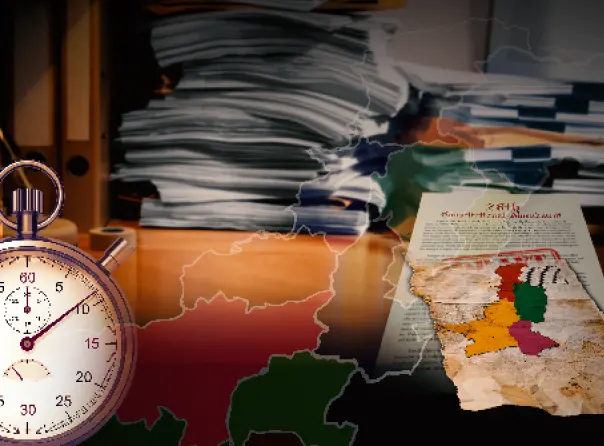
Lately, there’s a lot of excitement in political circles about the upcoming 28th Amendment to the Constitution. People often suspect that such Amendments are driven by hidden motives and the ruling party’s hidden agendas, leading the other parties to act as if they are unaware of any plans. Still, it’s quite clear that something is definitely on the horizon.
It’s very likely that the 28th Amendment, just like the 26th and 27th Amendments before it, would have been quietly added to our often-updated Constitution without much fuss. Politicians generally accept these changes, especially regarding how judges are appointed and transferred under the new system established by those earlier amendments. But this time, the situation feels a bit more significant.
Following the significant boost in our government’s international reputation after the four-day war with India in May 2025, and Pakistan stepping in as a facilitator for a peace deal during the brief Israel-US conflict with Iran, Pakistan’s so-called Establishment saw a golden opportunity. They believed it was a chance to broaden their influence and repair the damage caused by the 18th Amendment to the Constitution. This amendment, introduced by the Pakistan People’s Party, shifted more power to the provinces, reducing federal authority.
The People’s Party, on its part, proposed ending the MQM’s call to make Karachi a federally administered city forevermore. With a view to achieving this purpose without seeming to have any ulterior motive, the People’s Party stalwarts had to permanently put an end to the ambition of all those who aspired to create more provinces in the country. Hence, the Amendment relating to the creation of a separate province was made subject to approval of the legislature of the very Province from which the new provinces were to be carved out, which, to say the least, is ironic as it is misgovernance by the hierarchy of the large parent province itself that creates the need for a new province to be carved out.
As we celebrate their success in helping to prevent the creation of New Provinces, it’s also a good reminder that similar aspirations could arise within Sindh itself someday. People there might wish to establish new provinces such as “Sukkur” and “Mirpur Khas” to promote growth and ensure their communities are better represented, possibly by separating from the rural parts of Sindh. Plus, Karachi’s lively, diverse, and energetic spirit clearly makes it deserving of its own province, highlighting its unique identity beyond just ethnicity.
At the same time, thriving centers in other provinces began to grow, leading to the creation of new provinces like Balochistan, which now includes its Southern Coast, and KPK, where some areas are exploring mining opportunities for rare earth minerals. In the northern regions, there’s been a sudden rise in global interest in tourism, fueled by Pakistan’s growing international profile and more active commercialization. Moreover, global business giants have shown interest in investing in our region, encouraged by the impressive progress in digitalization and information technology. This development has contributed to the emergence of a more open-minded society with changing social norms, making the area more inviting and friendly for visitors from cultures with more relaxed attitudes.
As Pakistan’s presence on the international stage has grown in recent years, we also see important historical events shaping a new global landscape. This change is largely driven by China’s rise as a major world power and the world’s move towards a multipolar order, shifting away from the earlier unipolar or bipolar world balance.
What’s really needed is a significant Constitutional Amendment—referred to as a “Reversal of the 18th Amendment.”
Considering Pakistan’s growing connection with China, especially through the Belt and Road initiative, it’s quickly becoming a major power. However, for Pakistan to truly establish itself at this level, it will need to navigate its competition with India. India has also shown strong ambitions of becoming a global power. However, its progress has been hindered by economic struggles, widespread poverty, and some concerning tendencies.
For Pakistan to truly stand out from India, it will need to significantly strengthen its economy. To achieve this, Pakistan might consider redefining its geographical boundaries, drawing new lines that better reflect its current needs. Essentially, it’s about reshaping itself—reorganizing administrative regions to move beyond the old, often narrow-minded divisions of traditional provinces. These changes could help create a more unified and progressive nation.
However, it was tough to achieve because the province of Sindh was quite determined to keep control of Karachi. This prevented Karachi from becoming a significant power hub that could benefit Sindh and the country as a whole. Clearly, what’s really needed is a gentle easing of the provincial grip on the economy and a fairer sharing of authority between the Federation and the Provinces. This way, the Federation can make important decisions that boost the country’s economy more effectively, benefiting everyone.
The question now is whether Pakistan should continue with its longstanding policy of maintaining provincial autonomy or make a positive change by moving towards a more active Federation that manages the country’s overall functions. This way, the provinces can focus more effectively on local government, ultimately benefiting the people. To help Pakistan progress and thrive, it will be important for the country to transfer some powers from the provinces to the Federation, paving the way for a brighter future.
Given that Pakistan has developed a deeply rooted culture of parochialism that influences our social fabric, it’s important for our Parliament to pass laws that help reduce parochial attitudes and the conflicts they can cause.
To reach this goal, it’s clear that simply changing laws won’t be enough. Instead, what’s really needed is a significant Constitutional Amendment—sometimes referred to as a “Reversal of the 18th Amendment.” This would involve creating new Provinces or Administrative Units and rethinking how resources are shared between the Federation and Provinces. It would also include revisiting the NFC Award and adjusting the distribution of responsibilities between Provinces and the Federation.
For example, making education a federal subject could help us better navigate the digital age. With the rapid growth of information technology and artificial intelligence, a unified approach can ensure that young people across the country have access to quality learning opportunities. Likewise, ensuring health facilities are equally available everywhere is essential. That’s why considering health as a federal subject is also worth exploring, to promote better health services for everyone.
Reaching these political goals might be quite challenging because our country’s society is deeply rooted in an elitist feudal culture based on hereditary principles. Such traditions are likely to be challenged and displaced by reforms, which would lessen feudalism’s hold on those beneath it. As a result, there could be significant resistance from them. This situation brings to mind the famous Shakespearean question, “To be or not to be,” especially when considering the proposed 28th Amendment.
If Pakistan wishes to make the most of the recent global developments, which have put our country in the spotlight, boosted our international reputation, and given us an edge over neighboring countries like India—who have always sought the same position—we should look beyond minor legislative tweaks. Instead, we need meaningful changes to our Constitution. Right now, it feels quite outdated because it doesn’t truly reflect the will of the people, even though it claims to support a Parliamentary system. Plus, it doesn’t clearly define the checks and balances that are essential features of a Presidential system.
It’s important to recognize that this is, at best, a Hybrid Constitution that aims to maintain the current situation. That’s why there’s a real need for a meaningful 28th Amendment, rather than just a superficial one that merely includes the suggestions mentioned earlier. The question is whether our political leaders are truly capable of making such significant changes to the Constitution, or if Pakistan will continue to struggle with poverty, backwardness, and outdated traditions. 

Based in Karachi, the writer is a former judge of the Sindh High Court. He has been actively involved in human and women’s rights causes.
Leave a Reply