



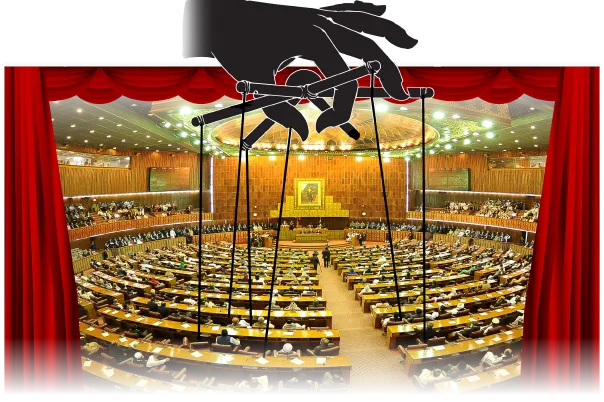
“The Holy Book calls upon Muslims to resist tyranny.
Dictatorship in Pakistan, however long, has, therefore, always collapsed in the face of this spirit.” [Benazir Bhutto]
Good governance, the reasonable conduct of public affairs, and the responsible management of public resources are essential to the success of any state. Democracy is commonly described as “government of the people, by the people, for the people,” and the Constitution is the social contract between the state and its citizens.
The ‘Basic Structure’ of the Constitution is the Contractual Obligation, which cannot be changed, but unfortunately, it has been altered through the recent two amendments. In Pakistan, however, this ideal has long been viewed with skepticism. Whether under democracy or dictatorship, the country’s history of governance has been troubled. Military intervention in civil affairs has repeatedly produced political turmoil and imposed high costs on the people. Quaid-e-Azam envisioned a democratic, parliamentary system, and that vision is reflected in our Constitution.
Yet, from the very beginning, weak political parties and persistent corruption created a vacuum that stronger, unelected forces were ready and did fill. The most recent election, as widely acknowledged, severely damaged public confidence in both the electorate and the electoral process.
A government installed now is the result of a compromised process and cannot be expected to produce good governance. Power in a constitutional system should be used to protect fundamental rights and freedoms, make sound economic decisions, promote social welfare, uphold the rule of law, and maintain an independent judiciary free from political interference. As Etounge Manguella observed, “Good governance implies the presence of the rule of law, the safeguard of human rights, and the existence of an honest and efficient government.”
Unfortunately, what Pakistan increasingly experiences is an “elected dictatorship” or “dictatorial democracy,” in which citizens may vote once every five years but have little real voice in decisions that shape governance, accountability, or development in their own areas.
The Constitution provides for governance through a Parliament fairly and honestly elected by the people. Elections are to be conducted by an independent Election Commission acting honestly and impartially. Regrettably, that ideal has not been fulfilled. An institution that should stand above influence has too often appeared partisan and subject to the pressure of those who wield power behind the scenes.
For good governance, institutions matter. Unfortunately, in Pakistan, they are often used for political purposes. Elected leaders and their allies behave as though the state belongs to them. Authority, coercion, and the exercise of force do not build successful countries; institutions that function fairly do. The Executive, Parliament, and Judiciary are the three pillars of the state. However, the third pillar now seems to be compromised. Yet once a government is elected, the very institutions that give it legitimacy are frequently subdued or sidelined.
Parliament is too often used by the powerful to advance self-serving laws that weaken accountability and distort the constitutional balance. Legislation is rushed through without serious committee review or any meaningful debate. Laws are passed in haste to preserve authority, ignoring the very processes on which responsible government depends. Parliament then becomes hostage to the government, while unelected actors ensure that it remains symbolic rather than functional.
The manner in which the 26th and 27th Constitutional Amendments were passed, within days and without proper debate or committee scrutiny, speaks volumes about how subordinate the Parliament has become. As has rightly been said, “The Constitution is not an instrument for the Government to restrain the people; it is an instrument for the people to restrain the government.” Yet these amendments have, in effect, been made and used to strengthen the government against the people.
Another vital institution is the bureaucracy, both civil and military. No government can function effectively without a stable and competent bureaucracy. It provides continuity, expertise, and service delivery. Yet instead of strengthening it, successive governments have controlled, politicized, or sidelined it. Political interference in postings, transfers, and promotions has become normal. Loyalty is rewarded more than performance, creating a system in which officers serve those in power for survival rather than for service to the public. Frequent rotations destroy continuity, and bureaucracy begins to serve the influential rather than the people.
The judiciary is another key institution. Its duty is to protect citizens from government excesses and to ensure justice for all. In the past, the judiciary has at times stood up against unreasonableness and misuse of power. As observed in the Independent Newspapers case, “Excessive use of lawful authority is unlawful.” Yet the 26th and 27th Constitutional Amendments appear designed, in large measure, to bring the judiciary under greater control. The method of appointing judges of the superior courts has been substantially altered with a view to undermining their independence by giving Parliament and government nominees a larger role in their appointment and removal.
The proposed Federal Constitutional Court, whose Chief Justice is to be appointed by the President on the advice of the Prime Minister, with the first batch of judges appointed in the same way, raises serious concerns about executive influence. Thereafter, judges are to be appointed by a committee in which parliamentary members are in the majority. When judicial appointments become a matter of vote rather than merit, the independence of the judiciary and its role as a saviour of people is inevitably put at risk, and the public is left to wonder how freely such judges can decide cases involving those who elevated them through a process of election, rather than merit.
Both civilian and military governments have repeatedly interfered in judicial affairs. At different times, courts have been too compliant, too reactive, or too vulnerable to political pressure. But what this “dictatorial democracy” now seeks is not merely influence; it seeks obedience. Once the judiciary is weakened, nearly every other institution weakens with it, and the citizen suffers most. Young Pakistanis must understand this clearly: mature democracies balance governance with popularity, but Pakistan has failed to do so. Our institutions have been weakened not by one party alone, but by decades of political, military, and bureaucratic choices.
Our country is deeply polarized, yet the real question is whether governance matters more than the mere popularity, power, or authority of politicians. There has to be a determination by the people that mere popularity, combined with other sources of power and authority, is insufficient; one also needs to see whether the popular person aligns with democratic principles. Citizens must ask whether a popular leader also believes in democratic values and would strengthen the institutions on which democracy depends. Speeches and charisma do not build nations; strong institutions do. Leaders should therefore be judged fairly, not by slogans, but by whether they strengthened or weakened the Parliament, protected or undermined the judiciary, and insulated or politicized the bureaucracy.
We must choose those who will restore institutions, respect constitutional limits, and rebuild the country through law rather than through personal power.

The writer, who is based in Karachi, is a Senior Advocate of the Supreme Court of Pakistan and has also served as the Attorney General of Pakistan.
Leave a Reply