



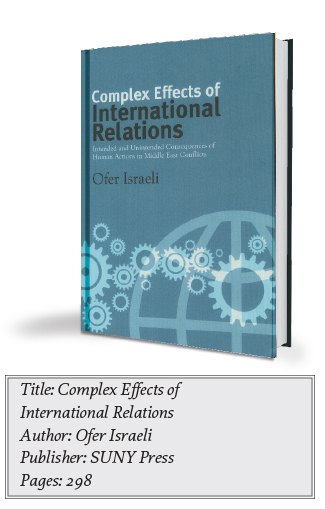
Ofer Israeli’s Complex Effects of International Relations builds on the assumption that foreign policy activities inevitably have unpredictable consequences. It is difficult to tackle the intricacies of this subject without relying on practical insights gleaned through a critical understanding of global events. The author doesn’t just restrict his analysis to political facts, but also skillfully intersperses theoretical concepts into it.
At its core, the book uses the notions of unintended and intended consequences to appraise the complex effects of international relations. In an effort to assess the unintended consequences, the author provides readers with a complex-causal mechanism to explore the rebound results and derivative products of international relations. Meanwhile, the complex-causal mechanism presented in the book to examine intended consequences seeks to explain results that are “circuitous but intended”.
Part I of the book effectively outlines the key concepts and themes without resorting to heavy jargon or esoteric knowledge. All major concepts are explained without compromising on academic rigour or clarity. Various notions, such as the concept of complexity, are difficult to define in precise terms. Nevertheless, the author actively engages with the ambiguity surrounding this concept and never allows it to impede his analysis.
By presenting a theoretical framework and a cohesive typology on complex effects, the author argues that the intricate nature of our international system cannot be explained in a simplistic fashion. Even so, an excessive dependence on theory will only present a skewed perspective on the issue. As a result, the book offers case studies from the Middle East to explain the practical relevance of these theoretical notions. The author’s emphasis remains on qualitative methods of analysis rather than quantitative ones. This is a useful technique that allows readers to develop a deeper understanding of case studies where results don’t always follow a linear trajectory and details tend to be convoluted.
In order to understand rebound results within the category of unintended consequences, Ofer Israeli draws attention to the Six-Day War of June 1967. The war, which eventually decimated “Arab pride” and culminated in the Yom Kippur War of October 1973, can be construed as a rebound result when viewed from an Israeli perspective. Ofer Israeli explores the derivative products of international relations by highlighting the positive and negative side-effects of key political events in the Middle East. In an incisive chapter on the Yom Kippur War, the author reveals that the conflict doesn’t just reflect a dark chapter in Israel’s history, but also unintentionally spurs a much-needed peace treaty between Egypt and Israel.
The sections of the book that seek to demonstrate the complexity of intended consequences are handled deftly with the help of concrete real-life instances. Ofer Israeli evokes memories of the Yom Kippur War and Operation AJAX to reveal the essence of circuitous yet intended consequences in international relations.
With rich detail and a welcome freshness of perspective, the book offers some unique insights into the security dynamics within the Middle East. Complex Effects of International Relations doesn’t seek to offer a diplomatic history of the region. Instead, the author intends to present the complex-causal mechanism as a distinct international relations mechanism.
Skeptics may rightly argue that the validity of this mechanism can’t be assessed through case studies from the Middle East only. However, the workings of an inherently complex system of international politics cannot be summarized in one book. Ofer Israeli’s insights ought to be taken further and analysed with reference to case studies from other parts of the world.
Imbued with historical details on the conflicts within the Middle East, Complex Effects of International Relations examines the consequences of actions taken in the international arena and may serve as a useful guide for experts and policymakers. 
Leave a Reply