That’s particularly true when it comes to relations between Israel and the United Arab Emirates.
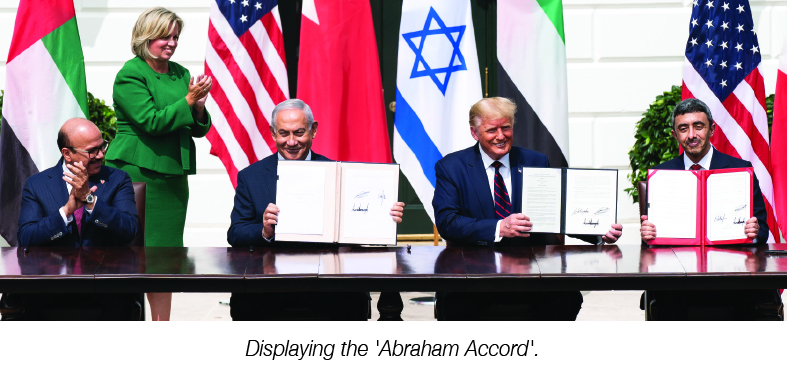
Following the announcement of a normalization agreement between the two in August, Israeli Prime Minister Benjamin Netanyahu mentioned that his country would import from the UAE free zones, declaring that “we know that we will get good prices,” and hinting that further engagement would follow. What had appeared to be a “marriage of convenience”, has blossomed into a full-fledged love affair. Unlike traditional marriages both nations fell in love...and secretly consummated their relationship.
The Emiratis have woven appeasement as a strategic calculation to prevent Israel’s illegal annexation of Palestinian lands to promote peace in the region. This has been an issue, which made people laugh!
In doing so, UAE perhaps harboured greater hostility than sympathy towards the Palestinians. This deal is more than likely to weaken the Palestinians’ struggle for their freedom. This has been more an act of alliance, rather than agreement, directed at the regional powers Iran and Turkey. And, this could disturb the regional peace in times ahead
Israel may be turning over a new leaf with the UAE; however its ties to Free trade zones are not something quite novel. This cooperation over free trade zones has followed a ritual in which economic partnerships between nations have garnered wonderful relations!
The emirate of Dubai, widely considered the Gulf’s de facto free zone hub, has used its flagship commercial entities to cement ties with Israeli counterparts. In September, DP World—the Dubai-based multinational logistics company—and other government-related entities signed multiple agreements with Israel-based DoverTower Group, a shareholder of the Israel Shipyards port in Haifa and a partner in Eilat Port. DP World plans to assess port and free zone development opportunities in Israel as well as establish a direct shipping route between Eilat and the UAE port of Jebel Ali.
Moreover, the Israel Diamond Exchange and the Dubai Diamond Exchange, which is part of the government-owned Dubai Multi Commodities Centre free zone, inked an agreement to enhance cooperation in diamond trade. The Jebel Ali Free Zone and Dubai Airport Free Zone Authority both signed memorandums of understanding with the Federation of Israeli Chambers of Commerce in late September to support Israeli companies intending to establish businesses in Dubai.
The involvement of free zones in geopolitical reconfigurations is not restricted to the Persian (Arabian) Gulf states. Plans made by Iran and China to formalize a 25-year strategic partnership have included Chinese commitments to develop Iranian free zones in Maku, Abadan, and Qeshm Island. In 2019, a state-owned Chinese oil-trading company imported Iranian oil into what is known as bonded storage—a component of free zones—in China so that the oil would not pass through customs or appear on national import records.
Free zones and other mega projects with free zone characteristics are also crucial channels for foreign direct investment flows into the Middle East. Chinese firms have invested or pledged billions of dollars for projects in Abu Dhabi’s Khalifa Port Free Trade Zone and the special economic zone in Duqm, Oman.
Several factors explain why free zones have moved to the forefront of geopolitical relations in the broader Middle East.
First, there is a widely held perception that free zones reduce risks associated with entering new markets.
Marketing strategies depict free zones as politically neutral commercial gateways with seamless and cost-effective services. Host governments may create free zones and other forms of special economic zones to gauge the effects of potential economic reforms—such as easing local ownership requirements—or to develop new industries. In this respect, governments and policymakers may treat free zones as commercial litmus tests.
Second, free zones attract a wide array of local, regional, and international economic actors. This diversity of players can shield individual governments from criticism relating to new international relationships, for example between the Gulf states and Israel. Global business actors operating in Gulf free zones also enjoy preferential business incentives, which include greater ownership rights, lax labour regulations, and exemptions from customs duties and taxes. There are prominent structural components of the Middle East’s political economy, especially that of the Gulf region. In Dubai, for example, investors may well choose between dozens of operating free zones, and the emirate’s 50-year charter sets out its vision of a virtual commercial city that can host 100,000 firms. Saudi Arabia’s Neom—a megaproject-cum-free zone in the northwest of the country—stretches the bounds of national sovereignty by aspiring to incorporate nearby Egyptian and Jordanian territories.
Saudi policymakers have also proposed free zones along Saudi Arabia’s borders with Yemen and Iraq, presumably to advance its objectives in those countries. The Qatar Free Zones Authority aims to offer “state of the art” infrastructure next to Hamad Port and Hamad International Airport, while Omani free zones ostensibly seek to promote growth in underdeveloped parts of the country.
Free zone development occasionally faces local opposition.
Some Kuwaiti policymakers fret that a planned economic zone in the massive Silk City project would have adverse commercial and legal effects, such as excluding local developers or permitting the consumption of alcohol. However, other Kuwaitis believe that creating an economic zone and adjoining business hubs is a promising approach for strengthening Kuwait’s links with the northern Gulf, Central Asia, and Europe.
While free zones do play a role in broader efforts to encourage friendlier political ties between countries, it is difficult to identify a clear causal link between this economic mechanism and positive foreign relations outcomes. The considerations underlining business interests often diverge from key foreign affairs objectives.
Moreover, employing free zones within the domain of foreign relations has the potential to enrich small, isolated segments of given populations without engaging larger swaths of respective societies.
Ultimately, free zones are attractive because of their flexibility as economic policy instruments. If president-elect Joe Biden and his administration permits Iran to engage more fully with the global economic community, free zones in places like Dubai will be among the first beneficiaries.
Existing free zones are keeping pace with changing international relations; future free zones shall most likely foster new and surprising global linkages in the coming years. 





Leave a Reply