
Education
Single System Debate
Improving minimum standards does not mean a uniform curriculum for all.
It will only end up killing the healthy diversity of education systems.

There is no denying that disparities persist often as a result of serious policy-level discrimination and neglect of economically disadvantaged and vulnerable communities. It also goes without saying that poor allocation of education funds is responsible for dismal performance of schools and higher education institutions. Under such circumstances, the government’s assertion that bringing uniformity in the education system would help alleviate the perils of poverty would not be fair, given the fact that the education sector, along with the health sector, is among the least prioritized areas for the government to allocate sufficient funds. At the federal level, education gets an average share of around 2.5% or less of the GDP and, at the provincial level, a lion’s share of the funds is generally exhausted in mere maintenance of staff and other operational activities, whereas no improvement is seen in further development of infrastructure, improving quality of standards for teachers and students, content generation and increase in enrollments.
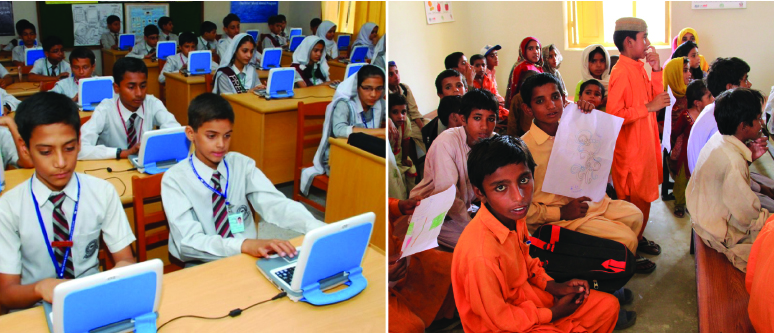
The Federal Ministry for Education and Professional Training has identified at least four parallel education systems, which it holds responsible for creating education apartheid. These systems are formal public schools, formal private high-end schools (following the Cambridge or IB curriculum), formal private schools (following the curriculum prescribed by local boards) and Deeni Madaris, or religious seminaries. Before we delve into a conversation on the streams of education present in Pakistan, let us first look into why parallel systems of education exist. Where communities and societies are segmented by their socio-economic situations, different preferences are bound to take place. It all boils down to what parents want for their children who are too young to decide for themselves. Poor parents are often more prone to send their children to Madaris in place of a public school, because there they are offered free lodging and food. This preference may not necessarily be for religious teachings. At the same time, there are some affluent families that prefer to send their children to religious schools for specific religious teaching. Then there are also families that prefer to send their children to low-budget private schools as they lack confidence in state-run schools, just like affluent or rich families send their children to English medium private schools because they find the general quality of public schools sub-standard. And then, there are those students who graduate or drop-out of secondary schools to get into vocational institutions to get required mechanical skills as per the labour market needs.
Although not recognized by the government yet, but there are also mentionable welfare initiatives that offer experiential learning opportunities for street or gypsy children by offering them flexible timings and improvised, self-designed curriculums based on basic literacy and creativity. All these systems and streams of education have their own goals, represent a certain mindset and help develop economic opportunities for students within their own domains. To push ahead with the idea of single curricula might take away the variety of streams that were able to conveniently address specific preferences of parents and communities.
What is a Single National Curriculum? Why are so many concerns being raised by almost all eminent educationists in Pakistan? To many, the SNC is a replacement for all other curriculums at both the private and public school level. The Federal Minister for Education and Professional Training, Shafqat Mahmood, said in a TV show that the SNC would be enforced at all educational institutions through an act of parliament and, so far, all mainstream political parties appear to be in agreement. The SNC is a way to end “education apartheid” whereas, in reality, it may end up amplifying quality apartheid.
Transparency of the entire curriculum development process is being questioned, as some whose names appeared in the published NCC members’ list later claimed their attendance signatures were taken as their approval of the curriculum, whereas their concerns were not heard or entertained. Some even pointed out that the exercise for setting minimum standards was already elaborately done in 2006, and that this is, in fact, a copy-paste of the same. The only thing that is different this time is that Student Learning Outcomes have been defined for the Islamiyat curriculum, which will now be introduced from Grade 1, instead of Grade 3, as previously done. Educationists and critics of SNC have pointed out that with the menace of already poor learning outcomes in public schools, this will greatly impair learning abilities of children as they will then succumb to more rote-memorization.
There are also major concerns for indoctrination based on the idea of religious nationalism. Dr. Maryam Chughtai, an eminent educationist herself and also a spokesperson for Single National Curriculum has, in many webinars, expressed her idea of using religion positively to encourage good citizenship practices early on. In a very interesting webinar debate, she defended the position that religion can be used as a tool to further secular or nationalistic objectives. But there is an inherent central question on how religion should be taught? The clue for rampant radicalization of youth lies in the methodologies and teachings, which adopt a confessional approach that results in further alienation of non-Muslim and other minority pupils in the school.
Good citizenship behaviours and ethics need not have a certificate of religion. Religious education should be a matter of choice, not compulsion and should at best be considered for public schooling with non-confessional pedagogies. We need to realize that, in Pakistan, the youth is becoming more influenced by extremist religious ideologies. Previous experiments of religious nationalism have already provided worrying consequences. Something that was pervasively introduced at public schools four decades ago needs to be undone, and the solution for it does not lie in introducing more religion in our curriculum. Nor does it lie in ending different streams of education. The only thing that matters now is making education accessible, while not destroying the essence of evolutionary strife for standard settings. Improving on minimum standards does not mean a uniform curriculum for all. It will only end up killing our healthy diversity of education systems.![]()
The writer is a peace educator and an opinion writer based in Lahore. She is also a co-founder of the Centre for Peace Dialogues. She can be reached at zeeba.hashmi@gmail.com |
|
Cover Story
|
|
News Buzz
|
Leave a Reply Cancel reply |
Update |


Very well written Zeeba Hashmi. I second you in this thought that SNC will destroy the diversity. Maleeha Lodhi in her book, Pakistan beyond the crisis state, states that Diversity is the strength. Furthermore, she states that It is because of the diversity in Pakistan, the chances of its disintegration is minimum. So by implementing SNC, the academic standards of our educational system will get worse.