

Heritage
Inter-faith Harmony
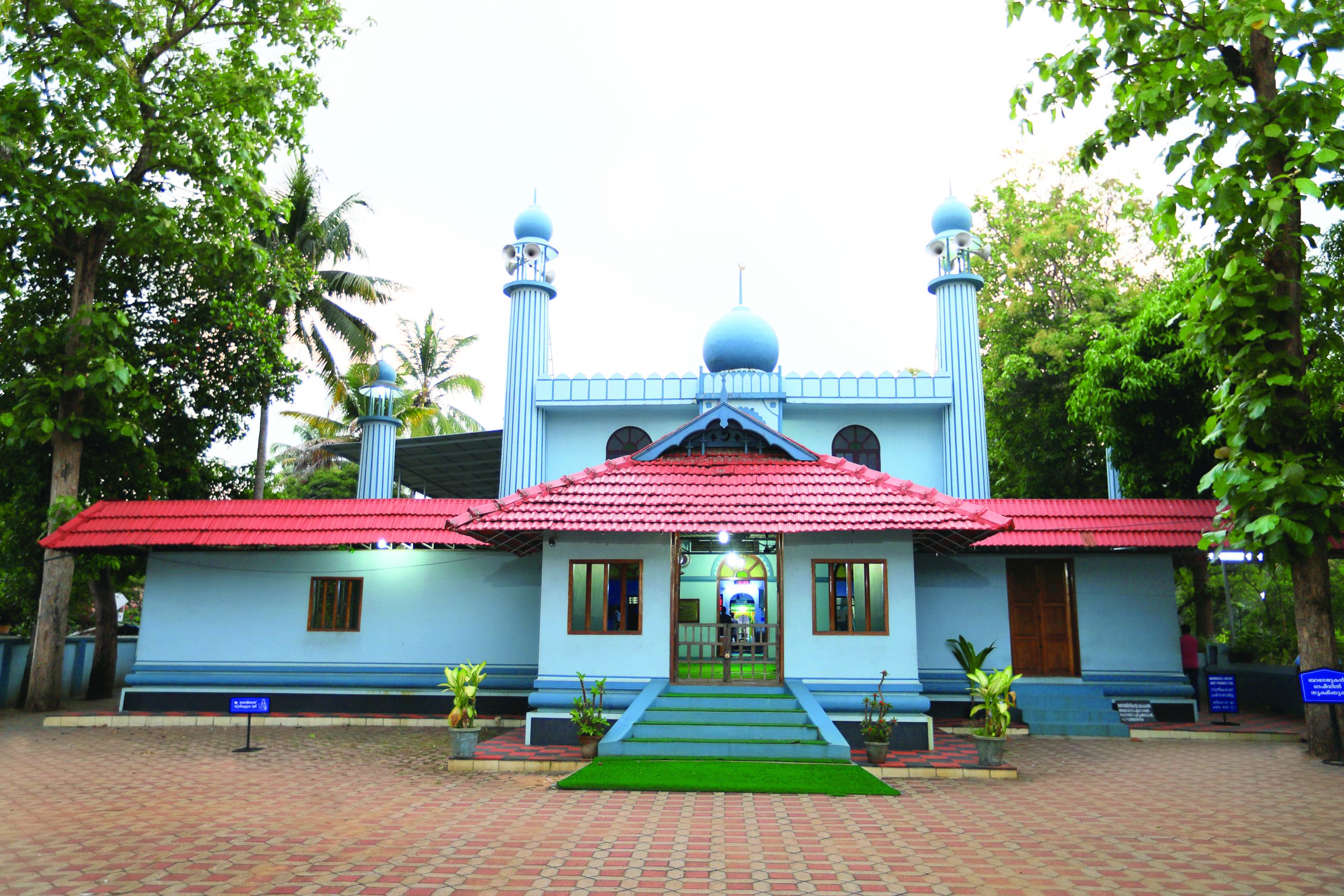
The Cheraman Juma Masjid in Kerala, India, built in 629 AD, is a symbol
of interfaith harmony that was groomed and nurtured over centuries.
It is a structure almost as old as time. Built somewhere in 629 AD, the Cheraman Juma Masjid in Kerala, India, is probably the oldest Muslim structure constructed in the country. It could probably be one of South Asia’s mosques built during that era. Researchers estimate that the mosque was built during the time of the Holy Prophet Mohammad (Peace Be Upon Him). Ever since, it has remained a place of prayers for Muslims.
Considered as India’s first mosque, the Cheraman Juma Masjid is located in Kodungallur, Kerala. Historians claim that one of the first Arabs to arrive in India was Malik Bin Dinar. He was a proponent of Islam. Some sources claim that Malik Dinar was a Persian traveller who died in 748 CE. It is reported that his father was a Persian slave from Kabul who was one of the disciples of Hasan al-Basri.
It is worth noting that the Arab general Muhammad Bin Qasim invaded Sindh in 711 AD via the sea route; this was much after the Cheraman Juma Masjid was built in Kerala 629 AD.
However, the name of the Cheraman Juma Masjid does strike interest among people. It is named after a non-Muslim. Some stories say that Cheraman Perumal was a king from this area. He was fascinated by Islam. He gave up his throne and embraced Islam to begin a new life. Cheraman made a pilgrimage to Mecca and stayed there for a few years. While returning to India, he fell ill on the way and died. It is said that Malik Bin Dinar was captivated by Cheraman’s life story. Dinar resolved to complete the journey to India that Cheraman had begun. Dinar arrived in India with his companions after great efforts. They had letters written by Cheraman who wanted to ask the local rulers of Kerala to permit him to build a mosque.
The mosque was built as a praying and congregation area for the Muslims. Its architecture has many details of Islamic heritage. However, the mosque also has elements of Kerala’s architecture. This speaks about the manner in which buildings were built in the years before and after 629 AD in this part of India. Furthermore, historians say that there is an ancient lamp inside the mosque which they believe has been continuously burning ever since the mosque was constructed. Tourists and visitors often bring oil to add to the lamp as a way to pay homage to the structure.
Some sources state tha the Portuguese had destroyed the mosque in 1504 when Lopo Soares de Albergaria attacked the port in Kodungallur. Albergaria was the third Governor of Portuguese India. Over the years, wear and tear has compelled the authorities to renovate the mosque from time to time. The inner halls, the interior and the ancient lamp are still preserved in their original state. Another historical site standing near the Cheraman Juma Masjid is the St Thomas Church of Palayoor which was constructed in 52 CE. It is considered to be one of India’s first churches.
The exterior of the Cheraman Juma Masjid is simple. The entrance has a wooden double door with a few stairs. Two windows at either side of the main entrance beautify the front end. The red bricks on the roof along with the blue exterior add a soothing ambiance.
Visitors and tourists seeing the masjid for the first time may perceive it to be just another place of offering prayers for the Muslims. When the locals narrate to them the history and the legacy of the mosque, the visitors greatly admire the religious significance of the place.
In view of the history of the Cheraman Juma Masjid, one may have questions about the period when Islam actually arrived in this part of the world. It is evident that when Malik Bin Dinar came to Kerala, this was long before the Mughals had established their rule in India. This means that Islam arrived in India and in the sub-continent decades before we think it actually did. Furthermore, the construction of the Cheraman Juma Masjid reveals that the people in this part of the world, who were Hindus, accepted the arrival of the Muslims. The natives even allowed the Muslims to construct a mosque on their land. Even today, the Muslims and the Hindus in Kerala along with Christians live a peaceful life based on coherence and mutual trust backed by interfaith harmony.
According to historian Muttayil G. S. Narayanan, “There is no reason to reject the tradition that the last Chera king embraced Islam and went to Mecca, since it finds its place not only in Muslim chronicles, but also in Hindu Brahmanical chronicles like the Keralolpatti, which need not be expected to concoct such a tale which in no way enhances the prestige of the Brahmins or Hindu population.”
The history and legacy of the Cheraman Juma Masjid compel us today to ponder on several points. The mosque is proof that interfaith harmony can be achieved by people who learn to live together though they may be from distinctly different belief systems and religions. If the people of Kerala in 629 AD could permit Muslims to construct a mosque on their land, then why can’t similar emotions of harmony emerge today? The Cheraman Juma Masjid has continued to stand for centuries. Today, India has become a country where Muslims face atrocities at the hands of just a clutch of Hindus. The Cheraman Juma Masjid’s history and how it has survived through centuries should be an eye-opener for the rulers of today’s India. ![]()
The writer has a special interest in the region’s social and political affairs. He can be reached at omariftikhar82 |
|
Cover Story
|
|
Special Editorial Feature
|
|
Region
|
|
News Buzz
|
Update |


Leave a Reply