

Cover Story
Double Standards
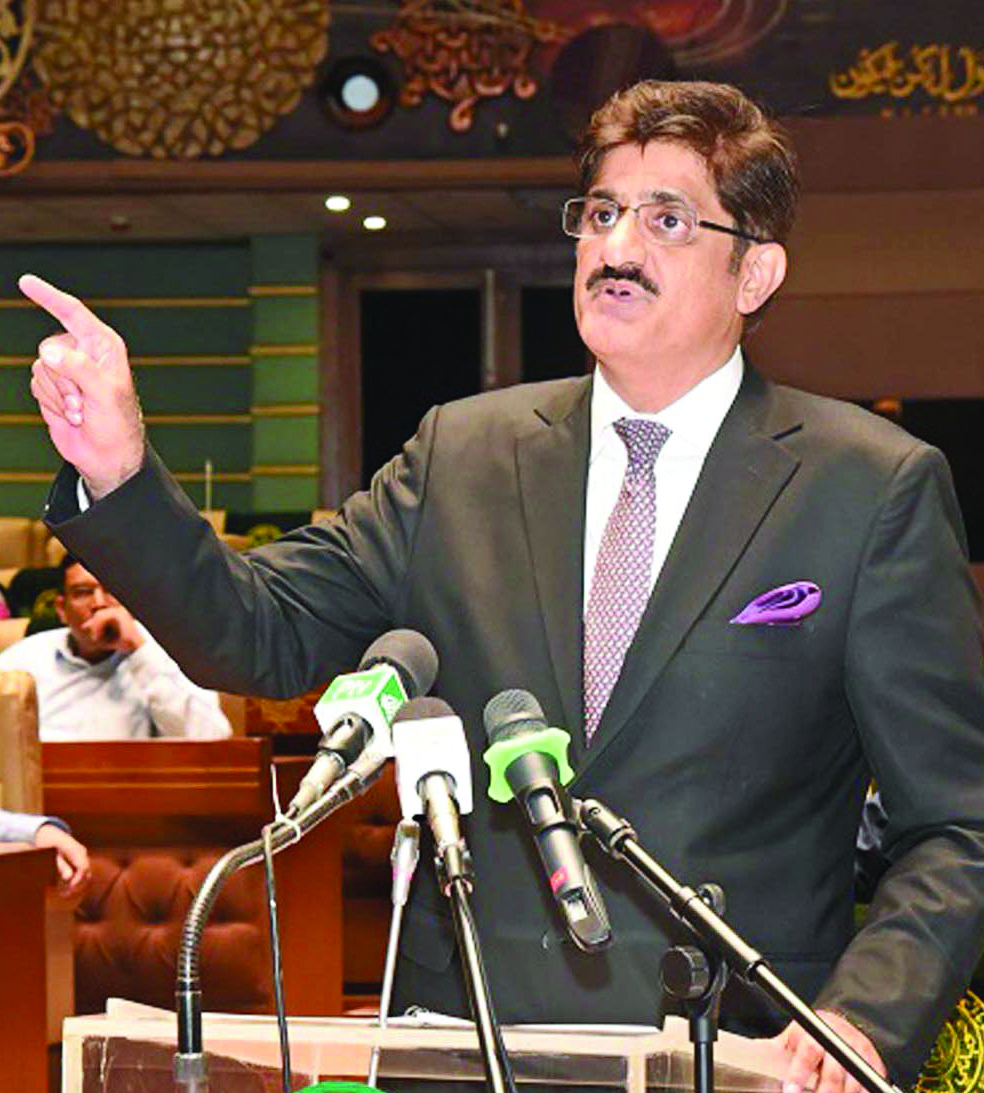
Chief Minister Murad Ali Shah does not want Sindh to be treated as
Islamabad’s colony but he treats Karachi as a colony of Sindh.
The Chief Minister of Sindh Murad Ali Shah often uses supremely confident rhetoric to put forward his principled stance. Wrapped in consummate confidence and peppered with an unwavering conviction, his clear-cut statements corroborate his so-called upright veracity of judgment when he categorically warns Islamabad of the repercussions of treating the Sindh province as its ‘colony.’ Murad deserves a thumbs-up for his remarks as this sets a textbook example of how a truly independent soul should always think and act.
However, an independent human being will neither want to be treated as a seized property, nor will he treat someone else the same way. Boasting of himself as a fully independent, free soul, Murad Ali Shah unfortunately exposes himself as a man of double standards. On the one hand, he does not want Sindh to be downgraded as Islamabad’s colony but, on the other hand, he treats the urban areas of Sindh, particularly Karachi, as if the metropolis is merely a colony of Sindh.
The Sindh government rightly claims provincial autonomy as enshrined in the 18th Constitutional Amendment, but the autonomous Sindh government is reluctant to concede any level of autonomy to the civic administrative body of Karachi. Isn’t this an act of colonizing Karachi, Pakistan’s largest city as well as the hub of the country’s economic activities?
Depriving the Karachi City Government of power and autonomy is just a petty example of the colonial mindset espoused by the Sindh government. A bundle of thanks to the infamous 40/60 quota system imposed in the 1970s on the basis of rural and urban divide. Since then, the rulers of Sindh have pursued a proven track record of denying the entire urban sections of the province of their due rights in terms of jobs and higher education.
The term ‘Mohajir’ refers to the lot of those people who had migrated from India to Pakistan during the Partition in 1947 and most of them had chosen to reside in the urban areas of Sindh, namely Karachi, Hyderabad and Sukkur. The Mohajir youth, or the people of urban Sindh, were more educated compared to the Sindhi population who were mainly confined to the rural areas and were unable to compete with the Mohajirs on the basis of merit. They therefore deserved much-needed social security in terms of employment, but for a period of 15 to 20 years.
For this reason, a one-sided opposition to the imposition of the quota system introduced on an ad hoc basis is unjustified as well. However, the system should have not been continued in the succeeding decades. Unfortunately, the subsequent Sindh governments did nothing but turned the quota system into an absolute reality.
The hanging of Zulfikar Ali Bhutto played a major role in multiplying the sense of deprivation in the people of rural Sindh. General Ziaul Haque misused his powers to suppress the political uprising instigated by the Movement for the Restoration of Democracy (MRD), a political alliance formed against Zia’s military dictatorship. However, Ziaul Haque extended the quota system for another ten years, to somehow appease the fury of rural Sindh. Thus, the opportunistic extension of the quota system became the order of the day.
Though quota reforms were introduced as a makeshift arrangement to provide social justice to the educationally and economically backward rural population of Sindh, its repeated extension turned it into a universal right of Sindh and that too at the expense of social injustice to the urban populations.
State and society can only grow when merit becomes the norm, which, as a result, helps the citizenry to enter into a kind of bondage with the state. On the contrary, people start losing their trust in a state which is ruled by injustice, favouritism and nepotism. A society where merit is the rule makes its people work hard in order to attain excellence, but merit is openly murdered when people are lazy and work-shy. This is what the quota system has achieved for the people of Sindh, making such noble human attributes as justice, merit and hard work totally irrelevant for them.
As things currently stand, the rural youth of Sindh have the least participation in the private sector where things mostly work only on merit. In doing this, the Pakistan People’s Party (PPP) has in fact turned out to be the biggest enemy of the people it represents, since it has ruined many generations of rural Sindh. They can no longer compete on the basis of merit and always look for a pre-defined quota to move ahead in the educational and professional fields.
Recently, Jamaat-e-Islami Karachi Emir Hafiz Naeem-Ur-Rehman filed a petition in the Sindh High Court against the recruitment of some 36,000 people from rural Sindh in government jobs on the basis of fake domiciles of Karachi, Hyderabad and Sukkur. For the people of the Punjab, Khyber Pakhtunkhwa and Balochistan, the word ‘domicile’ would be just another legal document. However, thanks to the quota system, a domicile tends to be a do-or-die matter for the people of Sindh, since their future hangs on the proof of their residence.
In the beginning after Pakistan was established, Sindhis and Mohajirs used to be natural allies and the manner in which the Mohajirs were welcomed by the people of Sindh was warm and inviting. However, the PPP leadership turned them into an eternal enemy by dividing them on the basis of the rural-urban quota and the division on racial grounds ultimately gave rise to a fascist party like the Mohajir Qaumi Movement. MQM’s violent politics created a further rift between the Sindhis and Mohajirs. Sindh has immense development potential because of its capital city Karachi. Since Karachi is the country’s economic and industrial hub and a major seaport on the Arabian Sea, Sindh could have become the most developed province for the country.
The Sindhi-Mohajir rift peaked after the imposition of the quota system in 1973. Subsequently, the MQM’s crude and violence-ridden politics in the late 80s and 90s ended all possibilities of Sindh becoming the leader of the country. The way the military and political establishments let Karachi be destroyed and burned for a period of 30 years shows that there were many internal forces that were ambitiously longing for the city’s destruction. Unfortunately, both the Sindhi and Mohajir leaderships unknowingly played into the hands of such forces, pushing the city of Karachi and entire Sindh far behind in their efforts to benefit from the development potential.![]()
The writer is a columnist and poet. |
|
Cover Story
|
|
Special Editorial Feature
|
|
News Buzz
|
Update |


Leave a Reply