

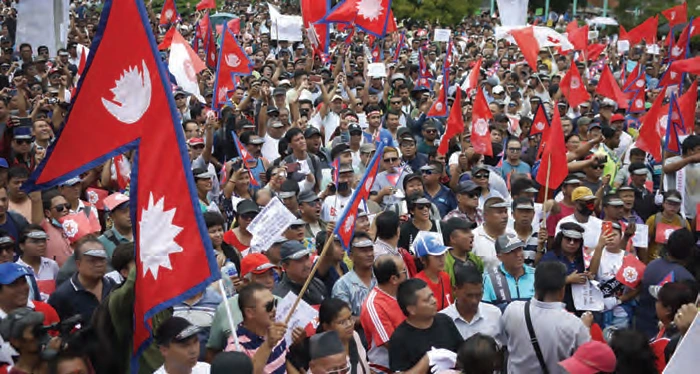
Kathmandu
Land of Instability
The politically unstable atmosphere in Nepal is borne out by the rapid succession of thirteen prime ministers in the fifteen years after the constitution’s implementation in 2015.

The transition of Nepal from a monarchy to a federal democratic republic has been the subject of several ups and downs through political turmoil. The formal establishment of an independent democratic political system in the country can be traced back to the abolition of the royalty and the advent of a new somber dawning in Nepal in 2008. The political changes with which the political process accompanying the end of monarchy was possible produced changes that differed from the old ones. The new constitution-writing process further exposed the country’s significant political and social differences. It became clear how difficult it is to build a solid democratic system during the demonstrations and delays surrounding the constitution’s proclamation in 2015 when oppressed communities such as the Tharu and Madhesi demonstrated their discontent. The long-term stability of Nepal is still being determined due to the country’s ongoing struggles with political instability that originates from these historical divides. A time of greater volatility began with the announcement of the 2015 constitution, which was both a big step forward and a hindrance. The initial goal of establishing a federal system of government via the Constitution was to decentralize power and make government more approachable to the people. However, new issues arose due to the federal structure’s implementation, as various regional and ethnic groups contested power and resources.
The adoption of the federal system, however, brought additional problems as different ethnic and regional groups fought for resources and authority. The politically unstable atmosphere in Nepal is borne out by the rapid succession of thirteen prime ministers in the fifteen years after the constitution’s implementation in 2015. A long-running power struggle has broken out in Nepal among the country’s three major political groups: the Nepali Congress, the Communist Party of Nepal (Unified Marxist-Leninist), and the Communist Party of Nepal (Maoist Centre). Coalition shakeups are commonplace due to the administration’s focus on short-term political benefits rather than long-term sustainability. This disintegration was further demonstrated by the precarious coalition administration and hung parliament that resulted from the 2022 national elections. Because of this volatility, the government cannot address essential matters like social welfare and economic progress. Ranking 143rd out of 167 nations in political stability and 91st out of 163 on the Global Peace Index are international measures highlighting Nepal’s ongoing issues in its administration.
Many different internal and foreign causes have contributed to the political instability in Nepal. There are 125 distinct ethnic groups and 123 official languages in the nation, which provides a wealth of cultural variety but also presents difficulties for the government. Disagreements and rivalries arise often because these groups have different ambitions and grudges from the past. With more than 80 registered political parties for the 2022 general elections, the situation is already complicated due to political fragmentation. Coalition instability and policy paralysis are outcomes of the expansion of parties, many of whom have limited regional or ethnic agendas. Nepal ranked 117th out of 180 nations in Transparency International’s 2023 Corruption Perceptions Index, highlighting the role of corruption and a lack of accountability in contributing to instability. The external factors that complicate Nepal’s politics include its geographical situation, which places it between China and India. With India’s long history of dominance and China’s growing influence thanks to Belt and Road Initiative (BRI) infrastructure spending, both countries have substantial sway over Nepal’s internal affairs. One example of the external pressures Nepal confronts is the 2015 Indian blockade, which followed the ratification of Nepal’s new constitution. This shows how susceptible Nepal is to meddling and how politicians there must walk a fine line to avoid conflict.
Even in the middle of the year 2024, the political turmoil in Nepal is far from over. It is now being determined if the coalition can continue in government due to internal disagreements. Disputes and rivalry between the federal government and the provinces have halted development projects and policies despite decentralization being a proclaimed objective of the federal system. Corruption, a lack of responsibility, and unmet promises were among the reasons why more than 70% of respondents in 2023 were unhappy with the current political system. The pace at which people are losing faith in this is concerning. The reliance of Nepal’s economy on tourist spending and remittances has made it vulnerable to domestic and international economic downturns. The World Bank has downgraded its growth rate prediction for 2024 from 6.3% to 3.2% due to the continuing high inflation rates and young unemployment. Political and economic factors combine in complicated ways, making the present situation uncertain and inhibiting quick progress.
Despite the intricacy, Nepal’s political instability has yet to have a simple solution. The nation’s top leaders must resolve their ideological disagreements and collaborate to address pressing issues. Addressing political fragmentation, corruption, and ethnic strife—the root drivers of instability—requires reforms. For the federal system to work and for every person to have a say in government, democratic institutions and a more vital rule of law are essential. Nepal can overcome its issues with the support of other nations. Still, guiding Nepal towards a brighter and safer future will need concerted action from government leaders and the general public. If Nepal wants to overcome its troubled history and become a thriving democracy, it must work relentlessly to establish an inclusive and responsible government system. ![]()
Gunvor to Acquire Total Pakistan
The Bank of Punjab Hosts Professor Stefan Dercon
Former Indian batsman dies at 71
Indus Motor Company Extends its partnership with Arshad Nadeem
Residents of Venice welcome new tourist limits
Trump questions Kamala’s identity
Nestlé for Healthier Kids (N4HK) Room Inaugurated
Konnect by HBL Crowns Valorant Champions
Charity Dinner raises funds for vulnerable segments


The writer is a freelance contributor. She can be reached at
Leave a Reply