



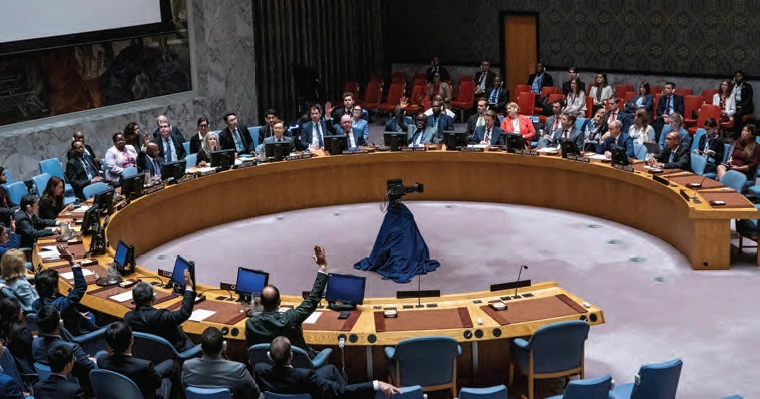
Pakistan’s election to the United Nations Security Council (UNSC) as a non-permanent member for the term 2025-2026, with a substantial majority, represents a notable achievement for the country. It needed 124 votes, constituting a two-thirds majority in the General Assembly, to secure its seat representing the Asia-Pacific region on the UNSC. Out of 193 UN member states, 190 participated in the ballot. Pakistan received 182 votes, significantly surpassing the required threshold, with five abstentions and three votes against.
This victory marks Pakistan’s eighth term in the UNSC. It served in 1952-53, 1968-69, 1976-77, 1983-84, 1993-94, 2003-04 and 2012-13. Only a few countries have had the honor of being elected so frequently. Beyond diplomatic accolades, this victory signals Pakistan’s emergence from diplomatic isolation and presents it with a chance to reshape its trajectory amidst evolving global politics.
Of late, Pakistan has found itself largely isolated diplomatically, facing international scrutiny for its perceived role in fostering extremism and terrorism. The country’s strategic importance as a nuclear power has been accompanied by global apprehensions regarding the security and management of its nuclear weapons, fueling discussions on non-proliferation and disarmament. Moreover, Pakistan’s historical alignment with various global powers and regional dynamics has sometimes characterized it as a client state, dependent on external support for economic and military aid. Pakistan found itself less aligned with this new orientation as the US-led West redirected its attention from South Asia to the Indo-Pacific region to counter China.
In this strategic shift, India emerged as a favored partner for the Western nations, and Pakistan lost its clout. The country’s looming economic crisis also tarnished its reputation. In this context, securing 182 votes out of 190 in an international body is not an ordinary development. Notably, the presence of ambassadors from the five permanent UNSC members—China, the United States, Russia, France, and Britain in a celebratory reception which was hosted by Pakistan’s Ambassador to the UN, Munir Akram, and attended by nearly a hundred ambassadors and UN officials from diverse regions, demonstrates recognition and engagement from major global powers towards Pakistan. It is essential to examine the factors contributing to this change.
The ongoing conflict in Ukraine has significantly reshaped global geopolitics, heightened tensions, and prompted international actors to reconsider their strategies, fostering new alliances and straining existing relationships. Nations worldwide are reassessing their security policies and partnerships in response to the ongoing war, underscoring its profound impact on the international order.

 The writer is an Assistant Professor at the Department of International Relations, University of Karachi.
Leave a Reply